Chapter 5 – THE GOOD PLATE
Helen was sitting at Mom’s kitchen table when we arrived.
For once, there was nothing impressive around her.
No crystal.
No silver.
No enormous dining room.
Just Mom’s old oak table, four ordinary chairs, and afternoon sunlight falling across a scratched floor.
Helen looked different.
Not ruined.
Not transformed.
Just smaller somehow.
Maybe because I was no longer looking at her through the architecture of everything she’d acquired.
The chipped blue bowl sat in front of her.
Lily stopped when she saw it.
Helen stood.
“Hi.”
Lily didn’t answer.
I kept hold of her hand.
Helen looked at me.
“Can I talk to her?”
“You can talk. She doesn’t have to answer.”
Helen nodded.
Then she sat again.
“I kept this bowl.”
Lily looked at it.
“I know you remember it.”
“Yes.”
Helen swallowed.
“I told myself I gave it to you because you were a child and children break things.”
Lily said nothing.
“But Daniel’s boys got the good bowls.”
“Yes.”
Helen’s eyes filled.
“Yes.”
Silence.
“I told myself a lot of things.”
I watched her carefully.
She wasn’t performing well.
That was perhaps why I believed at least some of it.
Her voice shook.
“I told myself you didn’t notice.”
Lily answered immediately.
“I noticed.”
Helen closed her eyes.
“I know.”
“I noticed everything.”
“I know.”
“You gave me bad stuff.”
“Yes.”
“You laughed.”
“Yes.”
“You told me Mom read my letter.”
Helen’s face crumpled.
“Yes.”
“Why?”
There it was.
The question adults had spent months answering around.
Helen looked at me.
Then at Lily.
“Because I was jealous.”
Lily frowned.
“Of me?”
Helen wiped her face.
“Not because you did anything.”
“Then why?”
“Because Grandpa loved you.”
Lily’s expression changed.
“He loved everybody.”
“I know.”
“No, you don’t.”
I almost intervened.
Then stopped.
Lily didn’t need rescuing from her own voice.
Helen stared at her.
Lily continued.
“Grandpa loved you too.”
“Yes.”
“So why were you mean to me?”
Helen looked down.
“Because sometimes adults know something is true in their heads, but they feel something ugly anyway.”
“That doesn’t make sense.”
“No.”
Helen gave a broken little laugh.
“It doesn’t.”
She took a breath.
“When Grandpa got sick, your mom did a lot for him. I didn’t do as much. I had reasons, but some of them were excuses.”
I glanced at her.
It was the first time I’d heard her admit that.
“After he died, I felt guilty. Then I found out he left your mom extra money because he worried about you.”
Lily looked at me.
I nodded.
Helen continued.
“And instead of admitting I felt guilty, I decided it meant Grandpa loved your mom more.”
“But Mom gave you money.”
Helen looked startled.
Lily knew.
Of course she knew some of it.
Children hear.
Children always hear.
“Yes.”
“A lot?”
I said gently, “That’s between the adults.”
Lily nodded.
Then looked at Helen again.
“So Mom helped you, and you were still mean to us?”
There are questions only children can ask because adults have spent too many years learning how to decorate contradictions.
Helen whispered, “Yes.”
“That’s stupid.”
“Lily,” I said automatically.
Then I stopped myself.
Helen laughed through her tears.
“No. She’s right.”
Lily looked at the bowl.
“Did you hate me?”
Helen’s answer came immediately.
“No.”
“You acted like it.”
Helen went very still.
Then nodded.
“I did.”
No excuse.
No qualification.
That mattered more than I expected.
“I am sorry.”
Lily looked at me.
I squeezed her hand.
She looked back at Helen.
“Okay.”
Helen’s face lifted with hope.
Lily added, “But I don’t forgive you yet.”
The hope disappeared.
And I had never been prouder of my daughter.
Helen nodded.
“Okay.”
“Mom says I don’t have to.”
“You don’t.”
“And I don’t want to go to your house.”
“You don’t have to.”
“And don’t buy me stuff.”
Helen glanced at me.
I said nothing.
“Okay,” she whispered.
Lily looked at the blue bowl again.
“Why did you bring that?”
Helen picked it up.
“Because I was going to throw it away.”
“Why?”
“Because I was ashamed.”
Lily thought for a moment.
“Can I have it?”
Both Helen and I stared at her.
“Why?” I asked.
Lily shrugged.
“I want to plant something in it.”
That was so completely Lily that I nearly cried.
Helen handed it to her.
“Okay.”
Lily took the bowl.
She turned it over in her hands.
Then she looked at the chip.
“You shouldn’t give broken dishes to people.”
“No,” Helen said.
“You can cut yourself.”
“I know.”
Lily held the bowl against her chest.
“I’m going to put dirt in it.”
Helen smiled weakly.
“That sounds safer.”
The conversation lasted another twenty minutes.
There was no dramatic embrace.
No instant reconciliation.
I didn’t want one.
Real damage doesn’t disappear because someone finally names it.
When we left, Helen asked if she could someday write Lily a letter.
I looked at Lily.
She thought about it.
“Maybe.”
Helen nodded.
“Maybe is enough.”
On the drive home, Lily held the chipped bowl in her lap.
“Are you still mad at her?” she asked.
“Yes.”
“Forever?”
“I don’t know.”
She looked out the window.
“I’m not as mad.”
“That’s okay.”
“But I still don’t want to see her.”
“That’s okay too.”
“Can both be true?”
“Yes.”
She seemed relieved.
That evening, we filled the bowl with soil.
Lily planted basil seeds because she’d grown basil in her classroom and knew how to take care of it.
She placed the bowl on the kitchen windowsill.
For several days, nothing happened.
Then tiny green shoots appeared.
Lily screamed so loudly when she saw them that I thought she’d hurt herself.
“Mom!”
I ran into the kitchen.
“Look!”
Two little leaves had pushed through the dark soil.
I laughed.
“They made it.”
She crouched until her face was level with the bowl.
“They’re tiny.”
“They’ll grow.”
“Do we need a bigger pot?”
“Eventually.”
She looked at me.
“Because this one’s broken?”
“No.”
I smiled.
“Because they’ll outgrow it.”
Something about those words stayed with me.
Over the next year, our family changed.
Not perfectly.
Perfect families exist mostly in photographs.
Mom stopped pretending neutrality was kindness.
When Daniel made a joke one Christmas about everyone being “too sensitive nowadays,” she told him directly that sensitivity hadn’t been the problem.
Daniel apologized.
Again.
This time without excuses.
Robert repaid the remaining personal loan in installments.
Our conversations stayed brief.
Helen began therapy.
I knew because Mom told me once, and I asked her not to keep giving me updates.
Helen’s healing was Helen’s responsibility.
Mine was elsewhere.
Lily eventually agreed to receive her letter.
Helen wrote four pages.
I asked Lily if she wanted me to read it first.
She said no.
That was fine.
She read it alone.
Then she put it in the drawer beside her bed.
“What did she say?” I asked later.
Lily shrugged.
“She’s sorry.”
“Anything else?”
“She said it wasn’t because of my clothes.”
I swallowed.
“Good.”
“I already knew that.”
That was better.
Months later, Lily agreed to see Helen again at Mom’s birthday.
Neutral ground.
No special seating.
No special dishes.
When we arrived, Lily walked into the dining room and looked at the table.
I saw her counting.
Plates.
Glasses.
Chairs.
She was checking.
My heart hurt.
Then she looked at me.
“All the same.”
“Yes.”
Helen heard her.
Her face tightened.
She said nothing.
That was appropriate.
During dinner, Helen served everyone from the same platter.
When she reached Lily, she didn’t choose for her.
“What piece would you like?”
Lily studied the platter.
“That one.”
Helen served it.
No joke.
No performance.
No praise for herself.
Just dinner.
That was how trust began returning.
Not with promises.
With repetition.
Good repetition.
The right chair.
The same cup.
Warm food.
A choice.
Again.
And again.
And again.
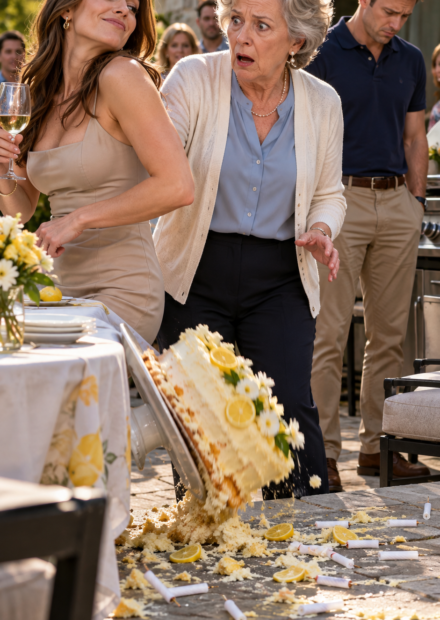
I never forgot the plate I threw.
I still regret throwing it.
There were better ways to react.
I could have picked Lily up and walked out.
I could have confronted Helen without sending porcelain across a dining room.
I could have been the adult I wanted my daughter to learn from.
But I don’t regret the moment I stopped pretending.
Those are different things.
For a long time, I thought my greatest failure had happened at that dinner table.
Eventually I understood it had happened before.
It happened every time Lily pointed toward something painful and I translated it into something harmless because the truth would have required me to confront someone I loved.
The cracked cup.
The cold food.
The old chair.
The missing pie.
The floor beside the couch.
The comments about clothes.
None of those things had seemed large enough on their own.
That was why they worked.
Cruelty often survives by staying beneath the threshold where witnesses feel entitled to object.
Helen understood that instinctively.
So did I, in another way.
She relied on my desire to keep the peace.
And I kept proving her right.
Until Lily asked me why.
That question changed everything.
Not the plate.
Not the money.
Not even the letter.
The question.
Why do they always do this to me?
Children shouldn’t have to develop theories about why their family treats them badly.
They shouldn’t have to earn the good plate.
They shouldn’t have to be exceptionally polite to deserve warm food.
They shouldn’t have to tolerate humiliation because the person causing it shares their blood.
And they should never have to wonder whether their mother sees it.
A year after that dinner, Lily turned nine.
We didn’t have a huge party.
She invited six friends to our apartment.
There were balloons taped crookedly to the wall.
Pizza boxes on the counter.
A homemade chocolate cake that leaned slightly to one side because I had underestimated how soft the frosting was.
Lily loved it.
My mother came early to help.
Daniel brought his boys.
Robert didn’t come.
Helen did.
Only because Lily invited her.
She arrived carrying no expensive gift.
Just a small basil plant.
The one we’d planted in the chipped bowl had eventually grown too large and we’d moved it into a proper pot.
Helen apparently remembered.
She handed Lily the plant.
“For the kitchen.”
Lily looked at me.
I smiled.
She took it.
“Thank you.”
Then Helen looked at the table.
I knew what she was seeing.
Paper plates.
All identical.
Plastic cups.
All identical.
Folding chairs.
All equally uncomfortable.
There was no good china.
No crystal.
No polished silver.
Nothing worth ranking people by.
When it was time for cake, I cut slices.
One piece collapsed as I lifted it.
The frosting slid sideways.
I looked at it.
Then at Lily.
She looked back at me.
For half a second, we both remembered.
Then she grinned.
“I want that one.”
“You sure?”
“It has extra frosting.”
I put it on her plate.
Helen was watching.
Her eyes filled.
But she didn’t look away.
Lily took a huge bite.
“Good?”
I asked.
She nodded enthusiastically.
“The best.”
Later, after everyone left, Lily and I cleaned up together.
She collected the cups.
I gathered plates.
At the bottom of the trash bag lay cake crumbs, napkins, and disposable forks.
Ordinary remnants of an ordinary birthday.
Lily climbed onto the counter.
“Mom?”
“Hmm?”
“Do you remember when you threw the plate?”
I groaned.
“I was hoping you’d forget that before college.”
She laughed.
“Did you know it was going to break?”
“Yes.”
“Did you know it was going to hit Aunt Helen?”
“I was very angry.”
“That’s not an answer.”
I looked at her.
She was smiling.
“Probably.”
“You shouldn’t throw plates.”
“No.”
“You tell me not to throw things.”
“I know.”
“That’s hypocritical.”
I stared at her.
“When did you learn that word?”
“School.”
“Of course.”
She giggled.
Then grew serious.
“I’m glad we left.”
“So am I.”
“Were you scared?”
That question surprised me.
“At dinner?”
“When everybody got mad.”
I leaned against the counter.
“Yes.”
“You didn’t look scared.”
“I was.”
“Why?”
“Because I knew things were going to change.”
“Was that bad?”
“I didn’t know yet.”
She thought about it.
Then asked, “Is that why people don’t say things?”
“Sometimes.”
“Because then stuff changes?”
“Yes.”
She looked down at her hands.
“But sometimes stuff needs to change.”
I smiled.
“Yes.”
She jumped off the counter.
Then she hugged me.
It was quick.
Casual.
The kind of hug children give when they assume there will be thousands more.
I held her a second longer.
She pulled away.
“What?”
“Nothing.”
“You’re being weird.”
“I love you.”
“I know.”
She walked toward her bedroom.
Then stopped.
“Mom?”
“Yes?”
“Next year can we get a bigger cake?”
I laughed.
“Yes.”
“And maybe strawberry?”
“Absolutely.”
“And can I invite Aunt Helen?”
I didn’t answer immediately.
Not because I objected.
Because I wanted to be certain whose decision it was.
“You want to?”
Lily nodded.
“I think so.”
“Then yes.”
She smiled.
“Okay.”
Then she disappeared down the hallway.
I stood alone in our little kitchen.
The basil plant sat on the windowsill.
Beside it was the chipped blue bowl.
Empty now.
Lily had washed it after transplanting the basil and decided to keep it.
Not as a dish.
As a reminder.
Once, I asked what it reminded her of.
I expected her to say Aunt Helen.
Or the bad dinners.
Or the night I threw the plate.
Instead, she said:
“That broken things don’t have to be used for the same thing forever.”
I think about that sentence often.
For years, I believed family loyalty meant enduring.
Enduring insults.
Enduring imbalance.
Enduring uncomfortable truths because confronting them might fracture something.
But some things are already fractured.
Silence just keeps everyone eating from them.
I couldn’t undo the years when I failed to notice.
I couldn’t take back every time I told Lily that Helen probably didn’t mean it.
I couldn’t erase the letter my daughter wrote because she was afraid to speak to me directly.
I couldn’t become the mother who noticed everything from the beginning.
But I could become the mother who listened now.
So that was what I did.
When Lily said something hurt, I listened.
When she didn’t want a hug, I listened.
When she changed her mind, I listened.
When she wanted to forgive someone, I didn’t rush her.
When she didn’t, I didn’t shame her.
And gradually, something changed in both of us.
She stopped asking whether she was good.
She stopped checking other people’s plates before eating from her own.
She stopped apologizing when she needed something.
One night, nearly two years after that dinner, I burned chicken.
Badly.
Smoke filled the kitchen.
The alarm started screaming.
Lily came running out of her room.
I stood over the stove holding a pan containing four pieces of charcoal.
She stared.
I stared back.
Then we both burst out laughing.
“Even a dog wouldn’t eat that,” she said.
The old words.
But they didn’t hurt anymore.
Not in our kitchen.
Not between us.
I pointed the spatula at her.
“Pizza?”
“Pizza.”
I ordered one.
We sat on the floor while waiting because I’d already moved the kitchen chairs to open the windows.
Lily leaned against me.
Outside, rain tapped softly against the glass.
Nothing about our life looked impressive.
Our apartment was still small.
My car was still old.
Sometimes money was still tight.
But Lily’s shoes fit.
Her dinner was warm.
Her voice filled the room.
And when she laughed, she didn’t check first to see whether anyone else thought she was allowed.
The pizza arrived.
I gave her the first slice.
She looked at it dramatically.
“Is this the good one?”
“They’re all the good ones.”
She smiled.
I hadn’t meant the sentence to be profound.
But perhaps the most important truths rarely sound profound when we finally learn how to live them.
I spent years believing love meant making room for everybody.
Helen.
Robert.
Mom.
Daniel.
Their excuses.
Their discomfort.
Their pride.
Their emergencies.
Their version of peace.
Then one night, my daughter sat beside me with a burned piece of meat on her plate and asked why everyone always did this to her.
And I finally understood.
I had made room for everyone except the person who needed me to stand beside her.
So I changed that.
The plate shattered only once.
The silence had been breaking her for years.
And if there is one thing I hope Lily remembers when she’s grown, it isn’t the night her mother lost her temper.
It isn’t the money.
It isn’t Helen’s beautiful house.
It isn’t even the letter hidden under a chair.
I hope she remembers what happened afterward.
That when she finally told me the truth, I believed her.
That when she said she didn’t want to go back, I didn’t make her.
That when adults demanded forgiveness, I gave her time.
That when our family called cruelty a misunderstanding, I learned to call it what it was.
And that she never again had to earn the good plate.
Because at our table, there was never supposed to be a bad one.