MY SON HIT ME AND ORDERED ME OUT OF “HIS” MANSION. HE HAD NO IDEA WHOSE NAME WAS ON THE DEED.
Chapter 1 – THE HOUSE HE CALLED HIS
My thirty-nine-year-old son hit me across the face at his birthday dinner because I refused to give him another four hundred thousand dollars.
But the slap wasn’t the moment that changed everything.
It was what he said afterward.
“Get out of my house.”
My house.
Those two words ended nearly forty years of excuses.
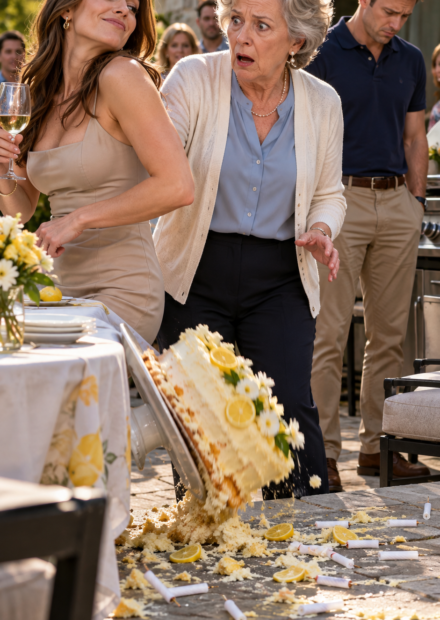
I stood beside the dining table with my left cheek burning and a broken slice of chocolate cake scattered across the white linen tablecloth.
For several seconds, nobody moved.
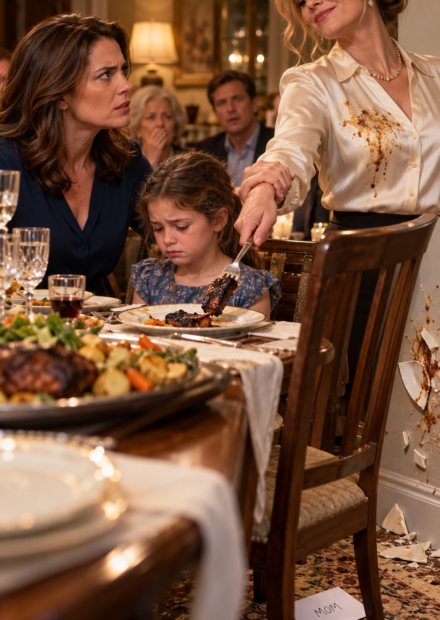
The dining room of the River Oaks mansion was large enough to seat fourteen people comfortably. That evening there had been only six of us for dinner, and the other guests had already drifted toward the patio after dessert.
They hadn’t seen Brandon hit me.
Amber had.
My daughter-in-law sat on the cream-colored sofa near the windows, one leg crossed over the other, staring at me with the expression of someone annoyed by an argument that had gone on too long.
She didn’t rush over.
She didn’t ask whether I was hurt.
She didn’t even look shocked.
Instead, she sighed.
“Honestly, Margaret,” she said, “you need to stop provoking him.”
I touched my cheek.
My fingers were trembling.
“Provoking him?”
Brandon was standing six feet away from me, breathing heavily.
At thirty-nine, he was taller than his father had been, broad-shouldered and still handsome in the way that had allowed him to talk himself out of consequences for most of his life.
His face was red.
“Are you listening now?” he demanded.
“I heard you the first time.”
“Apparently you didn’t.”
“You asked me for four hundred thousand dollars.”
“Yes.”
“And I said no.”
He laughed once, without humor.
“Exactly.”
I stared at him.
It was such a strange response that for a moment I wondered whether I had missed something.
“Exactly what?”
“You always do this.”
“Do what?”
“Make me beg.”
I almost laughed.
Not because it was funny.
Because sometimes a lie is so enormous that your mind rejects it before your emotions can catch up.
“Brandon, I have never made you beg for anything.”
He pointed at me.
“You make everything conditional.”
“What conditions did I put on this?”
“You started interrogating me.”
“I asked what the investment was.”
“Same thing.”
“You’re asking me for four hundred thousand dollars. I think I’m allowed to ask where it’s going.”
Amber stood then.
She walked toward the dining table and began gathering plates as though this were an ordinary family disagreement.
“You know what the problem is?” she said.
I looked at her.
“You still think Brandon is a child.”
“No,” I said quietly. “I think he’s a thirty-nine-year-old man asking his mother for four hundred thousand dollars.”
Her hands stopped.
Brandon’s jaw tightened.
I should have stopped there.
For thirty-nine years, stopping had been one of my specialties.
When Brandon failed his first semester of college, I stopped asking questions because he said he was depressed.
When he wrecked the car Michael had bought him, I stopped being angry because he wasn’t hurt.
When his first business failed, I paid enough of the debt to keep creditors away.
When his second business failed, I told myself entrepreneurship required courage.
When he needed legal fees after a partnership dispute, I hired a good attorney.
When he needed a down payment, I provided it.
When the down payment disappeared into another investment, I said nothing.
And when Sophie was born five years earlier and Brandon told me he and Amber were drowning financially, I did something much bigger.
I gave them a home.
Or at least I let them live in one.
That distinction, I was beginning to understand, mattered very much.
Amber set a plate down harder than necessary.
“It’s not like you can’t afford it.”
There it was.
The sentence that had become increasingly common over the years.
It’s not like you can’t afford it.
As though the existence of money automatically transferred ownership of it to anyone who wanted some.
I looked at Brandon.
“What exactly is the investment?”
He rolled his eyes.
“I already told you. Commercial property.”
“Where?”
“We’re working through the details.”
“Who is ‘we’?”
“Partners.”
“Which partners?”
“Mom.”
“Do I know them?”
“Why does that matter?”
“Because you’re asking me for four hundred thousand dollars.”
Amber threw up her hands.
“Oh my God.”
I turned toward her.
“If you went to a bank tomorrow and asked them for four hundred thousand dollars, do you think they’d ask fewer questions than I just did?”
“This isn’t a bank,” Brandon said.
“No. It isn’t.”
“You’re my mother.”
“Yes.”
“Then act like it.”
The room became very quiet.
I remember hearing the faint hum of the refrigerator in the kitchen.
I remember seeing one candle still burning on Brandon’s birthday cake.
Thirty-nine.
I had placed the candles myself.
For some reason, that detail hurt.
“I’m going to act like your mother,” I said. “Possibly for the first time in a very long time.”
His expression changed.
“What does that mean?”
“It means no.”
He stared at me.
I repeated it.
“No, Brandon. I’m not giving you four hundred thousand dollars.”
His chair scraped backward.
“You’re serious?”
“Yes.”
“After everything I’ve done?”
I couldn’t help myself.
“What exactly have you done?”
The instant the words left my mouth, I saw something change in him.
His face hardened.
He took two steps toward me.
“You come into my home on my birthday and humiliate me in front of my wife?”
“I answered a question you asked.”
“You’ve been doing this my entire life.”
“Doing what?”
“Controlling me with money.”
I felt something old and tired crack inside me.
“Brandon, if I had controlled you with money, you would have learned how to live without mine twenty years ago.”
His hand moved.
I saw it.
I simply didn’t believe it was going to happen.
Then it did.
The sound came before the pain.
A sharp crack.
My head snapped sideways.
My hip struck the edge of the dining table, and the cake plate slid. A chunk of chocolate frosting landed against the tablecloth.
For perhaps three seconds, the world became perfectly still.
My son had hit me.
My little boy.
The baby I had held through fevers.
The teenager whose baseball games I had rearranged meetings to attend.
The young man whose mistakes I had paid to erase.
The grown man whose family I had housed for five years.
He had struck me because I said no.
I slowly turned my head back toward him.
Brandon looked shocked.
But not sorry.
That distinction would stay with me.
Amber rushed forward.
For one second, I thought she was coming to me.
She went to Brandon.
“Baby,” she whispered, touching his arm.
I stared at them.
Brandon pulled away from her.
“Mom—”
I waited.
Three letters could have changed the entire night.
I’m sorry.
Instead he said, “You pushed me too far.”
I felt the pain in my cheek deepen.
Amber looked at me.
“You did.”
I almost couldn’t understand her.
“What?”
“You know how stressed he’s been.”
I stared at my daughter-in-law.
“And that makes hitting me acceptable?”
“Of course not.”
“Then why are you explaining it?”
“Because you’re acting like this came out of nowhere.”
That was the moment something inside me became strangely calm.
Not forgiveness.
Not shock.
Clarity.
I reached for my purse.
Brandon stepped between me and the hallway.
“Where are you going?”
“Home.”
“We’re not finished.”
“I am.”
“You don’t get to drop a bomb on my birthday and walk away.”
I looked at him.
“The bomb was four hundred thousand dollars?”
“You know what I mean.”
“No. I don’t think I do anymore.”
I moved around him.
Behind me, Amber said, “Margaret, you’re making this worse.”
I kept walking.
Then Brandon shouted the sentence that changed everything.
“If you walk out that door, I’ll throw every piece of your stuff out of my house!”
I stopped.
My hand was already on the foyer table.
For several seconds, I looked at the family photograph Amber had placed there.
Brandon.
Amber.
Sophie.
The three of them standing on the front steps of the mansion.
Their mansion.
At least that was what they apparently believed.
I turned around.
Brandon was standing beneath the chandelier.
Amber was beside him.
Both were angry.
Neither looked frightened yet.
“Oh, no,” I said.
Brandon frowned.
“What?”
“Do you actually think living here makes this house yours?”
He blinked.
Then he laughed.
“It is mine.”
I studied his face.
He wasn’t bluffing.
That was the astonishing part.
He genuinely believed it.
“I don’t think so.”
Amber’s expression changed first.
“What do you mean?”
I picked up my purse.
Neither of them followed me when I walked out.
Outside, Houston’s humid night air settled over my skin.
My old Lincoln was parked several houses down because Brandon’s driveway had been crowded earlier.
I walked slowly.
My cheek throbbed with every heartbeat.
When I reached the car, I opened the driver’s door but didn’t get in immediately.
Through the trees, I could see the mansion glowing beneath its exterior lights.
Five bedrooms.
Six bathrooms.
A pool.
A detached guest suite.
A kitchen Amber had renovated two years earlier after telling me the original cabinets made the house “feel dated.”
I had paid for that too.
I sat down behind the wheel.
On the passenger seat was a small walnut box.
I stared at it.
Inside was Michael’s watch.
My husband had worn that watch for more than twenty-five years.
Through construction meetings.
Through recessions.
Through our first million-dollar contract.
Through nights when we weren’t sure we could make payroll.
Through Brandon’s high school graduation.
Through our thirtieth anniversary.
Through chemotherapy.
After Michael died eleven years earlier, I put the watch away.
I always intended to give it to Brandon.
But not until I believed he understood what it meant.
That morning, I had decided thirty-nine was old enough.
Now I placed my hand on the walnut box and cried.
My phone rang.
BRANDON.
I wiped my eyes.
A ridiculous piece of me hoped he was calling to apologize.
I answered.
“Mom.”
I waited.
“Are you actually going to do something with the house?”
That was his first question.
Not Are you hurt?
Not Did you get home safely?
Not I’m sorry I hit you.
The house.
I looked through the windshield at the mansion.
“Why are you asking?”
“Because of that little comment you made.”
“What comment?”
“Don’t play games.”
“I haven’t played any games.”
“You know exactly what you implied.”
“I implied that you might want to understand who owns the place before threatening to throw its owner out.”
There was silence.
Then he laughed.
But this time it sounded forced.
“Whatever game you’re playing, don’t involve my house.”
I closed my eyes.
“Then you’d better hope it’s actually yours.”
I heard movement.
Then Amber’s voice came through the phone.
“Margaret?”
“Yes?”
“This is ridiculous.”
“Which part?”
“You using money and property to manipulate your son.”
I touched my cheek again.
“Your husband struck me.”
A pause.
Barely one second.
“You know Brandon gets emotional when you push him.”
I hung up.
I drove home without turning on the radio.
The house in West University Place looked small after River Oaks, although it wasn’t.
Michael and I had bought it when Brandon was six.
We had renovated it twice but never left because Michael loved the oak tree in the backyard and I loved the pencil marks inside the pantry door showing Brandon’s height year after year.
Five years ago, I had offered the house to Brandon.
He hadn’t wanted it.
Too old.
Too small.
Not the right neighborhood.
So I bought the River Oaks property.
At the time, I told myself it was for Sophie.
That was how I justified most things.
For Sophie.
For Brandon.
For family.
I went upstairs.
Under the bathroom light, the mark on my cheek was already becoming visible.
Four red streaks.
I looked at myself for a long time.
Then I cried.
Not because the slap hurt.
Because I finally understood something Michael had tried to tell me years ago.
We had been sitting on the back patio when Brandon was twenty-seven and needed money after another failed venture.
Michael had said, “Margaret, every time we remove the floor before he hits it, we teach him there is no floor.”
I had been furious.
“He’s our son.”
“I know.”
“He needs us.”
“No,” Michael had said. “He needs consequences.”
I had accused my husband of being cold.
Two days later, I gave Brandon the money.
Now Michael had been dead eleven years, and I was standing in front of a mirror with our son’s handprint on my face.
“I understand,” I whispered.
I went downstairs.
Michael’s study still smelled faintly of leather and old paper.
His drafting tools remained on the shelves. His construction helmet sat above the filing cabinet. A photograph of the three of us stood on the desk.
I opened the fireproof safe.
Property documents.
Corporate records.
Estate papers.
Trust documents.
I knew what I was looking for before I found it.
MERCER PROPERTY HOLDINGS LLC.
RIVER OAKS RESIDENCE.
I pulled out the folder.
My hands had stopped shaking.
Inside were tax records, insurance documents, purchase papers and the recorded deed.
I opened it.
The house had never been transferred to Brandon.
It wasn’t even titled in my personal name.
Five years earlier, following advice from our estate attorney, I had purchased it through Mercer Property Holdings LLC, an entity I controlled.
Brandon had been given permission to occupy the property.
Nothing more.
No deed.
No ownership interest.
No equity.
No transfer.
No promise in writing.
He lived there because I allowed him to.
And apparently, somewhere along the way, he had rewritten that generosity into ownership.
I sat in Michael’s chair.
For a long time, I stared at the deed.
Then my eyes moved toward the walnut box I had carried inside.
I opened it.
Michael’s watch lay against the dark velvet.
I picked it up.
“Not yet,” I whispered.
Then I reached for my phone.
There was one person I needed to call in the morning.
And for the first time in my son’s life, I wasn’t calling someone to rescue him.
I was calling someone to make sure I stopped rescuing him.
—