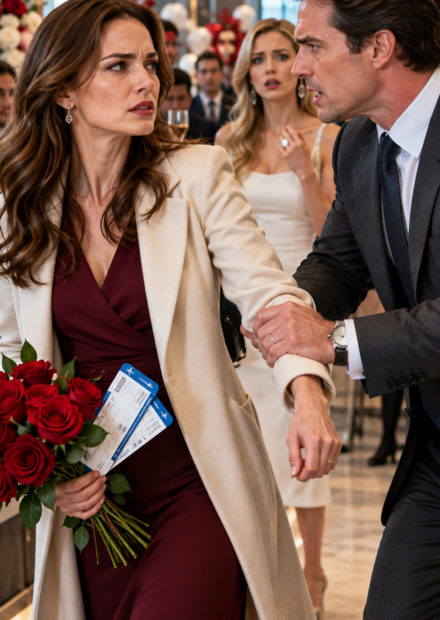
SHE SHAVED MY HEAD ON HER WEDDING MORNING—AND STILL EXPECTED MY $22 MILLION
Chapter 5 – THE INHERITANCE I FINALLY GAVE MY SON
Sabrina chose a café in Back Bay.
Public.
Neutral.
That told me she had changed at least one thing.
She no longer assumed she could control the room.
I arrived ten minutes early.
She was already there.
For a moment, I almost did not recognize her.
No designer dress.
No elaborate makeup.
No diamond earrings.
Her hair was tied back.
She looked younger.
And tired.
She stood when I approached.
“Beatrice.”
“Sabrina.”
“Thank you for coming.”
I sat.
She remained standing for a second longer, as though uncertain whether she was permitted to join me.
Then she sat.
Neither of us spoke.
Finally she looked at my hair.
It had grown several inches.
“I like it.”
I nearly smiled.
“That is an unfortunate opening.”
Her face flushed.
“You’re right.”
She looked down.
“I rehearsed this.”
“I assumed.”
“None of it sounds right now.”
“Then don’t rehearse.”
She nodded.
A waitress approached.
We ordered coffee.
When she left, Sabrina clasped her hands.
“I hated you.”
There was no point pretending surprise.
“I know.”
“No. I mean before you ever did anything to me.”
That caught my attention.
“Why?”
“Because Michael talked about you constantly.”
I frowned.
“Not lovingly.”
She gave a sad smile.
“He talked about how controlling you were. How you bought everything. How he could never escape your shadow.”
“That sounds like Michael.”
“I believed him.”
I waited.
“And then I met you.”
Her fingers tightened.
“You were exactly what I expected in some ways. Rich. Controlled. Always watching.”
“I do watch.”
“I know.”
“But?”
“But you weren’t cruel.”
She looked ashamed.
“That made me angrier.”
“Why?”
“Because if you weren’t terrible, then Michael’s relationship with you was complicated. And complicated meant I couldn’t just rescue him from you.”
I absorbed that.
“So you decided to make me terrible.”
“Yes.”
At least she was honest.
“At first I made jokes. About your clothes. Your age.”
“I remember.”
“You never reacted.”
“I reacted privately.”
“I thought you believed you were above me.”
“No.”
“What did you believe?”
I considered lying.
Then decided I was tired of that too.
“I believed if I objected, Michael would choose you.”
Her eyes lifted.
“You were afraid of me?”
“Yes.”
She looked stunned.
“Why?”
“Because I was afraid of losing my son.”
For the first time, Sabrina’s expression softened.
“I was afraid of the same thing.”
There it was.
Not an excuse.
A mirror.
Two women afraid of losing the same man.
One used money.
The other used humiliation.
Both called it love.
Sabrina looked at my hair again.
“The night before the wedding, Michael and I fought.”
“About me?”
“Yes.”
“He told you about the twenty-two million?”
“He told me weeks earlier.”
Of course.
“He said it meant you finally accepted me.”
That hurt more than I expected.
“I see.”
“I asked what would happen if you changed your mind.”
“And?”
“He said you never changed your mind once money was involved.”
A bitter laugh escaped me.
“He knew me well.”
Sabrina continued.
“I told him I wanted you to understand that after the wedding, I came first.”
“So you entered my house.”
“Yes.”
“With Michael’s code.”
“Yes.”
“Did he know you were going?”
“No.”
I watched her carefully.
“He gave me the code months earlier. I told him I was going for an early run that morning.”
“Why shave my head?”
Her face tightened.
“I wanted to humiliate you.”
No euphemism.
No prank.
No misunderstanding.
“I wanted you to look in the mirror and feel old.”
I held her gaze.
“Why?”
“Because you never looked weak.”
The answer sat between us.
Sabrina’s eyes filled.
“My mother spent my whole childhood worrying about money. My father made good money and lost most of it twice. Investments. Businesses. Bad decisions. We looked wealthy, but everything was unstable.”
I said nothing.
“When I met Michael, he seemed safe. Not because of you. At least that’s what I told myself.”
“But because of me.”
“Because of what your money meant.”
She wiped beneath one eye.
“I hated depending on it. And I hated you for having the power to take it away.”
“So you proved I should.”
“Yes.”
Her answer came immediately.
That surprised me.
“I thought if I could make you afraid of me, you wouldn’t interfere.”
“And instead?”
“I destroyed my marriage.”
She looked down.
“I lost Michael. I lost friends. My parents barely speak to me about it. And every time I explain what happened, I hear how insane it sounds.”
I did not rescue her from that.
Some truths deserve silence around them.
She finally said, “I’m sorry.”
I looked at her.
“For shaving your head. For entering your house. For the note. For trying to humiliate you. For assuming your silence meant weakness.”
Her voice shook.
“I don’t expect forgiveness.”
“Good.”
She flinched.
“I don’t forgive you.”
Tears slipped down her cheeks.
“Maybe someday I won’t feel anything when I remember that morning. Maybe someday I’ll even understand you without anger. But forgiveness isn’t something you can schedule because you’ve apologized.”
“I know.”
“And if you’re apologizing because you hope I’ll withdraw my complaint—”
“No.”
She met my eyes.
“Don’t.”
That surprised me.
“I deserve the consequences.”
For several seconds, I studied her.
Then I nodded.
“All right.”
She exhaled.
We finished our coffee.
When I stood, Sabrina did too.
“Beatrice?”
“Yes?”
“Did you really give away the penthouse money?”
“Yes.”
“All of it?”
“Yes.”
A faint smile touched her face.
“That would have made me furious once.”
“And now?”
“It seems like the first good thing that came out of what I did.”
I put on my coat.
“No.”
She looked confused.
“What?”
“You don’t get credit for what I chose to do afterward.”
Her smile disappeared.
Then slowly, she nodded.
“You’re right.”
That mattered.
More than the apology.
I left.
I never became friends with Sabrina.
This is not that kind of story.
Healing does not require every broken relationship to be rebuilt.
Sometimes healing means understanding why a bridge collapsed and deciding not to cross it again.
Michael finalized his divorce the following spring.
He did not celebrate.
Neither did I.
A failed marriage is still grief, even when ending it is necessary.
He spent the next year rebuilding his life.
Mostly without my help.
Especially financially.
On his thirty-eighth birthday, I invited him to my office.
He arrived suspicious.
“You’re not giving me something expensive, are you?”
“No.”
“Good.”
I handed him a folder.
He opened it.
Inside were documents.
His face changed.
“Mom.”
“Read them.”
He did.
Then he looked up.
“This is the foundation.”
“Yes.”
“You’re making me a trustee?”
“A junior trustee.”
He stared at me.
“I thought you didn’t trust me with the money.”
“I don’t.”
His mouth fell open.
I smiled.
“Yet.”
He laughed.
Then I became serious.
“You asked once why I was willing to give you twenty-two million dollars.”
“I remember.”
“I thought money was an inheritance.”
He waited.
“It isn’t.”
I tapped the folder.
“This is.”
He looked down.
“The foundation?”
“Responsibility.”
His expression changed.
“I spent your entire life trying to make things easy for you because your childhood was hard.”
I sat beside him.
“That was my mistake.”
He shook his head.
“You kept me safe.”
“Too safe.”
I touched his hand.
“You need to know how to carry something before I leave you anything worth carrying.”
His eyes filled.
“Are you sick?”
“No.”
“Don’t do that.”
I laughed.
“I’m sixty-four, Michael. I intend to annoy you for decades.”
“Good.”
“But eventually, everything I built will belong to someone else.”
He looked at the papers.
“The foundation.”
“Most of it.”
“And me?”
“You’ll have enough.”
He smiled faintly.
“That sounds threatening.”
“It should.”
Then he turned serious.
“Do you trust me?”
The old me would have lied.
She would have said yes immediately because mothers are supposed to trust their sons.
I had learned something about immediate answers.
“No.”
He absorbed it.
“Not completely.”
He nodded.
“That hurts.”
“I know.”
“But I understand.”
“That is why I’m giving you the chance to earn it.”
He closed the folder.
Then he did something he had not done since he was a teenager.
He rested his head against my shoulder.
I put my arm around him.
Neither of us spoke.
No check changed hands.
No property transferred.
No debt disappeared.
It was the most valuable thing I had ever given him.
Three years have passed since the wedding.
My hair reaches my shoulders again.
Not because I needed to restore what Sabrina took.
Because one morning I decided I wanted it long.
That distinction matters.
Michael now runs one of the foundation’s housing programs.
Not the company.
Not yet.
Perhaps never.
I no longer confuse inheritance with entitlement.
He earns a salary.
A normal one.
He complains about it.
I remind him he knows the chairman.
He reminds me the chairman is cheap.
We are learning how to be mother and son without a transaction hiding between us.
It is harder than writing checks.
It is also real.
Sabrina and I have not spoken in nearly two years.
The legal matter concluded without spectacle.
She accepted responsibility.
I did not ask for vengeance.
I asked for accountability.
There is a difference.
Sometimes people ask whether I regret making the speech at the wedding.
They phrase the question carefully.
“Wouldn’t it have been more dignified to handle things privately?”
Perhaps.
But privacy had protected everyone except me for years.
Silence had allowed every insult to become the foundation for a larger one.
A joke.
A comment.
A dismissal.
A demand.
Then a razor.
Cruelty rarely begins with the worst thing someone does to you.
It begins with the smallest thing you teach them they can get away with.
I had taught Michael that my money had no boundary.
I had taught Sabrina that my dignity could be negotiated for peace.
On his wedding morning, both lessons ended.
I still have the note.
Not because I enjoy looking at it.
I keep it in the safe where the twenty-two-million-dollar transfer once waited.
Occasionally I see it when retrieving other documents.
“Congratulations—you finally have a hairstyle that suits your age.”
And beneath it, that tiny heart.
Once, it made my hands shake.
Now it reminds me of something entirely different.
The morning I woke without my hair was the morning I stopped measuring motherhood by sacrifice.
It was the morning I stopped apologizing for surviving.
It was the morning I stopped buying forgiveness for mistakes no amount of money could erase.
Most importantly, it was the morning I understood that losing someone’s approval is not the same thing as losing their love.
And if their love disappears the moment your money does?
Then it was never love you were holding.
It was leverage.
Last month, Michael and I visited Richard’s grave.
The afternoon was cool.
Silver clouds covered the sky.
Michael placed flowers beside the stone.
We stood there quietly.
Then he said, “Dad would have been proud of you.”
I smiled.
“Your father thought I was terrifying.”
Michael laughed.
“I can see why.”
We stood shoulder to shoulder.
After a while, he asked, “Do you ever wish you hadn’t worked so much?”
“Yes.”
He looked at me.
I continued.
“And no.”
“That’s not an answer.”
“It’s the only honest one.”
I looked at Richard’s name carved into the stone.
“I wish I’d been at every concert. Every game. Every dinner.”
Michael nodded.
“But if I hadn’t worked the way I did, our lives would have been different.”
“Maybe better.”
“Maybe worse.”
He considered that.
“I spent years believing there was a version where Dad lived, you were always home, and everything was perfect.”
“So did I.”
He looked surprised.
I smiled sadly.
“Adults invent impossible lives too.”
He slipped his hands into his pockets.
“I don’t blame you anymore.”
My throat tightened.
“I blamed myself enough for both of us.”
“I know.”
He reached for my hand.
At thirty-nine years old, my son held my hand beside his father’s grave.
And suddenly I understood something.
The twenty-two million dollars had never been the inheritance Michael needed.
Neither were the buildings.
Neither were the investments.
Neither was the company.
The inheritance was this.
The ability to tell the truth without running away.
The ability to love someone without owning them.
The ability to apologize without demanding immediate forgiveness.
The ability to establish a boundary without turning it into punishment.
The ability to survive losing something you once believed you could not live without.
I spent half my life building an empire for my son.
In the end, the most important thing I could leave him was the knowledge that he did not need it in order to be whole.
We walked back toward the car.
A cold breeze lifted my silver hair.
For a moment, I remembered waking that wedding morning.
The burning scalp.
The antiseptic.
The mirror.
The note.
The terrible stillness that came before anger.
I remembered believing something had been taken from me.
My dignity.
My place in my son’s life.
My power.
I know better now.
Sabrina took my hair.
Nothing more.
Everything else I almost lost, I had been giving away voluntarily for years.
My voice.
My boundaries.
My self-respect.
My right to say no.
She did not take those things.
She forced me to notice they were missing.
And once I noticed, I took them back.
Michael opened the passenger door for me.
I stopped before getting in.
“What?” he asked.
“Nothing.”
“You’re smiling.”
“Am I?”
“Yes.”
I looked toward the gray Boston sky.
Then back at my son.
“I was just thinking.”
“That usually costs me money.”
“Not anymore.”
He laughed.
I got into the car.
As we drove away, I caught my reflection in the window.
Silver hair.
Fine lines.
Sixty-six years of surviving things I once thought would destroy me.
For most of my life, I had been afraid of growing old alone.
That fear had cost me millions.
Worse, it had nearly cost me myself.
Now I understood.
Being alone is not the worst thing that can happen to a person.
The worst thing is surrounding yourself with people who require you to disappear so they can remain comfortable.
I would never disappear again.
Not for Michael.
Not for Sabrina.
Not for anyone.
And somewhere inside the safe at home, beneath legal documents and property records, a cruel little note remained folded in half.
I kept it because it marked the exact moment everything changed.
Sabrina had intended it as proof of my humiliation.
Instead, it became proof of my awakening.
She shaved my head because she believed I was powerless without appearances.
She expected me to arrive smiling because she believed I was powerless without my son’s approval.
She expected twenty-two million dollars because she believed I was powerless without their love.
She was wrong about all three.
I arrived.
I smiled.
I told the truth.
And I kept every dollar.
But the money was never the victory.
The victory was walking into that ballroom believing I might lose my son—
and finally understanding that I could survive if I did.
Because love that requires silence is not peace.
Generosity without boundaries is not kindness.
And a mother does not have to purchase a place in her own child’s heart.
That was the inheritance I finally gave Michael.
And it was the freedom I finally gave myself.