THEY WERE WAITING TO INHERIT MY HOUSE. ON NEW YEAR’S EVE, I GAVE THEM TWO ENVELOPES INSTEAD.
Chapter 2 – THE HOUSE THEY HAD ALREADY INHERITED
Harper ordered pizzas.
Nine of them.
It was probably the most expensive meal she had personally paid for since moving into my house.
The irony improved my appetite.
Her guests tried to salvage the evening.
Music came on.
Someone opened champagne.
People gathered around the dining table with paper plates because Harper had apparently planned to use my good china but no longer felt comfortable asking.
I remained at the island.
I finished my steak.
I washed my plate.
Then I made coffee.
Nobody asked me to clean anything else.
That alone felt revolutionary.
Around nine, Patricia approached me.
“Evelyn, may I talk to you?”
“Of course.”
We stepped into the den.
David’s leather chair was back where it belonged.
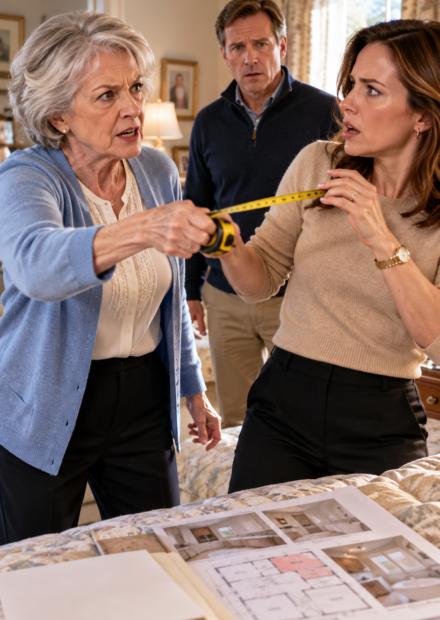
I had moved it there myself after the measuring-tape incident.
Patricia sat on the sofa.
“This has gotten out of hand.”
“Yes.”
“She shouldn’t have spoken to you that way.”
“No.”
“But surely you understand she’s embarrassed.”
I almost smiled.
There it was.
The apology that wasn’t one.
“I understand perfectly.”
Patricia lowered her voice.
“Harper thought tonight was settled.”
“I told her three times I would not host.”
“She assumed you didn’t really mean it.”
“That seems to be a recurring problem.”
Patricia shifted.
“They’re under tremendous pressure.”
“So am I.”
“They’re trying to build a future.”
“In my house.”
She looked away.
That told me something.
“How much has Harper told you?”
Patricia’s eyes returned to mine.
“About what?”
“Their plans for this house.”
A pause.
Too long.
“Just normal ideas.”
“Such as?”
“Evelyn, I don’t want to be caught in the middle.”
“You were standing in my kitchen discussing removing a load-bearing wall.”
She flushed.
“That was hypothetical.”
“Was it?”
Patricia sighed.
“Harper gets excited.”
“No. Harper gets possessive.”
“That’s unfair.”
“Is it?”
“She loves Liam.”
“I don’t doubt that.”
“She wants security.”
“So do I.”
That silenced her.
I leaned back.
“You know what I find interesting, Patricia? Nobody has asked what I want.”
She looked uncomfortable.
“It’s your house.”
“Yes.”
The sentence sounded strange coming from her because for months everyone had behaved as if that fact were a temporary inconvenience.
She left the den shortly afterward.
I remained.
On the mantel was a photograph of David and me taken on our twenty-fifth anniversary.
We were standing on a beach in North Carolina.
His arm was around me.
I remembered the argument we had had ten minutes before that photograph.
He had forgotten sunscreen.
I told him he was impossible.
He told me I had married him with full knowledge of the defects.
The photographer caught us laughing.
Grief is strange.
Sometimes the memories that hurt most are not the important ones.
They are the ordinary ones.
The arguments.
The coffee.
The shoes left by the door.
The person who knew which cabinet held the batteries.
I touched the edge of the frame.
“What would you have done?” I whispered.
I knew.
David had been generous.
But he had never confused generosity with surrender.
At ten thirty, Liam entered.
“Can we talk?”
“You’re talking.”
He closed the door.
“Mom.”
I waited.
He sat across from me.
“I’m sorry about tonight.”
“Which part?”
He rubbed his face.
“All of it.”
“Are you sorry Harper invited everyone, or sorry I didn’t cook?”
He looked down.
That was answer enough.
“You could have told her no,” I said.
“I tried.”
“No, Liam. You complained. That isn’t the same thing.”
His head lifted.
“You don’t know what it’s like.”
“What what is like?”
“Being caught between you.”
I stared at him.
“Between us?”
“Yes.”
“Liam, I am not asking you to choose between your wife and your mother.”
“That’s what it feels like.”
“I am asking your wife not to take over my house.”
“She’s trying to make herself comfortable.”
“She discussed demolishing my kitchen.”
“She wasn’t actually going to do it.”
“She calls my home hers.”
“It’s just language.”
“She invited fourteen people here after I explicitly said no.”
He exhaled.
“Okay. That was wrong.”
“And Thanksgiving?”
He said nothing.
“And moving David’s chair?”
Silence.
“And the conversation I heard in this room?”
His face changed.
There.
The moment.
“What conversation?”
“Don’t.”
“Mom—”
“I heard you.”
His skin went gray.
I could almost see him replaying December nights.
“Which—”
“The one where your wife explained that I am sixty-eight years old and therefore apparently an obstacle between the two of you and this property.”
His mouth opened.
“I heard all of it.”
“Mom, that wasn’t—”
“And I heard you say, ‘I know.’”
He stood.
“You misunderstood.”
“No.”
“She was talking about finances.”
“She was talking about my death.”
“No, she wasn’t.”
“She was discussing what happens when I am gone as a solution to your housing problem.”
His voice rose.
“She specifically said she didn’t want anything to happen to you!”
“That is an astonishingly low standard, Liam.”
He turned away.
I watched my son stand in the room where his father had read him stories as a child and defend a conversation about dividing the spoils of my future death.
Something inside me ached.
But it no longer bent.
“I didn’t mean it like that,” he said.
“Then what did you mean?”
He had no answer.
“You had one job in that conversation,” I said. “One sentence. ‘We are not planning our life around Mom dying.’”
“I was tired.”
“So was I.”
“You were eavesdropping.”
I actually laughed.
It came out softly.
“That’s what you’ve got?”
His face tightened.
“No. I just—God, Mom, everything has become a fight.”
“Because I stopped surrendering.”
He stared at me.
Then his eyes shifted toward the kitchen.
“The envelopes.”
“Yes.”
“What are they?”
“Documents.”
“What documents?”
“You’ll find out with Harper.”
His expression hardened.
“Why are you doing this in front of everyone?”
“I’m not. I’m waiting until they leave.”
That seemed to surprise him.
“I’m not interested in humiliating you, Liam.”
“Could’ve fooled me.”
“Your wife screamed at me in my kitchen in front of fourteen people. I’m the only person here making an effort to keep family business private.”
He flinched.
Good.
Some truths should hurt.
At eleven forty-five, the guests began gathering in the living room for the countdown.
Harper had recovered enough to perform.
She poured champagne.
She laughed too loudly.
She posted photographs.
At one point, I heard her say, “Dinner disaster, but we survived.”
We.
Always we.
Ten.
Nine.
Eight.
Everyone shouted.
I stood near the doorway.
Seven.
Six.
Five.
Liam looked at me.
Four.
Three.
Two.
One.
“Happy New Year!”
People kissed.
Glasses touched.
Harper threw her arms around Liam.
I watched fireworks burst silently on the television.
A new year.
For the first time since David died, the idea did not frighten me.
People left between twelve fifteen and twelve forty.
Patricia hugged Harper at the door.
Before leaving, she looked at me.
I could not read her expression.
Maybe concern.
Maybe resentment.
Maybe the first realization that her daughter’s comfortable arrangement was about to end.
At twelve forty-three, the front door closed.
Only three of us remained.
I went to the kitchen.
Harper followed.
“So?”
I unlocked the drawer.
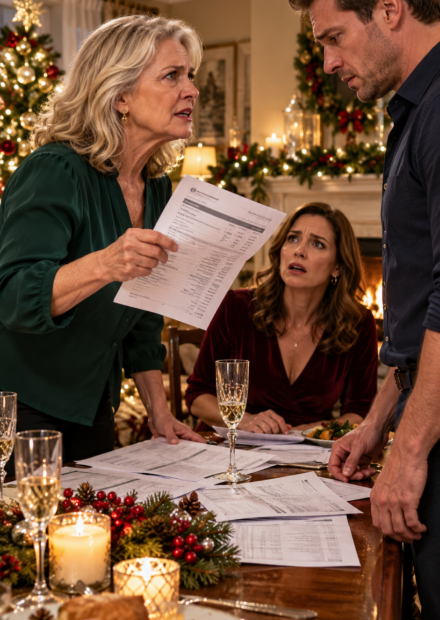
I removed the two envelopes.
One had Harper and Liam’s names.
The other had Liam’s alone.
I placed the first on the counter.
Harper reached for it.
“Read it together,” I said.
Liam came beside her.
She tore it open.
Her eyes moved down the page.
Then stopped.
“What is this?”
“A written notice confirming that your temporary stay here ends January thirty-first.”
She looked up.
“You’re kicking us out?”
“I am requiring you to honor the date you gave me when you moved in.”
“Are you serious?”
“Yes.”
“Thirty days?”
“You have known the date for four months.”
“That was before—”
“Before what?”
She stopped.
Before she decided the house was hers?
Before she began planning renovations?
Before she convinced herself temporary meant until I died?
Liam took the paper.
“Mom.”
“The attorney explained the notice requirements. Everything is properly documented.”
Harper stared at me.
“You went to a lawyer?”
“Yes.”
“Because of a dinner?”
“No.”
I looked at Liam.
“Because of a pattern.”
Harper’s voice became sharp.
“Where are we supposed to go?”
“That is something two employed adults will need to decide.”
“You know we’ve been saving.”
“I know.”
“You’re going to destroy that.”
“No. Paying for your own housing is not me destroying your finances.”
“You said we could stay!”
“Until the end of January.”
She turned to Liam.
“Say something.”
He looked at the paper.
Then at the second envelope.
“What’s that?”
I placed my hand on it.
“This is for you.”
Harper immediately reached toward it.
I moved it away.
“I said it is for Liam.”
Her eyes flashed.
“We’re married.”
“Yes.”
“So there shouldn’t be secrets.”
“Then Liam can decide whether to show it to you.”
I handed it to my son.
He opened it slowly.
Inside was a letter from me and a copy of the relevant estate documents.
He read the first paragraph.
His face changed.
Then he sat down.
Harper leaned over his shoulder.
“What?”
He didn’t answer.
“What does it say?”
She pulled the paper closer.
Her eyes raced down the page.
Then she looked at me.
“You changed the will?”
“Yes.”
The words hung in the kitchen.
Harper blinked.
“You changed your will.”
“Yes.”
“Because of me?”
“Because of what I learned.”
Liam looked as if I had struck him.
“The house?”
“Will not pass automatically to you.”
“Mom.”
“The estate plan has been changed.”
Harper’s mouth tightened.
“So who gets it?”
I almost admired the speed with which she asked.
Not why.
Not whether I was hurt.
Not whether Liam and I could repair what had happened.
Who gets it?
“Eventually,” I said, “what remains of my estate will be distributed according to the plan David and I originally discussed for charitable giving, along with a protected provision for Liam. But this house is no longer his guaranteed inheritance.”
Harper stared.
“That’s insane.”
“No.”
“You’re giving away your son’s inheritance.”
“It is not his inheritance while I am alive.”
“That’s semantics.”
“No, Harper. That is ownership.”
Liam stood.
“Stop.”
We both looked at him.
He was crying.
Not dramatically.
His eyes were simply wet.
“Mom, please.”
My anger weakened for one dangerous second.
He was still my boy.
I could see the six-year-old who had once fallen asleep against David’s shoulder.
But then I remembered the staircase.
She’s sixty-eight.
Who else is she going to leave it to?
I know.
“I love you,” I said.
His face crumpled.
“That’s why this hurts.”
“Then don’t do it.”
“You still don’t understand.”
“Understand what?”
“I did not change those papers because I stopped loving you.”
I tapped the envelope.
“I changed them because I realized my death had become part of your financial planning.”
Harper scoffed.
“That is such a disgusting way to twist—”
“Enough.”
The word came from Liam.
We both stared at him.
He turned toward Harper.
“Enough.”
Her face changed.
“Excuse me?”
“She heard us.”
“So?”
His voice broke.
“So she heard us.”
Harper crossed her arms.
“We didn’t say we wanted her dead.”
“I know.”
“Then stop acting like we did.”
He looked at her for a long time.
Then he whispered:
“That isn’t the point.”
For the first time in four months, my son finally understood there was a point.
Harper grabbed her purse.
“This is unbelievable.”
She stormed upstairs.
A door slammed.
Liam remained in my kitchen.
He looked down at the letter.
“What do I have to do to change your mind?”
It was the wrong question.
And from the expression on his face, he knew it the moment he asked.
I closed the drawer.
“Start by understanding why that is the wrong question.”
Then I went upstairs.
Behind me, my son remained alone at the kitchen island with the future he had assumed would be his spread out on the counter.
—