SHE SLAPPED ME AT THE WEDDING I PAID FOR. THEN SHE LEARNED WHOSE NAME WAS ON EVERY CONTRACT.
Chapter 1 – THE SIX FEET BETWEEN US
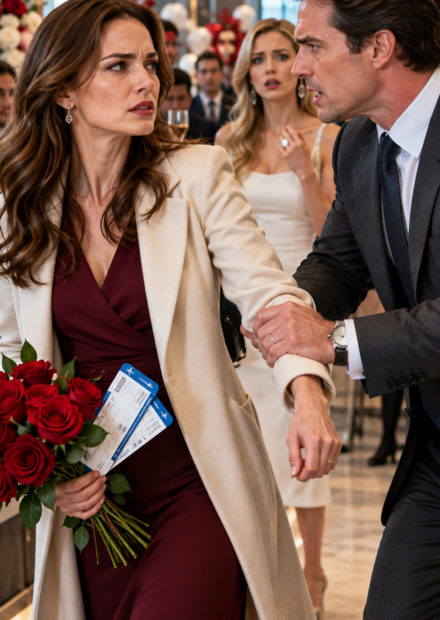
My daughter-in-law slapped me across the face in the middle of the wedding reception I had spent more than $45,000 to give her.
My only son, Daniel, stood six feet away in his tuxedo and watched the red mark spread across my cheek without taking a single step toward me.
Then Tiffany pointed toward the ballroom doors.
“Leave. You’re ruining my wedding.”
She said it loudly enough for the people nearest us to hear.
What she did not seem to remember was that almost every major contract keeping her beautiful wedding alive had my signature on it.
For several seconds, I couldn’t move.
The ballroom had gone strangely quiet around us even though more than two hundred guests filled the room beneath crystal chandeliers. A waiter stood frozen beside me with a tray of champagne balanced against one palm. Two bridesmaids near the dance floor stared openly. Somewhere behind me, a woman whispered, “Oh my God.”
But I barely heard any of them.
I was looking at my son.
“Daniel?”
I don’t know why I said his name.
Maybe some part of me still believed the little boy I had raised was hiding somewhere inside the thirty-four-year-old man standing in front of me.
Maybe I expected him to cross those six feet.
Maybe I expected him to say, “Don’t you ever touch my mother again.”
He didn’t.
Daniel looked at Tiffany.
Then he looked at me.
“Tiffany…” he whispered.
That was all.
Not Stop.
Not Mom, are you all right?
Not What did you just do?
Just her name, spoken softly, as though he were asking her not to make a scene rather than confronting the fact that she had struck his mother.
That hurt more than the slap.
My name is Margaret Bennett.
I was sixty-one years old when my only child got married, and until that night, I believed there were sacrifices a mother could make that her child would eventually understand.
I was wrong.
Daniel’s father, Robert, had died seven years earlier.
Robert and I had been married for thirty-three years. We weren’t wealthy, but we had built a comfortable life. Robert owned a small surveying business, and I had worked for twenty-six years as an administrative manager for a medical supply company. We saved carefully, paid off our house, and owned twenty-three acres outside town that had belonged to Robert’s family for generations.
That land mattered to him.
His father had worked it.
His grandfather had worked it.
Robert used to stand at the back fence in the evenings and look across those fields as though he could still see every Bennett who had come before him.
Developers had approached us more than once.
Robert always refused.
“Some things aren’t worth more just because somebody puts a bigger number on them,” he once told me.
After he died, I kept the land.
I thought I always would.
Then Daniel announced his engagement.
Tiffany was charming in the beginning.
She hugged me the first time Daniel brought her to dinner. She complimented my house, asked about Robert, and listened while I told embarrassing stories about Daniel as a boy.
When Daniel proposed, she called me before she called half her friends.
“Margaret,” she said, breathless with excitement, “I’m going to be your daughter.”
I cried.
I truly did.
Daniel was my only child, and after Robert died, the idea of our family growing again felt like light entering a room I had assumed would remain dark.
I wanted their wedding to feel like one final gift from both his parents.
The original plan was sensible.
Eighty guests.
A nice dinner.
Flowers.
Music.
A modest venue.
Daniel and Tiffany had some savings, and I offered to contribute $15,000.
“Mom, that’s too much,” Daniel said.
I should have remembered those words.
Because they were among the last times he ever told me not to spend money on them.
Two weeks later, Tiffany found Bellamy Lake Estate.
The property sat beside a private lake about forty minutes outside town. It had stone walls covered with ivy, formal gardens, fountains, a glass conservatory, and a ballroom with enormous windows overlooking the water.
She showed me photographs on her tablet.
“It’s perfect.”
“It’s expensive.”
“It’s only once in our lives.”
That sentence became the soundtrack of the next nine months.
Eighty guests became 126.
Then 160.
Eventually, 214 people were expected.
The simple floral package became imported white roses and orchids.
The DJ became a nine-piece live band.
The standard lighting package became custom uplighting.
Then there was the designer cake, upgraded linens, specialty cocktails, an open bar, a champagne display, luxury transportation for the bridal party, a honeymoon suite, a late-night dessert station, personalized favors, and a farewell brunch the following morning.
Every increase was presented as small.
Just $700 more.
Just $1,100 more.
Just $450 more.
Just one final upgrade.
But small numbers have a way of becoming enormous when you keep stacking them.
At $30,000, I should have stopped.
I knew it even then.
I remember sitting at my kitchen table one evening with invoices spread around me while Robert’s old reading glasses rested inside the drawer beside my knee.
I had been planning a trip to Italy.
Robert and I had talked about it for years.
Florence.
Rome.
A train north.
He wanted to see Tuscany because his grandmother’s family had come from Italy, though he joked that after three generations in Ohio, his only authentic Italian skill was knowing where to find the best pizza.
After he died, I couldn’t imagine taking the trip alone.
Then, eventually, I could.
I had saved brochures.
I had marked hotels.
I had even chosen the month.
October.
That evening, I canceled it.
I told myself Italy would still be there.
My son would only get married once.
At $36,000, the wedding account was nearly empty.
That should have been the absolute end.
Instead, I sold five acres of Robert’s land.
I can still remember the sound of the attorney sliding the papers toward me.
“Margaret, you’re certain?”
I looked at the signature line.
“No,” I said.
He frowned.
I forced a smile.
“But I’m doing it anyway.”
I signed.
Driving home afterward, I pulled onto the shoulder beside those fields and cried for twenty minutes.
Then I wiped my face before Daniel came over that evening because I didn’t want him feeling guilty.
That was my mistake.
Not paying for the wedding.
Not loving my son.
Not even selling the land.
My mistake was making sacrifice look effortless.
If people never see what something costs you, eventually they can begin to believe it costs you nothing.
By the week of the wedding, I had spent more than $45,000.
Then Tiffany wanted another $2,000.
Her father, Charles Whitmore, wanted Laurent Reserve champagne for his toast.
I had never heard of Laurent Reserve.
Apparently that was part of the problem.
Tiffany explained that her father had served it at some business celebration years earlier and that it was “meaningful to the family.”
I looked at the additional charge.
Nearly $2,000.
“No.”
Tiffany stared at me across the table during our final planning meeting.
“What do you mean, no?”
“I mean the regular champagne is perfectly good.”
“My father specifically requested Laurent Reserve.”
“Then your father can pay for Laurent Reserve.”
She looked offended.
Daniel immediately stepped in.
“Mom, she’s stressed.”
I looked at him.
“So am I.”
“We’re almost there.”
“We have been ‘almost there’ for six months.”
Tiffany pushed her chair back.
“Forget it.”
She left.
Daniel remained at the table.
“Mom.”
“No.”
“I didn’t even say anything.”
“You were about to.”
He rubbed his forehead.
“It’s two thousand dollars.”
I almost laughed.
“To you, apparently.”
He went silent.
I wanted to ask him whether he knew I had canceled Italy.
Whether he knew I had sold Robert’s land.
Whether he had ever once sat down and added the invoices.
Instead, I said, “The answer is no.”
He left disappointed.
I spent that night wondering whether I had ruined his wedding.
That should tell you how far I had allowed things to go.
The wedding day itself was beautiful.
Painfully beautiful.
The weather was clear. The gardens looked magnificent. Tiffany walked down the aisle in a fitted ivory gown while a string quartet played, and when Daniel saw her, he cried.
So did I.
For a few minutes, all the bills and arguments disappeared.
I imagined Robert sitting beside me.
I could almost hear him saying, Look at our boy.
At the reception, Daniel hugged me.
“Thank you, Mom.”
Those three words nearly made everything worth it.
Nearly.
Then, less than two hours later, Tiffany discovered the champagne change.
She came toward me near the ballroom entrance.
“Did you cancel my father’s champagne?”
“I kept the champagne included in the package.”
“You knew what I wanted.”
“And you know what we’ve already spent.”
“Put it on your card.”
“No.”
Her eyes narrowed.
“What?”
“No, Tiffany.”
“You’re seriously doing this tonight?”
“I’m not doing anything. The wedding is happening around us.”
“You promised to help us.”
“I have helped you.”
“You’re embarrassing my father.”
“Then your father can purchase the champagne.”
She stared at me.
People nearby had begun listening.
I lowered my voice.
“Tiffany, not here.”
“You did this deliberately.”
“No.”
“You’ve resented this wedding from the beginning.”
That stunned me.
I looked around at the ballroom.
At the roses.
The chandeliers.
The band.
The tables.
The hundreds of meals.
The bar.
The cake.
The lighting.
The wedding I had paid for.
“I have given you enough.”
Her face changed.
“You’re a bitter old woman who can’t stand that today isn’t about you.”
“Tiffany.”
“You’ve been trying to control everything because Daniel is finally choosing somebody besides you.”
I felt something inside me go still.
“That is enough.”
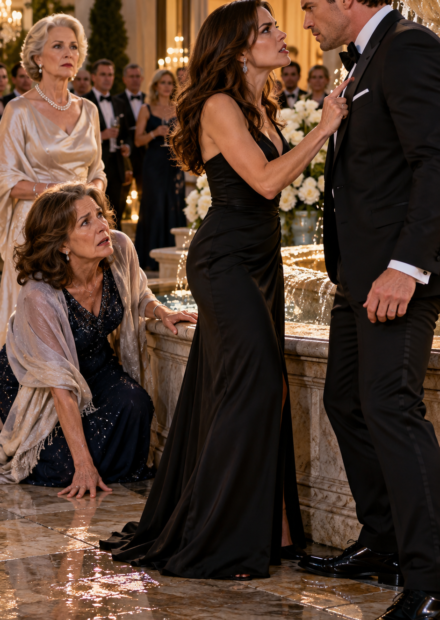
Then she slapped me.
Hard.
My head turned with the impact.
A gasp moved through the people around us.
When I looked back, Tiffany’s hand was still raised.
And Daniel was standing six feet away.
“Daniel?”
He didn’t move.
Tiffany pointed toward the doors.
“Leave. You’re ruining my wedding.”
I looked at my son one final time.
“All right,” I said.
I walked away.
Inside the women’s restroom, I locked myself in a stall and pressed both hands against my mouth until I was certain no sound would escape.
Then I stood at the mirror.
Tiffany’s handprint was visible on my cheek.
I thought about Italy.
I thought about Robert.
I thought about five acres of land I would never get back.
And then I remembered something.
The contracts.
The ballroom agreement was in my name.
The extended bar package was in my name.
The band extension.
The transportation.
Several catering extras.
The honeymoon suite.
The farewell brunch.
All mine.
I took out my phone and called the venue manager, Mr. Harris.
“What happens,” I asked him, “if the person whose name is on those contracts withdraws authorization tonight?”
There was a long pause.
“Mrs. Bennett, some services have already been delivered.”
“I understand.”
“But several others can still be terminated under your agreement.”
“The extended bar?”
“Yes.”
“The band’s additional time?”
“Yes.”
“Transportation after the reception?”
“Yes.”
“Tomorrow’s brunch?”
“Yes, ma’am.”
Twenty minutes later, I sat in his office.
Mr. Harris explained every clause carefully.
I wasn’t getting $45,000 back.
I knew that.
The ballroom had been used. Dinner had been served. Flowers had been delivered. Staff had worked.
This wasn’t about magically erasing a wedding after it happened.
It was about one thing.
I was done financing it.
Mr. Harris pushed the cancellation authorization toward me.
“If they want these services after I withdraw payment, who pays?”
“The bride and groom would need to make arrangements themselves.”
I picked up the pen.
I signed.
Then I signed the next page.
And the next.
When I finished, Mr. Harris gathered the contracts.
Through the ballroom doors, I could see Tiffany laughing with her bridesmaids.
Daniel stood beside her.
She had slapped me, thrown me out, and returned to celebrating with money she still assumed belonged to her.
Mr. Harris tucked the folder beneath his arm.
Then he walked directly toward Tiffany.
Her smile disappeared the moment she saw him coming.
And for the first time that night, my daughter-in-law looked afraid.