Chapter 1 – LEARN YOUR PLACE
“Your mother should learn her place.”
I stopped so suddenly that the stem of the champagne glass in my hand nearly snapped between my fingers.
For one heartbeat, I thought I had misheard Evelyn.
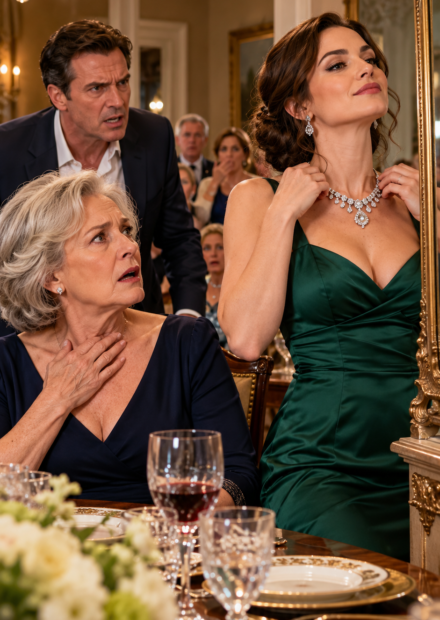
The quartet was still playing somewhere behind me. Beyond the open terrace doors, hundreds of candles reflected against polished marble and crystal. Men in black tuxedos stood beneath chandeliers that had been imported from Venice. Women wearing diamonds worth more than most houses smiled beneath arrangements of white orchids.
It was supposed to be the most important dinner I had hosted that year.
Instead, my mother was on one knee beside the fountain.
One hand was braced against the stone.
Champagne darkened her shawl.
And my husband stood over her.
Garrett held an empty glass loosely between two fingers.
He was smiling.
That smile was what made something inside me go cold.
If he had been drunk, perhaps I could have told myself he had lost control.
If he had looked ashamed, perhaps some stupid part of me might have tried to rescue the evening.
But Garrett looked completely certain that he had done nothing wrong.
Only seconds earlier, I had seen him tilt his glass.
Not accidentally.
Deliberately.
Champagne splashed across the marble near my mother’s shoes and caught the edge of her shawl.
Then Garrett took a linen napkin from the table and dropped it at her feet.
“Clean it.”
My mother had stared at him.
So had I.
Around us, several conversations faltered.
Then resumed.
That was how Garrett’s world worked.
People noticed cruelty.
They simply pretended not to.
My mother, Miriam, was sixty-three years old. She had spent thirty-two of those years teaching elementary school children. She was the woman who had worked summer programs when I was a teenager because college tuition terrified her more than exhaustion did.
She had never asked Garrett for anything.
She had never embarrassed him.
She had barely spoken to him that evening.
And yet there she was, crouched beside a fountain while my husband treated her like a servant.
Then Evelyn stepped forward.
My mother-in-law wore ivory silk and pearls.
Her silver-blond hair was arranged perfectly at the nape of her neck.
She looked at my mother.
“Your mother should learn her place.”
I put down my champagne.
Carefully.
Because if I hadn’t, I would have thrown the glass.
Then I walked toward them.
People stopped talking as I passed.
My mother saw me first.
“Alessia, don’t.”
Garrett turned.
“What?”
He laughed.
“You’re upset because someone finally told her the truth?”
I stopped three feet from him.
“Kneel and apologize.”
Garrett blinked.
For eight years, I had watched that man charm investors, flatter old families, and turn cruelty into something that sounded almost reasonable.
He could humiliate a waiter and call it standards.
He could mock a friend’s divorce and call it honesty.
He could tell me I looked exhausted before a charity gala and call it concern.
And I had become very skilled at translating.
Garrett doesn’t mean it that way.
Garrett is under pressure.
Garrett grew up differently.
Garrett will apologize later.
He usually did apologize.
That was part of the machinery.
Cruelty.
Silence.
Apology.
Flowers.
Then cruelty again.
Small enough each time that leaving seemed dramatic.
Small enough that staying seemed rational.
I had filed away hundreds of moments because understanding them honestly would have required me to make a choice.
Not tonight.
Garrett stepped toward me.
“To her?”
He laughed directly in my face.
“She embarrassed my mother in front of half the room. She should be grateful I’m only asking her to clean up after herself.”
“I didn’t embarrass anyone,” my mother said.
Evelyn watched us.
Even then, I noticed something strange.
There was no outrage on her face.
No concern that her son had publicly humiliated an older woman.
No embarrassment.
No instinct to stop him.
She looked almost…
interested.
I turned back to Garrett.
“I said apologize.”
His smile disappeared.
Not completely.
Just enough.
“Or what?”
My mother touched my arm.
Her fingers were cold.
“Please,” she whispered. “Not here.”
That sentence broke my heart more than Garrett’s insult had.
Because I knew what she meant.
Protect yourself before you protect me.
She had been telling me that in different ways since I married him.
I had never listened.
Garrett looked down at her hand on my sleeve.
His jaw tightened.
Then he kicked her.
It happened so quickly that nobody moved.
His shoe struck the side of her leg hard enough to knock her against the fountain.
My mother cried out.
The sound that came from me wasn’t a scream.
It was one sharp breath.
Garrett barely had time to turn.
My fist caught him across the mouth.
He stumbled backward.
His heel struck the fountain edge.
For one ridiculous second, his arms windmilled.
Then Garrett Vale—perfect Garrett, untouchable Garrett, the man who believed rooms rearranged themselves around him—fell backward into the decorative fountain.
Water exploded over his tuxedo.
Floating candles scattered across the marble.
Someone screamed.
I heard glass break.
Garrett sat in the fountain staring at me.
He looked less angry than shocked.
I had broken the rule.
Not his rule about violence.
His real rule.
I had embarrassed him.
Publicly.
Then his face twisted.
“You bitch.”
He climbed out.
“Garrett,” someone warned.
He didn’t listen.
He charged.
I had taken self-defense classes for years.
Garrett knew that.
Like everything else about me, he simply considered it decorative.
He swung.
I moved.
His fist passed my cheek.
I caught his arm, used his momentum, and drove him backward.
He crashed into the silver banquet console.
Trays, serving domes, crystal vases, utensils, and glasses came down around him in an explosion of silver and crystal.
Guests scattered.
Security finally moved.
Evelyn backed away.
Not because her son was hurt.
Because a tray nearly struck her gown.
I stared at my husband.
Eight years.
Eight years reduced to a soaked man sprawled beneath overturned serving trays.
My hands were shaking.
Not from fear.
From clarity.
I removed my wedding ring.
Garrett saw it.
His expression changed.
“Don’t you dare.”
I threw it onto his chest.
“You kicked my mother.”
“Alessia—”
“Now crawl out of my house.”
The room went silent.
My house.
Technically, legally, undeniably mine.
The house had belonged to my father before his death and had passed to me.
Garrett hated that fact.
Usually we called it ours.
Not anymore.
Security approached him.
Garrett looked around, expecting someone to intervene.
Nobody did.
“Get your hands off me.”
“Sir—”
“This is my home!”
“No,” I said.
Garrett looked at me.
I had never corrected him before.
“This is my home.”
His eyes narrowed.
“You have no idea what you’re doing.”
“For the first time in eight years, I think I do.”
My mother stood behind me.
I could hear her breathing.
Garrett pointed at her.
“This is because of her.”
“No. This is because of you.”
“You’re going to destroy your marriage over one stupid misunderstanding?”
I stared at him.
“A misunderstanding?”
His mouth opened.
I looked toward the fountain.
Toward my mother’s wet shawl.
Toward the napkin still lying on the marble.
Then at the bruise already forming beneath her stocking.
Garrett followed my gaze.
And for the first time, I saw calculation replace rage.
He realized there had been witnesses.
Lots of them.
His voice softened.
“Alessia.”
That frightened me more than his shouting.
I knew that voice.
It was the voice he used after.
After insults.
After slammed doors.
After nights when he froze me out for hours and then climbed into bed as though nothing had happened.
“Baby, come on.”
I felt sick.
“Get out.”
“Think.”
“I am.”
“You’re emotional.”
There it was.
The word he had used whenever my feelings became inconvenient.
I almost laughed.
Instead I said, “Security.”
Two guards stepped forward.
Garrett’s face hardened.
“If I walk out that door, don’t expect me to come crawling back.”
“I don’t.”
He looked at me as if waiting for more.
There wasn’t more.
The guards escorted him toward the terrace doors.
Guests separated to let him pass.
Nobody laughed.
That somehow made it worse for him.
Garrett could survive hatred.
What he could not survive was irrelevance.
My mother touched my shoulder.
“Alessia.”
I turned.
Her face was pale.
“Are you hurt?”
“I’m fine.”
“You’re not.”
“Neither are you.”
Her mouth trembled.
I hugged her.
For several seconds, I forgot everyone else.
Then I remembered Evelyn.
She stood beside the fountain.
Perfect posture.
Perfect gown.
Perfectly calm.
Everyone else had watched Garrett leave.
Evelyn watched me.
Her expression wasn’t victory.
But it was far too close to satisfaction.
Then she lowered her eyes toward my wedding ring, which had fallen from Garrett’s chest onto the wet marble.
“Exactly,” she whispered.
I froze.
“What did you say?”
Evelyn looked at me.
For the first time that evening, something cracked in her expression.
Not guilt.
Not triumph.
Sadness.
Then she turned and walked away.
I watched her disappear through the crowd.
And suddenly I knew the worst thing that had happened that night wasn’t Garrett kicking my mother.
It was the realization that his mother had been waiting for me to finally hit back.
—
By midnight, the house was empty.
The musicians had gone.
Catering staff moved quietly through rooms that smelled of extinguished candles and spilled champagne.
My mother sat in my bedroom while I pressed an ice pack against her leg.
“You should see a doctor.”
“I’ve had worse bruises from classroom furniture.”
“Mom.”
“All right. Tomorrow.”
I sat beside her.
Neither of us spoke for a while.
Then she said, “I’m sorry.”
I stared at her.
“For what?”
“For tonight.”
“Garrett assaulted you.”
“I shouldn’t have come.”
Something inside me twisted.
“Don’t.”
She looked at me.
“Don’t make his behavior your responsibility.”
A faint, sad smile crossed her face.
“Listen to you.”
“What?”
“Nothing.”
“No. Say it.”
She hesitated.
Then she took my hand.
“I’ve been waiting eight years to hear you say that.”
I couldn’t breathe for a second.
“Was it that obvious?”
“To me?”
She squeezed my fingers.
“Yes.”
“Why didn’t you tell me?”
“I did.”
“You never said he was abusive.”
“No. Because you would have defended him.”
I looked away.
She was right.
“You told me I seemed quieter after I married him.”
“Yes.”
“You asked why I stopped seeing Rachel.”
“Yes.”
“You asked why I changed therapists.”
“Yes.”
I closed my eyes.
Every question returned with a different meaning.
My mother had never told me to leave Garrett.
She had been smarter than that.
She had kept the door open.
I whispered, “I thought you disliked him because he came from money.”
Miriam laughed softly.
“Sweetheart, you came from money.”
That almost made me smile.
Then I remembered Evelyn.
“Mom.”
“Yes?”
“What happened between you and Evelyn tonight?”
My mother’s expression changed.
“Nothing.”
“She said you embarrassed her.”
“I disagreed with her.”
“About what?”
She hesitated.
“Garrett.”
My stomach tightened.
“What about him?”
“She said a wife who respects her husband doesn’t contradict him publicly.”
“And?”
“I told her respect wasn’t obedience.”
That sounded exactly like my mother.
“What else?”
“She asked whether I had taught you that.”
“And you said?”
“That I hoped I had.”
I stood.
The room suddenly felt too small.
“That was it?”
“Yes.”
“Then why did Evelyn say you should learn your place?”
My mother looked toward the windows.
“I don’t know.”
I did not believe her.
But before I could push, my phone vibrated.
Garrett.
Twenty-three missed calls.
Fourteen messages.
The newest appeared while I stared at the screen.
YOU’VE MADE YOUR POINT.
Another arrived.
NOW STOP PERFORMING AND CALL ME.
Then:
MY MOTHER WILL FIX THIS TOMORROW.
I read that one twice.
My mother noticed.
“What?”
I showed her.
She frowned.
“What does that mean?”
“I don’t know.”
But Evelyn’s whisper came back.
Exactly.
Then another message appeared.
This one wasn’t from Garrett.
It was from Evelyn.
DON’T LET HIM BACK INTO THE HOUSE TONIGHT.
I stared at it.
A second message followed.
AND DON’T WARN HIM BEFORE YOU CHECK YOUR OFFICE.
I stopped breathing.
My mother stood.
“What is it?”
I showed her.
Her face went white.
“What office?”
I looked toward the hallway.
My father’s study was downstairs.
Since our marriage, Garrett had called it our office.
Lately, he had spent more time there than I had.
I grabbed my phone.
“Stay here.”
“Absolutely not.”
“Mom—”
“I spent thirty-two years separating fighting eight-year-olds. I’m coming.”
Under any other circumstances, I might have laughed.
We went downstairs together.
The house felt unfamiliar after midnight.
Too quiet.
Every room seemed to contain the ghost of the party.
We reached my father’s study.
The door was closed.
I opened it.
Nothing looked disturbed.
Desk.
Books.
Leather chairs.
My father’s old photographs.
Then I noticed something.
The bottom drawer of my desk wasn’t completely shut.
I pulled it open.
Inside were household accounts, property documents, and correspondence.
Nothing strange.
Then I remembered Garrett sitting there three nights earlier.
He had shut the drawer when I entered.
At the time, I hadn’t thought about it.
Now I did.
I removed the folders.
At the back of the drawer was a thin black envelope.
My name was written across it.
Not in Garrett’s handwriting.
In Evelyn’s.
I opened it.
Inside was one sheet of paper.
No explanation.
Only six words.
ASK YOUR HUSBAND WHAT HE NEEDS YOU TO SIGN.
I read the sentence twice.
Then my phone rang.
Garrett.
I rejected the call.
A message appeared immediately.
WE NEED TO TALK ABOUT THE FOUNDATION DOCUMENTS TOMORROW.
My mother read it over my shoulder.
I looked down at Evelyn’s note.
For the first time that night, fear replaced anger.
Because Garrett had not merely expected me to forgive him.
He had expected me to sign something.
And his mother had apparently known.