Chapter 1 – THE WOMAN IN THE MIRROR
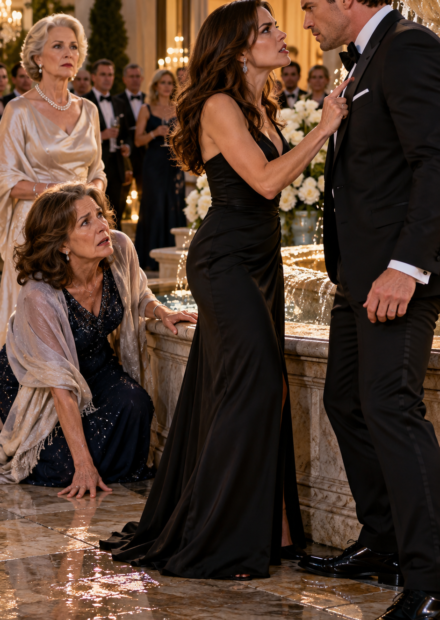
My daughter-in-law reached across a dinner table surrounded by thirty-two members of my late husband’s family, unclasped the diamond necklace from my neck, and said, “Margaret, you’re too old for something like this.”
Then Claire put the necklace around her own throat and admired herself in the antique mirror as if she had just inherited it.
What she didn’t know was that three weeks before my husband died, he had quietly met with our attorney about that exact necklace.
I was sixty-three years old, and Edward had been gone for fourteen months.
That dinner was the first large Whitmore family gathering I had attended since his death. Wearing the necklace had taken me most of the afternoon to work up the courage.
I almost put it back in the safe three times.
The necklace had been in Edward’s family for generations, but when we married, his grandmother Ruth had placed it around my neck herself.
“You don’t hide beautiful things because you’re afraid of losing them,” she had told me.
Edward turned that into his own little joke over the years.
Whenever we attended an anniversary dinner, charity gala, wedding, or Christmas party, he would stand behind me at the bedroom mirror, struggle with the tiny clasp because his fingers were too large, and say, “Wear them while you’re alive, Maggie. A safe has never admired a diamond.”
The last time he fastened it around my neck, he was already sick.
His hands shook.
I remember reaching backward to help him, but he gently pushed my fingers away.
“I can still do one thing for my wife,” he said.
That memory was why I wore it to the family dinner.
Not to impress anyone.
Not because I wanted people to notice me.
I wore it because I missed my husband.
At first, when Claire reached behind my neck, I thought she was fixing the clasp.
Then I felt the weight disappear.
She lifted the diamonds into the chandelier light.
“Margaret, you’re too old for something like this.”
The room went completely silent.
My son Daniel shoved his chair backward so quickly it scraped across the hardwood floor.
“Claire. Give it back.”
She barely looked at him.
Instead, she walked to the antique mirror that had belonged to Edward’s mother, fastened the necklace around her own throat, and turned her head from side to side.
Against her emerald dress, the diamonds flashed beautifully.
And Claire knew it.
“See?” she said, smiling at her reflection. “Jewelry like this needs someone who can actually carry it.”
I touched the empty place at my throat.
What hurt wasn’t the insult about my age.
Edward had made me feel beautiful at twenty-two, forty, fifty-five, and sixty-one. Claire couldn’t erase forty-one years of being loved with one cruel sentence.
What hurt was the casual certainty with which she had removed something from my body.
As though widowhood had demoted me.
As though everything Edward and I had shared was now waiting to be redistributed to younger people.
“You took it off me without asking,” I said.
Claire shrugged.
“I’m family.”
Daniel stared at her.
“That doesn’t make it yours.”
But she still didn’t remove it.
Instead, Claire touched the largest diamond.
Then she asked the question that changed the entire feeling in the room.
“What do you think this thing is worth?”
Not where it came from.
Not why I had chosen that night to wear it.
Not what it had meant to Edward.
Its value.
Across the table, Edward’s sister Helen lowered her wineglass.
“Claire.”
“What?” Claire said.
Helen’s voice sharpened.
“Take it off.”
Claire laughed.
“Oh, come on. I’m trying it on.”
“You didn’t ask.”
“I’m married to Daniel.”
Helen looked toward my son.
“And?”
Claire’s smile disappeared.
Daniel stood.
“Give Mom her necklace.”
For a moment, I thought she would.
Instead, she looked around the room and seemed to realize thirty-two people were watching.
Pride took over.
“I said I’m trying it on.”
Then she returned to her chair.
Wearing my necklace.
Dinner never recovered.
People attempted conversation, but every sentence died after a few words. Forks scraped plates. Glasses were refilled unnecessarily. Two of Edward’s cousins left before dessert.
I barely ate.
Claire, meanwhile, behaved as if nothing unusual had happened.
Several times, I saw her fingers drift toward the center diamond.
Each time, something cold settled deeper inside me.
Years earlier, one of Edward’s relatives had joked that the family should have sold the necklace during a difficult financial period.
Edward had looked at me afterward and said something I hadn’t understood at the time.
“Some things aren’t yours just because you’re holding them.”
I thought he had been talking about tradition.
Watching Claire touch those diamonds, I began wondering whether he had meant something else.
By nine thirty, relatives were collecting coats.
Daniel approached Claire again.
“Take it off.”
She rolled her eyes.
“The clasp is delicate.”
“You got it on.”
“I don’t want to break it.”
“Then let Mom help you.”
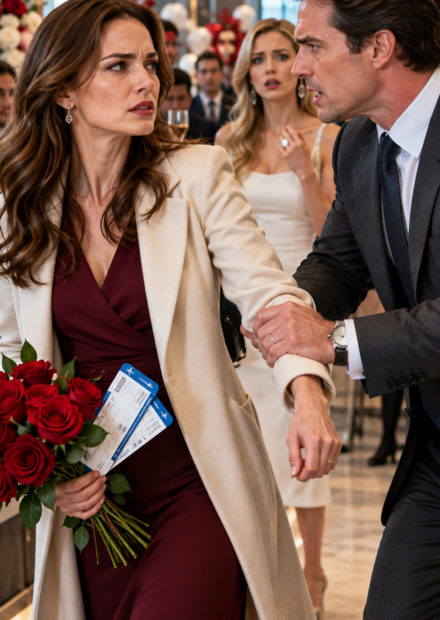
Claire grabbed her purse.
“We’re already late.”
I stepped between her and the front door.
“Claire. The necklace.”
She touched the center stone as if she had forgotten it was there.
“Oh. I’ll bring it back tomorrow.”
“No.”
Her expression hardened.
“Margaret, seriously?”
“Yes.”
“I’m not stealing it.”
“I didn’t say you were.”
“But that’s what you’re implying.”
“I’m saying it belongs with me tonight.”
Daniel rubbed his forehead.
“Claire, take it off.”
Helen had come into the foyer behind us.
“So am I,” she said.
Claire stared at all three of us.
Then she laughed once.
It wasn’t amusement.
It was defiance.
“The clasp is catching my hair. I’m not standing here another fifteen minutes while everyone stares at me like I robbed a jewelry store.”
“You removed it in three seconds,” Helen said.
Claire ignored her.
She opened the front door.
I should have stopped her.
I should have demanded the necklace before she crossed my threshold.
But as I watched her walk into the cold night wearing the diamonds Edward had fastened around my neck so many times, a strange memory returned.
Three weeks before Edward died, our longtime attorney, Samuel Price, had come to the house carrying his old leather briefcase.
Edward was weak then, but his mind was perfectly clear.
The two men spent nearly two hours behind the closed study door.
When Samuel left, he looked at me as though there was something he wanted to say.
I asked Edward whether something was wrong with the estate.
“No,” he said.
“Then what was Samuel doing here?”
“Just family things.”
His eyes moved toward the wall safe.
Toward the necklace.
At the time, I didn’t ask another question.
When someone you love is dying, ordinary things crowd out the important ones.
Did he take his medication?
Was he hurting?
Could he eat?
Was he warm enough?
Had the doctor called?
You keep believing there will be another afternoon to ask what something meant.
There wasn’t.
That night after Claire left, I barely slept.
At two in the morning, I checked my phone.
At four fifteen, I considered calling Daniel.
By six thirty, I was dressed.
By seven ten, I had made coffee I never drank.
At exactly 8:17 a.m., my phone rang.
Samuel Price.
I hadn’t spoken to him in months.
“Margaret,” he said immediately. “Daniel called me.”
I sat upright.
“About Claire?”
“About the necklace.”
Something in his voice made my stomach go cold.
Samuel asked whether Claire had physically removed the necklace from my neck herself.
“Yes.”
“Did you give her permission to do that?”
“No.”
“Did you give her permission to leave your house wearing it?”
“No.”
There was a pause.
Then Samuel said, “Edward was afraid this might happen.”
I gripped the phone tighter.
“What are you talking about?”
“The necklace is not ordinary personal property.”
“Samuel, Claire has my necklace.”
“I know. That’s why you need to listen carefully.”
He told me to go downstairs to Edward’s study.
I hadn’t changed much in that room since he died.
His reading glasses were still beside the lamp. Three pens remained aligned near the blotter. A photograph of Daniel at eleven sat beside a picture of Edward and me on our thirtieth anniversary.
Even the chair still creaked the same way when I sat down.
“Bottom drawer,” Samuel said.
I opened it.
Inside was a black binder stamped in small gold letters:
WHITMORE FAMILY TRUST.
I had seen it before.
I had never opened it.
“Find Schedule C.”
I turned through pages of property records, accounts, amendments, signatures, and legal descriptions until I found the heading.
HERITAGE PROPERTY AND STEWARDSHIP.
Underneath was a detailed description of the diamond necklace Claire had taken from my neck.
And below that was Edward’s signature.
My hands started shaking.
“Samuel,” I whispered. “What did my husband do?”
“Keep reading.”
I turned the page.
A white envelope was tucked inside a transparent sleeve.
Across the front, in Edward’s handwriting, were two words.
For Maggie.
I stared at my name until my eyes blurred.
“When did he write this?”
“The day I came to your house.”
I opened the envelope.
The first line read:
*Maggie, if you are reading this because someone has tried to take the necklace from you, then I am sorry I was right about something I desperately wanted to be wrong about.*
I stopped breathing.
Samuel’s voice came softly through the phone.
“There’s more, Margaret.”
I looked down.
“And you need to read the part where Edward explains what happens to the person who takes it.”
I continued.
Edward had written slowly. I could tell from the unevenness of the letters.
*Maggie, the necklace is yours to wear for the rest of your life. Not Daniel’s. Not Daniel’s wife’s. Not Helen’s. Not anyone else’s.*
My throat tightened.
*After you, it becomes part of the Whitmore Heritage Collection under the trust. No beneficiary may sell it, pledge it, borrow against it, remove it from the designated steward without permission, or represent it as his or her personal property.*
I looked at Samuel’s voice coming through the phone as though I could somehow see him.
“What does designated steward mean?”
“You.”
I read further.
Edward had named me lifetime steward.
Not temporary custodian.
Not widow holding something for the next generation.
Steward.
The necklace remained under my exclusive possession and control for the rest of my life.
Then I reached the paragraph Samuel wanted me to see.
It was shorter than the others.
And far more specific.
Any beneficiary or spouse of a beneficiary who knowingly removed heritage property from the possession of the designated steward without permission, refused a direct request for its return, attempted to sell or encumber the property, or knowingly asserted personal ownership over it would trigger a review of that beneficiary’s stewardship privileges under the family trust.
I read it twice.
Then a third time.
“What does that mean for Daniel?”
“It doesn’t automatically disinherit him.”
Relief came first.
Then confusion.
Samuel continued.
“Edward did not want you weaponizing the trust against your son over an argument. He was very clear about that. But he also didn’t want anyone using Daniel’s future interest as an excuse to pressure you.”
“So what happens?”
“If Claire returns the necklace immediately, probably very little. We document the incident. We remind them of the trust terms. That may be the end of it.”
“And if she doesn’t?”
Samuel paused.
“Then it becomes evidence that Daniel’s household may not be suitable to receive stewardship of heritage property after your death.”
I looked down at Edward’s letter.
There was one final paragraph.
*I hope none of this is ever necessary. But grief makes people vulnerable, Maggie. Families sometimes begin dividing a widow’s life before she has finished living it. If that ever happens to you, remember something for me.*
The next sentence broke me.
*You are not the hallway through which my belongings pass to the next generation.*
I covered my mouth.
For fourteen months, I had tried so hard not to be difficult.
When Daniel wanted Edward’s watch, I gave it to him.
When Claire asked for the silver tea service because it “fit their dining room better,” I let her borrow it.
When they wanted several paintings from the upstairs hallway, I told myself Edward would have wanted Daniel to enjoy them.
Every request had seemed small.
Reasonable.
Family.
But now I remembered something else.
None of the things they had requested were random.
They had all been old Whitmore pieces.
All valuable.
All listed, I now realized, in Schedule C.
“Samuel.”
“Yes?”
“Daniel has Edward’s watch.”
Silence.
“And Claire has the silver tea service.”
Another pause.
“They also took two paintings last Christmas.”
Samuel exhaled slowly.
“Margaret, did you transfer ownership of those items?”
“I thought I was giving them to Daniel.”
“Did anyone ask you to sign anything?”
“No.”
“Did Daniel ever say Edward had promised them to him?”
I closed my eyes.
“Yes.”
“When?”
“After the funeral.”
Samuel went quiet.
Then he asked a question that frightened me more than anything he had said yet.
“Did Daniel tell you that himself?”
I thought back.
No.
Claire had.
Daniel had been standing beside her.
But Claire had been the one speaking.
She had said Edward always intended Daniel to have the watch.
She had said the tea service was supposed to stay with “the younger household.”
She had said the paintings would eventually belong to Daniel anyway.
Daniel had never corrected her.
“No,” I whispered. “Claire did.”
Samuel said nothing for several seconds.
Then:
“Margaret, don’t call them yet.”
“Why?”
“Because I want to know whether this is a misunderstanding.”
I looked at the trust binder.
“And if it isn’t?”
“Then we need to know exactly how far it has gone.”
Before I could respond, my phone beeped.
A text message.
Claire.
I opened it.
There was a photograph.
She was wearing the necklace.
Not at home.
She was standing inside a jewelry store.
Behind her were glass display cases.
Underneath the photograph she had written:
**Getting it professionally appraised so everyone can stop being dramatic.**
My blood went cold.
“Samuel.”
“What happened?”
I read him the message.
For the first time in thirty years of knowing Samuel Price, I heard him swear.
Then he said four words.
“Do not warn her.”
And that was when I understood the necklace had stopped being the problem.
It had become the test.
And Claire had just failed it.
—