Chapter 5 – WHAT I CHOSE TO KEEP
Claire’s father, Richard Bennett, was not a criminal.
That mattered.
By then, it would have been easy for me to turn everyone connected to Claire into a villain.
Edward would have hated that.
Truth mattered more than revenge.
Richard had spent thirty years in commercial insurance and had helped Claire think through their financial problems.
According to Claire, she had sent him photographs and descriptions of items from my home because she wanted to know what could theoretically be insured, borrowed against, or sold after they eventually passed to Daniel.
Eventually.
That word had done terrible work in my family.
Eventually had allowed Claire to treat my present life as Daniel’s future property.
Samuel reviewed the list.
Richard cooperated.
There was no evidence he had helped sell the bracelet or instructed Claire to take anything.
He had, however, made comments in emails that turned my stomach.
*Margaret won’t need a house that size forever.*
*Once the estate transitions, liquidity improves.*
*Daniel should understand what his branch will control.*
Nothing illegal.
Nothing directly threatening.
But reading those sentences taught me something.
People had been discussing my death as a financial event.
I was sixty-three.
Healthy.
Living independently.
Driving.
Traveling.
Gardening.
Serving on two charity boards.
Having dinner with friends.
Still occasionally waking at three in the morning and reaching for a husband who wasn’t there.
And somewhere else, spreadsheets were being built around what happened when I stopped existing.
That changed me.
Not into an angry woman.
Into an awake one.
The next morning, I called Samuel.
“I want to change something.”
“What?”
“Not Edward’s trust.”
“Good, because much of it is irrevocable.”
“I want to change me.”
He laughed softly.
“That may be outside my professional qualifications.”
“I’m serious.”
“So am I.”
I looked around the study.
For fourteen months, I had preserved Edward’s life exactly as he left it.
His glasses.
His pens.
His sweaters.
His coffee mug.
His side of the closet.
I told myself I was honoring him.
Maybe part of me had simply stopped moving.
“I want to inventory everything.”
Samuel became quiet.
“Everything?”
“Everything in this house. Trust property, my property, ordinary household things. I want to know what belongs where.”
“I think that’s wise.”
“And then I want to decide what I actually want.”
That afternoon, I started with Edward’s closet.
I cried for twenty minutes before touching anything.
Then I removed one shirt.
His blue Oxford.
I held it against my face.
It smelled only faintly like him now.
I kept it.
The rest took three days.
Some clothes went to charity.
Several jackets went to Daniel.
Edward’s gardening boots went to his nephew Thomas, who had followed him around the yard as a boy.
I kept his wedding suit.
I kept the ridiculous fishing hat I had always hated.
I kept the sweater he wore the night Daniel was born.
And for the first time since Edward died, the empty space in the closet did not feel like betrayal.
It felt like air.
The inventory continued for weeks.
Some things stayed.
Some things left.
But now every object moved because I decided it would.
That distinction became sacred to me.
Daniel came over every Saturday.
At first, we talked mostly about practical things.
His business.
The house.
The separation.
Eventually, we talked about Claire.
He still loved her.
I could see that.
Love does not evaporate because someone behaves terribly.
Sometimes that is what makes betrayal so painful.
“Do you want me to hate her?” I asked one afternoon.
He looked surprised.
“No.”
“Good.”
“You should.”
“No.”
“Why not?”
“Because I’m too old to waste that much energy.”
He smiled.
“Careful. Apparently you’re too old for diamonds too.”
I stared at him.
He froze.
Then I started laughing.
So did he.
We laughed until I cried.
It was the first time Claire’s sentence had lost some of its power.
Months passed.
Daniel and Claire began counseling.
Not because I asked.
I deliberately stayed out of it.
Some weeks they seemed closer.
Other weeks Daniel looked exhausted.
Claire returned the nineteen-thousand-dollar check to me twice.
I returned it twice.
The third time, she did something different.
She donated nineteen thousand dollars to the historical foundation that maintained the Whitmore family archives.
She sent me the receipt.
No dramatic note.
Just one sentence.
**I know this doesn’t undo anything.**
I respected that more than an apology demanding forgiveness.
Nearly seven months after the dinner, Claire came to my house again.
Daniel was with her.
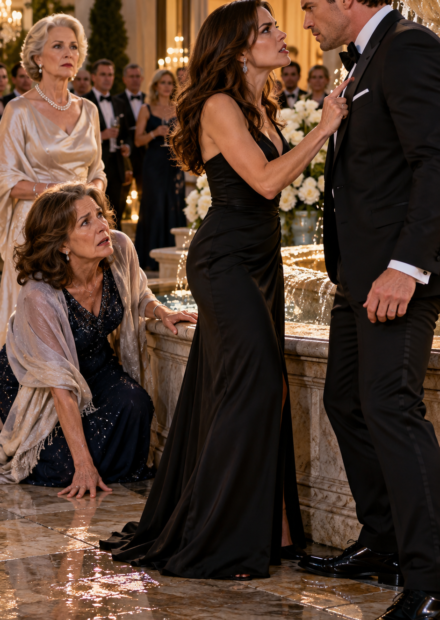
She stood in the foyer where she had dropped the necklace on the table.
“I need to say something.”
I waited.
“I used your grief against you.”
Daniel looked at her.
She continued.
“Maybe I didn’t say those words to myself at the time. But that’s what I did. I knew you didn’t want conflict after Edward died. I knew Daniel didn’t either. So I told each of you things that made it easier to move objects out of this house.”
Her voice trembled.
“I kept telling myself it was all going to be ours eventually.”
I did not correct her.
She corrected herself.
“Daniel’s eventually.”
Then again.
“No. Not even that. Maybe Daniel’s. Depending on the trust. Depending on you. Depending on decisions I had no right to make.”
I nodded.
Claire swallowed.
“I’m sorry I took the necklace off your neck.”
There were a thousand responses available.
I chose the simplest.
“Thank you.”
She looked almost disappointed.
Perhaps she expected absolution.
Perhaps punishment.
I gave neither.
Forgiveness, I had learned, did not have to be a ceremony.
Sometimes it was simply deciding that another person’s worst act would no longer organize your day.
Daniel and Claire stayed together.
That surprised Helen.
It surprised Samuel.
For a while, it surprised me.
But Daniel established conditions.
Separate financial oversight.
No borrowing without both signatures.
No involvement by Claire in trust property.
Full disclosure of personal debt.
Counseling.
And one boundary I did not learn about until much later.
Claire was not permitted to ask me for property.
Anything.
Not a chair.
Not a painting.
Not a serving spoon.
If I chose to offer something, that was different.
But she could not ask.
Their house was sold.
Not because I demanded it.
Because the debt required it.
They moved into a smaller place.
Daniel’s business survived, though barely.
He sold his interest in the Ashford project and spent two years rebuilding.
Claire went back to work full-time.
For the first time in years, their life looked less impressive from the outside.
Oddly, Daniel told me they were happier.
“Smaller mortgage,” he said.
“Smaller secrets?”
He smiled.
“Those too.”
One year after the night Claire took the necklace, Helen suggested we hold the family dinner at my house again.
I nearly refused.
Then I thought of Edward.
He loved those ridiculous gatherings.
Too much food.
Too many people.
Children running through rooms with adults yelling after them.
Arguments about politics.
Arguments about football.
Arguments about which dead Whitmore had actually purchased which piece of furniture.
So I said yes.
Thirty-four people came.
Two more than the previous year.
I stood upstairs getting dressed.
For a long time, I looked at the jewelry box.
Then I opened it.
The necklace lay inside.
Samuel had arranged for the clasp to be repaired by a specialist.
I picked it up.
For one second, my hands shook.
Then I heard Edward.
Not literally.
Memory has its own voice.
*Wear them while you’re alive, Maggie.*
I smiled.
“All right.”
I tried fastening it myself.
Failed.
Tried again.
Failed again.
Forty-one years of marriage had apparently prevented me from developing the necessary skill.
There was a knock at the bedroom door.
“Mom?”
Daniel.
“Come in.”
He entered wearing the navy suit I had always thought made him look like Edward.
Then he saw the necklace in my hands.
His expression softened.
“Need help?”
I turned around.
“Yes.”
He took the necklace.
For a second, neither of us moved.
Then Daniel lifted it around my neck.
His fingers struggled with the clasp.
I laughed.
“What?”
“Your father could never manage that thing either.”
Daniel smiled.
“Genetic defect.”
Eventually the clasp clicked.
I looked into the mirror.
My son stood behind me.
For one strange second, memory placed Edward there too.
Daniel kissed the top of my head.
“You look beautiful, Mom.”
My eyes filled.
“Thank you.”
Downstairs, the house was alive.
Helen was already complaining that someone had moved her place card.
Children chased one another through the hallway.
Someone opened the wrong bottle of wine.
My nephew Thomas was arguing with his brother about whether Edward cheated at golf.
It felt like family.
Messy.
Loud.
Imperfect.
Alive.
Claire arrived carrying a pie.
When she saw me, her eyes immediately went to the necklace.
I watched her.
She looked at it for perhaps two seconds.
Then she met my eyes.
“You look beautiful, Margaret.”
Nothing more.
No comment about value.
No joke.
No request to touch it.
“Thank you, Claire.”
Dinner began.
Halfway through dessert, Helen tapped her glass.
“Oh, no,” Daniel whispered.
Helen glared at him.
“I heard that.”
Everyone laughed.
She stood.
“I want to say something about my brother.”
The room quieted.
Helen looked at me.
“Edward was annoying.”
Laughter.
“He was stubborn. He cheated at cards.”
“I knew it!” Thomas shouted.
“He did not cheat at golf,” Helen continued, “despite certain defamatory statements made in this house tonight.”
More laughter.
Then her expression softened.
“But Edward understood something about family that I think the rest of us occasionally forget.”
She raised her glass.
“He knew family history isn’t something you own.”
My hand drifted toward the necklace.
“It’s something you take care of.”
Helen looked directly at Daniel.
Daniel nodded.
Then she looked at Claire.
Claire lowered her eyes.
Finally Helen looked at me.
“And sometimes taking care of family history means taking care of the person who is still here to remember it.”
I couldn’t speak.
Everyone raised their glasses.
“To Margaret.”
I laughed through tears.
“To Edward.”
They repeated it.
“To Edward.”
Later, after everyone left, I stood alone in the foyer.
The antique mirror was still there.
The same mirror Claire had admired herself in one year earlier.
I looked at my reflection.
Silver hair.
Lines around my eyes.
A neck that was undeniably sixty-four now.
And diamonds.
Beautiful diamonds.
For decades, I thought the necklace mattered because Edward’s family had owned it for generations.
Then I thought it mattered because Edward loved seeing me wear it.
After he died, I thought it mattered because it was one more piece of him I could keep.
I had been wrong every time.
The necklace mattered because of what it revealed.
It showed me who believed love created entitlement.
It showed Daniel the difference between avoiding conflict and protecting someone.
It showed Claire what happened when fear dressed itself up as necessity.
And it showed me that grief had made me surrender decisions I was still alive to make.
I reached behind my neck.
This time, after three attempts, I managed the clasp myself.
The necklace fell into my hand.
I laughed.
“Finally.”
I carried it into Edward’s study.
The black trust binder remained in the bottom drawer.
His letter remained inside.
I read it one last time.
*You are not the hallway through which my belongings pass to the next generation.*
I sat at his desk.
“No,” I whispered.
“I’m not.”
Then I read the final lines.
I had missed their full meaning the first time because I had been crying too hard.
*Maggie, everything I built means nothing if it becomes a reason for people to make you feel smaller after I am gone.*
*Wear the necklace.*
*Use the house.*
*Spend your money.*
*Travel.*
*Laugh loudly.*
*Give things away if you want to.*
*Keep them if you want to.*
*But never confuse being generous with being finished.*
My vision blurred.
There was one more sentence.
*You are still here.*
I pressed the paper to my chest.
For fourteen months after Edward died, I had measured my life by absence.
His empty chair.
His side of the bed.
His coffee cup.
His voice.
His hands fastening a necklace.
His name no longer appearing on my phone.
I had become so focused on the fact that Edward was gone that I had forgotten the other half of the sentence.
I was still here.
The following spring, I went to Paris.
Alone.
Everyone thought I would hate it.
I loved it.
I sat outside cafés.
Visited museums Edward had always promised we would see.
Bought an absurdly expensive red scarf.
A stranger flirted with me near the Seine, and I laughed so hard when I told Helen that she demanded every detail.
I wore the necklace one evening to dinner.
Not because it was worth hundreds of thousands of dollars.
Not because it belonged to the Whitmore trust.
Not because someday someone else would become its steward.
I wore it because I wanted to.
When I returned home, Daniel picked me up from the airport.
Claire came with him.
Our relationship was different now.
It probably always would be.
Trust, once damaged, does not return because someone apologizes.
It returns in teaspoons.
A truthful answer.
A respected boundary.
A promise kept when nobody is watching.
Claire was learning that.
So was I.
As Daniel loaded my suitcase into the car, Claire noticed the red scarf.
“That’s beautiful.”
“Thank you.”
“Paris?”
“Yes.”
She touched the fabric lightly.
Then immediately pulled her hand away.
“Sorry.”
I smiled.
“You can touch a scarf, Claire.”
She laughed nervously.
“Still learning.”
“So am I.”
On the drive home, Daniel asked what I wanted to do for my sixty-fifth birthday.
I looked out the window.
A year earlier, I probably would have said nothing.
No fuss.
Whatever everyone else wanted.
Instead I said, “Italy.”
Daniel nearly missed the turn.
“Italy?”
“I’ve never seen Florence.”
He laughed.
“Okay.”
“And I’m flying business class.”
Claire turned around from the passenger seat.
“Good.”
“And I’m spending my own money.”
Daniel grinned.
“Dad would approve.”
I looked at him.
“Your father would complain about the airfare for twenty minutes and then secretly upgrade my hotel.”
We laughed.
That night, after they dropped me home, I walked through the quiet house.
The paintings were back.
The candlesticks were back.
The tea service was back.
The bracelet was back.
The necklace was back.
But the house no longer felt like a museum waiting for someone to inherit it.
It felt like mine.
I walked into the study.
Edward’s photograph sat on the desk.
I picked it up.
“You knew,” I whispered.
Of course he hadn’t known exactly what would happen.
He hadn’t predicted Claire’s debt.
He hadn’t known she would contact a broker.
He hadn’t known she would take the necklace from my neck in front of thirty-two relatives.
What Edward understood was simpler.
He knew grief.
He knew family.
He knew me.
Most of all, he knew I would give until people forgot giving was a choice.
So three weeks before he died, while I was worrying about medication and meals and whether he was warm enough, my husband spent two hours with an attorney building one final boundary around me.
Not around the diamonds.
Around me.
The necklace was never the thing Edward was protecting.
I was.
I placed his photograph back on the desk.
Then I opened the wall safe.
The necklace lay inside its velvet case.
For a moment, I considered leaving it there.
Instead, I took it out.
I walked upstairs.
I stood in front of the antique mirror.
And after four frustrating attempts, I fastened it around my own neck.
The diamonds caught the light.
I saw the wrinkles Claire had once mocked.
I saw silver hair Edward never lived long enough to see completely silver.
I saw sixty-five years.
Forty-one of them beside a man I loved.
Fourteen months of grief.
One terrible dinner.
One damaged family.
One repaired clasp.
And a woman who finally understood she had not inherited her own life from anyone.
It was already hers.
I touched the center diamond.
Then I remembered Claire standing in that same place saying jewelry like this needed someone who could actually carry it.
I smiled at the woman in the mirror.
“You were right about one thing, Claire.”
The room was quiet.
I could almost hear Edward laughing.
“It does.”
And I carried it beautifully.