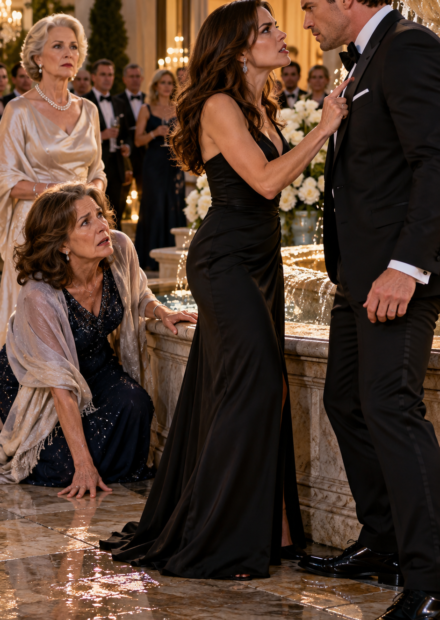
MY HUSBAND THREW MONEY AT MY FEET—THEN I USED ONE PHONE CALL TO FREEZE HIS EMPIRE
Chapter 1 – THE MONEY AT MY FEET
The first bill landed beside my shoe.
The second slid across the marble floor.
The third stopped beneath my daughter’s dangling pink sneaker.
Grant smiled.
That smile was what I remembered afterward.
Not the money.
Not the people staring.
Not even the blonde woman holding my husband’s hand as if my marriage had already become something old and embarrassing that everyone was supposed to pretend not to notice.
It was Grant’s smile.
Small. Satisfied. Cruel.
The smile of a man who believed he had finally taught his wife her place.
“Go home, Mara,” he said. “Figure out your own lunch.”
Our three-year-old daughter, Ellie, slept against my shoulder.
Her cheek was warm against my neck, her little fist tangled in the collar of my coat. She had fallen asleep in the car after asking me three times whether Daddy would eat pancakes with her.
I hadn’t known how to answer.
Now I did.
Grant Mercer stood ten feet away from us in the lobby of the Halston Grand, one of the most expensive hotels in Manhattan, wearing the navy suit I had bought him for our anniversary.
Beside him was Celeste Arden.
I knew her name because she had appeared often enough in Grant’s conversations over the past six months.
Celeste said this.
Celeste arranged that.
Celeste understood the hospitality market.
Celeste had connections.
Celeste was brilliant.
Apparently Celeste also slept with married men.
She was younger than me, though not by much. Beautiful in the deliberate, expensive way of women who never seemed to have a hair out of place. Her pale coat probably cost more than the car Grant had driven when we first met.
Her fingers were intertwined with his.
My husband didn’t even bother letting go.
I looked down at the cash scattered around my feet.
Two hundred and sixty dollars.
I knew because Grant had counted it before throwing it.
“Grant,” I said quietly, “Ellie is here.”
His jaw tightened.
“She’s asleep.”
“That isn’t the point.”
Celeste gave a soft laugh.
It wasn’t loud.
That somehow made it worse.
Grant glanced at her, and I saw the little spark between them—the private amusement of two people united against a third.
Against me.
“You came here uninvited,” he said.
“I came because you told me you were in Boston.”
“I had meetings.”
“With her?”
Celeste finally spoke.
“You’re making a scene.”
I looked at her.
She wore no wedding ring.
Grant still wore his.
“You’re holding my husband’s hand in a hotel lobby,” I said. “I don’t think the scene belongs to me.”
Her smile disappeared.
Grant stepped forward.
“Enough.”
I almost laughed.
Enough.
For nine years, that word had belonged to him.
Enough questions.
Enough worrying.
Enough asking about company finances.
Enough wanting to know why he came home after midnight.
Enough asking why his assistant suddenly stopped copying me on invitations.
Enough wondering why Grant had transferred our household accounts into structures I couldn’t access.
Enough objecting when he dismissed the nanny I trusted and replaced her with one chosen by his attorney’s wife.
Enough asking why Ellie’s preschool suddenly wanted copies of documents I had already provided.
Enough.
I had spent months wondering whether I was becoming paranoid.
Then that morning I had found Grant’s hotel reservation.
One room.
Two guests.
And now I was standing in front of the answer.
Grant looked at the money.
“Take it.”
I stared at him.
“For what?”
“You said you needed money.”
“I said my card was declined buying Ellie lunch.”
“That sounds like needing money.”
Celeste looked away, but I saw the corner of her mouth lift.
Something inside me became very still.
My personal credit card had been declined forty minutes earlier.
Then the joint card.
Then the emergency card Grant had insisted I keep.
I had called him because I thought there had been a banking error.
He told me he was at the Halston.
So I came.
Now I understood.
He had wanted me to.
Maybe not consciously.
Maybe some part of him simply wanted me to see what he had become powerful enough to do.
I crouched carefully, keeping one arm around Ellie.
Then I picked up the first bill.
Celeste laughed again.
Grant smiled.
There it was.
The moment he had wanted.
Mara Kingsley Mercer on her knees.
The wife he believed had nowhere else to go.
I picked up the second bill.
Then the third.
I gathered every one.
When I stood, Grant’s expression was almost tender with contempt.
“See?” he said. “That wasn’t difficult.”
“No,” I said.
It wasn’t.
I folded the bills once.
Then I walked to the marble reception desk and placed them in the glass charity box supporting the hotel employees’ emergency fund.
Grant’s smile weakened.
I turned back.
“You’re right,” I said. “That wasn’t difficult.”
His eyes narrowed.
“Mara.”
I shifted Ellie higher on my shoulder and opened my handbag.
Celeste was still amused.
Until she saw the phone.
It was black, thick, deliberately old-fashioned, and almost ugly compared with the smartphones around us.
But on the back, pressed into the casing in gold, was a falcon with its wings spread over a crown.
The Kingsley crest.
Celeste stopped laughing.
Grant’s face changed.
Not dramatically.
That was what frightened me.
He simply went pale.
He took one step toward me.
“Mara.”
For the first time that afternoon, there was no contempt in his voice.
There was fear.
I had not used that phone in four years.
My grandfather had given it to me after Ellie was born.
“For the day you cannot trust the ordinary channels,” he had said.
I had rolled my eyes.
Grandfather had been born into a world where wealthy families treated telephones like weapons and family offices like governments.
I had spent most of my adult life running from that world.
I married Grant partly because he seemed different from it.
He had been ambitious but warm. Poor by Kingsley standards, though hardly poor in reality. He had built a boutique logistics firm from a rented office and six employees.
I admired that.
When my grandfather offered to fund him, Grant refused.
At first.
Later, when expansion came, the Kingsley family office provided guarantees.
Then credit.
Then access.
Then introductions.
Grant called it independence.
But empires built on someone else’s foundation are rarely as independent as their owners imagine.
“Mara,” Grant repeated. “Don’t.”
Celeste looked from him to me.
“What is that?”
I pressed the activation key.
The satellite indicator blinked.
“Something my husband hoped I had forgotten.”
Grant crossed the space between us.
I stepped backward.
“Don’t touch me.”
People were watching now.
He stopped.
I entered a six-digit code.
The call connected immediately.
A man answered.
“Kingsley secure desk.”
“This is Mara Kingsley Mercer. Falcon Seven.”
A pause.
Then his voice changed.
“Identity confirmation.”
I gave the phrase my grandfather had made me memorize.
“Authority requested?”
Grant whispered, “Mara, think.”
I looked at him.
“I have been thinking for six months.”
Then I spoke into the phone.
“Activate spousal protection protocol on Mercer-controlled entities covered by Kingsley guarantees. Freeze discretionary accounts. Suspend derivative credit access. Cancel Grant Mercer’s authority over Kingsley-backed facilities pending review.”
Grant lunged forward.
“Jesus Christ, Mara!”
Two hotel security guards moved instantly.
He stopped again.
I continued.
“Flag all recent family-related transfers. Preserve records. No deletions, no amendments, no document destruction.”
The man on the phone said, “Confirmed.”
Grant stared at me.
“You have no idea what you’ve just done.”
“I think I do.”
“No, you don’t.”
His phone vibrated.
Then vibrated again.
Then again.
Celeste’s phone began ringing.
She looked at the screen.
The color drained from her face.
“What happened?”
Grant ignored her.
His own phone lit continuously.
BANK AUTHORIZATION SUSPENDED.
CREDIT FACILITY UNDER REVIEW.
EXECUTIVE ACCESS TEMPORARILY RESTRICTED.
TRANSACTION REJECTED.
BOARD COUNSEL REQUESTING IMMEDIATE CONTACT.
I didn’t see every message.
I didn’t need to.
I watched Grant’s expression.
That was enough.
The man who had thrown money at my feet twenty seconds earlier suddenly looked as if the floor had disappeared beneath his.
“Mara,” he said, lowering his voice, “we need to discuss this privately.”
“No.”
“You’re angry.”
“Yes.”
“You’re emotional.”
“Yes.”
“This affects hundreds of employees.”
That almost impressed me.
Not the argument.
The speed.
Grant had always been brilliant under pressure.
In less than thirty seconds, he had gone from mocking me to positioning himself as protector of innocent employees.
“I didn’t freeze payroll,” I said.
His face changed again.
He hadn’t expected me to know that.
I did.
The Kingsley guarantees had conditions. Protective suspension isolated executive discretionary authority without stopping ordinary operations.
The company could continue.
Grant simply couldn’t move large amounts of money.
Or hide them.
Celeste pulled at his arm.
“Grant, what does she mean by Kingsley-backed facilities?”
He turned on her.
“Not now.”
“But you told me—”
“Not now, Celeste.”
Interesting.
You told me.
I filed those words away.
Then my satellite phone vibrated.
Not the call line.
The secure data channel.
I looked down.
**RESTRICTED FAMILY FILE ACCESS GRANTED.**
That made no sense.
I hadn’t requested a file.
A second message appeared.
**PROTECTIVE REVIEW TRIGGERED BY CONFLICT MATCH.**
My heartbeat slowed.
“Sir?” I said into the phone. “Why am I receiving restricted records?”
The operator hesitated.
“That access was automatically released under Falcon Seven protection because one or more named parties in an active confidential matter matched your suspension request.”
“Which matter?”
“I’m not authorized to summarize it. You now have access.”
I ended the call.
Grant was watching the phone.
Not me.
The phone.
And for the first time, I knew something worse than adultery was happening.
I opened the file.
Three names appeared.
**GRANT MERCER.**
My fingers went cold.
**CELESTE ARDEN.**
I looked at her.
She was staring at Grant.
Then I read the third name.
**ELLIE MERCER.**
The hotel lobby seemed to tilt.
My daughter shifted in my arms.
“Mama?”
Her sleepy voice almost broke me.
I kissed her hair.
“I’m here, baby.”
Grant moved toward us.
I backed away.
“What is this?”
“Mara—”
“Why is Ellie’s name in a restricted Kingsley file with you and your mistress?”
Celeste’s head snapped toward him.
“Grant?”
He said nothing.
I opened the next document.
At first I saw legal headings.
Petition preparation.
Residential history.
Primary caregiver assessment.
Emergency custody considerations.
My eyes moved faster.
Then stopped.
There was a date.
Eight months earlier.
Eight months.
Grant’s affair might have begun recently.
But this had not.
I opened another page.
It contained notes about me.
My schedule.
My medications after Ellie’s birth.
Instances when I had left Ellie with a nanny.
A charity dinner where I drank two glasses of wine.
A weekend when I had gone to my mother’s estate after an argument with Grant.
A sentence was highlighted:
**Objective: establish pattern supporting paternal petition for primary physical custody should marital separation occur.**
My knees almost gave way.
I looked at Grant.
“You were planning to take her.”
His lips parted.
“Mara, listen to me.”
“You were planning to take my daughter.”
“Our daughter.”
The correction was automatic.
Cold.
Legal.
Prepared.
I looked at Celeste.
She wasn’t smiling anymore.
“How long have you known?”
Her eyes flicked toward Grant.
That was answer enough.
I pressed Ellie closer.
Grant took another step.
“Mara, put the phone away and come upstairs. We can talk.”
Upstairs.
To the room he had booked with Celeste.
Something inside me finally understood the scale of my mistake.
I had walked into the hotel believing I had discovered my husband’s affair.
But the affair wasn’t the plan.
It was only one part of it.
I looked back at the document.
At the date.
At the language.
At the careful record of my weakest moments.
Then another file unlocked.
This one contained a draft affidavit.
At the bottom was a blank signature line beneath my husband’s name.
Above it was a paragraph describing me as unstable, financially irresponsible, emotionally volatile, and increasingly incapable of providing a secure environment for our daughter.
My hands shook.
Not because it was true.
Because I suddenly remembered every moment Grant had spent the last eight months trying to make it look true.
Every argument he had provoked.
Every card he had canceled.
Every time he had disappeared and then accused me of overreacting when I demanded answers.
Every time he had watched me cry.
He hadn’t merely been hurting me.
He had been documenting me.
I raised my eyes to my husband.
And Grant knew from my face that I finally understood.
His phone kept ringing.
He didn’t answer it.
Neither did Celeste.
The hotel lobby had gone strangely quiet around us.
Grant swallowed.
“Mara,” he said. “Give me Ellie.”
I held my daughter tighter.
“No.”
His expression hardened.
Then he said the sentence that turned my fear into something colder.
Something useful.
“You’re only making the file stronger.”
And suddenly I knew the war had already begun.
—