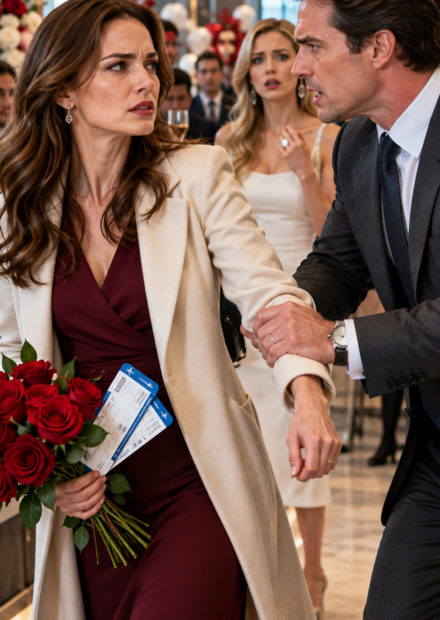
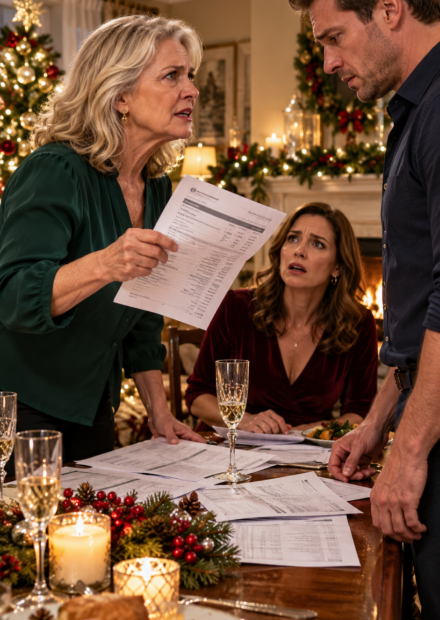
My Mother-in-Law Slapped Me on Christmas Eve. My Husband Blamed Me—Then the Doorbell Rang.
Chapter 1 – The Slap
My mother-in-law slapped me across the face on Christmas Eve, and my husband sat six feet away without moving.
The slap hurt.
But hearing Daniel say, “Sarah… you shouldn’t have pushed her,” while our four-year-old daughter cried beside me hurt worse than anything Linda could have done.
I had not pushed Linda.
Daniel knew it.
Everyone at that table knew it.
And in the few seconds after my husband chose his mother’s lie over what he had seen with his own eyes, something inside me went completely still.
I pulled off my wedding ring.
Daniel’s expression changed the moment he saw what I was doing.
“Sarah.”
I threw the ring across the dinner table.
It struck him in the chest, bounced once against his plate, and landed in a smear of gravy beside his untouched potatoes.
“You can stay married to your mother,” I said.
Our daughter, Emma, was crying so hard she could barely breathe.
Linda Harrington stood beside me with one hand still half-raised, as if even she had not expected me to react that way. A red wine stain spread across the white tablecloth where someone had knocked over a glass. Hot soup soaked the front of my sweater, and the skin beneath it burned.
Nobody moved.
Then Linda folded her arms.
“You’re being hysterical.”
That word almost made me laugh.
Three years of marriage had taught me that Linda had a vocabulary for women who refused to obey her.
Sensitive.
Dramatic.
Ungrateful.
Classless.
Hysterical.
She had called me all of them.
Daniel usually translated afterward.
“She didn’t mean it that way.”
“You know how Mom talks.”
“She grew up differently.”
“Can we please not turn this into a whole thing?”
Somehow, Linda was always allowed to say exactly what she wanted, while I was expected to become smaller so everyone else could remain comfortable.
Not that night.
I reached for my phone.
Linda gave a dismissive little laugh.
“Who are you calling? The police because somebody hurt your feelings?”
I tapped my father’s name.
Daniel jumped out of his chair.
“Sarah, don’t.”
It was the first time all evening I heard real fear in my husband’s voice.
Not when his mother insulted me.
Not when she grabbed my wrist.
Not when she struck me.
Not when hot soup poured across my chest.
But the second he saw my father’s name on my phone, Daniel was afraid.
That should have told me everything.
My father answered on the second ring.
“Merry Christmas, sweetheart.”
His voice was cheerful.
For half a second, I nearly broke.
“Dad.”
Silence.
Parents know.
It does not matter whether you are seven years old or thirty-seven. Sometimes they hear one syllable and know something is wrong.
“What happened?”
I looked at Daniel.
He shook his head.
I said, “You told me to call you if Daniel’s family ever crossed the line.”
The entire dining room went silent.
My father paused.
Then his voice changed.
“Are you still inside the Harrington house?”
“Yes.”
“Is Emma with you?”
“Yes.”
“Is she safe?”
“She’s scared, but nobody touched her.”
Another pause.
“Did somebody touch you?”
I swallowed.
Daniel whispered, “Sarah, please.”
I looked straight at him.
“Yes.”
“What happened?”
“Linda grabbed my wrist when I tried to leave. I pulled away. Then she slapped me.”
Linda made an irritated sound.
“Oh, for God’s sake.”
“And the soup spilled on me. It’s burning.”
My father did not shout.
That frightened Daniel more than shouting would have.
“Put me on speaker.”
Daniel stepped toward me.
“Don’t.”
I pressed the button.
“Dad, you’re on speaker.”
My father’s voice filled the room.
“Linda?”
She stared at the phone.
Richard, Daniel’s father, cleared his throat.
“Linda.”
“What?” she snapped.
My father asked, “Did you put your hands on my daughter?”
Linda rolled her eyes.
“She was creating a scene.”
“That wasn’t my question.”
“She was trying to storm out of Christmas dinner.”
“Did you grab her?”
Linda’s mouth tightened.
“She was disrespecting me in my own house.”
“Did you grab her?”
“Yes, I took her wrist.”
“And did you hit her?”
“She pulled away aggressively.”
“Did you hit her?”
Linda finally snapped.
“Oh, this is ridiculous.”
My father’s voice remained almost unnaturally calm.
“Sarah.”
“Yes?”
“Take Emma upstairs. Get her coat and anything you need. Photograph your face, your wrist, and the burn. Do not argue with anybody. Then leave.”
Daniel looked sick.
Dad continued.
“If anyone in that house blocks the door, takes your phone, prevents you from leaving, or tries to separate you from Emma, tell me immediately.”
Linda laughed.
“You don’t give orders in my house.”
My father ignored her.
“Sarah, did you hear me?”
“Yes.”
“Go.”
I took Emma’s hand.
She practically climbed into my arms.
Daniel moved around the table.
“Sarah, wait. Let me talk to you.”
“No.”
“Please.”
“Not now.”
Linda said, “Daniel, let her go. She’ll calm down once she stops performing.”
I turned toward her.
For the first time since I had met that woman, I did not feel intimidated.
I felt finished.
“You slapped me in front of my daughter.”
“You provoked me.”
“And your son lied for you.”
Daniel flinched.
“Sarah—”
“I’m finished talking.”
I carried Emma upstairs.
The moment we reached the guest room, I locked the door.
Emma wrapped both arms around my neck.
“Mommy, is Grandma mad at us?”
That question nearly destroyed me.
“No, sweetheart.”
“Why did she hit you?”
I did not know how to explain adults like Linda to a four-year-old.
So I told Emma the simplest truth.
“Grandma did something she was not allowed to do.”
“Because you were leaving?”
“Yes.”
“Are we still leaving?”
I kissed her forehead.
“Yes.”
Her shoulders relaxed.
That was when I realized my four-year-old daughter had been waiting for me to make us safe.
I set her on the bed and went into the bathroom.
The mirror shocked me.
A red handprint was visible along my cheek.
My wrist already showed four distinct marks where Linda’s fingers had closed around it.
When I carefully lifted my sweater, the skin below my collarbone was bright red. A small blister was beginning to rise.
I photographed everything.
Cheek.
Wrist.
Burn.
Then I photographed the soup-soaked sweater.
Three years earlier, I would have thought taking pictures was dramatic.
That night, I understood something my father had been trying to teach me for months.
Documentation was not drama.
It was protection against people who rewrote events afterward.
Someone knocked.
“Sarah?”
Daniel.
I said nothing.
“Please open the door.”
Emma looked toward me.
I shook my head.
“Sarah, please. Just me.”
“No.”
“I need to explain.”
I almost laughed.
“Explain what?”
“I didn’t see exactly what happened.”
“You were six feet away.”
“It happened fast.”
“You accused me of pushing your mother.”
“I thought—”
“You thought what?”
Silence.
Then he said, “I was trying to calm everything down.”
That sentence opened something in me.
I walked to the door but did not unlock it.
“No, Daniel. You weren’t trying to calm anything down. You were trying to calm me down because you knew I was the only person at that table who might listen to you.”
“That’s not fair.”
“Your mother slapped your wife in front of your daughter.”
“I know.”
“And your first response was to blame your wife.”
“I panicked.”
“Why?”
Silence again.
“Because you knew she was wrong?”
“Yes.”
“Because you knew I might leave?”
“Sarah—”
“Or because you knew if I called my father, he wouldn’t help you convince me that this was normal?”
He did not answer.
Months earlier, my father had taken Daniel aside after Linda humiliated me at Emma’s preschool fundraiser.
Linda had criticized my parents loudly enough for other families to hear, then told me I should be grateful the Harringtons had “accepted someone without their connections.”
I cried in the parking lot.
Daniel asked me to forget it.
My father happened to see me before we left.
He did not confront Linda.
Instead, he spoke privately to Daniel.
I only learned what he said later.
Keeping peace and demanding surrender are not the same thing.
And if anyone in your family ever physically hurts my daughter or granddaughter, Sarah will never need your permission to leave.
Daniel had called my father dramatic.
Standing behind that locked guest-room door, I finally understood why the conversation had bothered him so much.
Dad had seen something I had not wanted to see.
Daniel’s definition of peace required my cooperation.
Without my surrender, the system stopped working.
“Sarah,” Daniel said softly. “Please don’t end our marriage over one horrible night.”
I closed my eyes.
“Our marriage didn’t get here because of one night.”
Then the doorbell rang downstairs.
Once.
Twice.
A few seconds later, I heard voices.
Richard said something I could not understand.
Then his footsteps came toward the stairs.
“Daniel?”
My husband stopped talking.
Richard’s voice sounded different.
“Daniel, there are police officers here.”
Emma looked at me.
Daniel whispered through the door.
“Did your father call them?”
I looked at the photographs on my phone.
For the first time that night, I realized I did not care who had called.
Because someone had finally treated what happened to me as something more serious than a family disagreement.
And downstairs, Linda Harrington was about to discover that saying, “That’s just how I am,” did not erase what she had done.
—