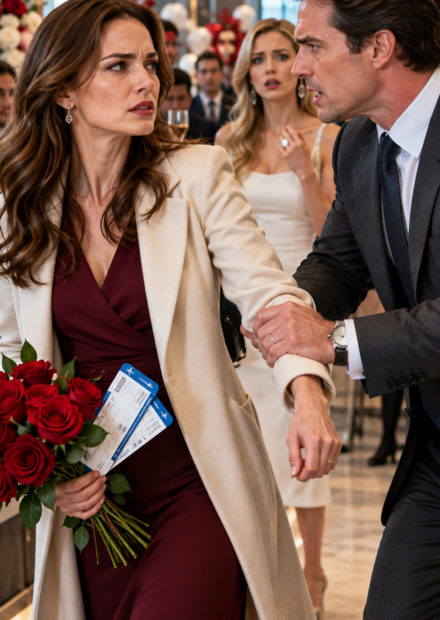
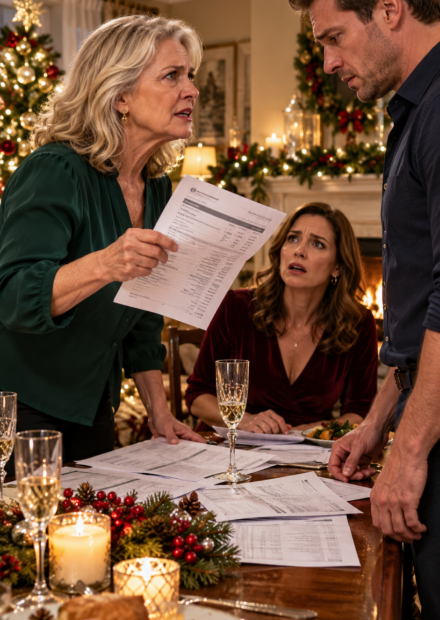
Chapter 1 – THE TEST SHE THOUGHT WOULD DESTROY ME
My mother-in-law demanded a DNA test to prove my six-month-old son wasn’t part of her family.
Three weeks later, Margaret sat across from me in a private consultation room at St. Catherine’s Medical Center, smiling as the doctor opened the envelope.
She thought she was about to destroy my marriage.
Instead, the doctor looked at my husband and said, “Daniel, the probability that you are Noah’s biological father is greater than 99.99 percent.”
Margaret’s smile disappeared for half a second.
Then it came back.
“Well,” she said, almost laughing. “There. At least that ugliness is finished.”
But Dr. Rebecca Collins didn’t close the folder.
She turned another page.
“There’s something else.”
I remember the exact way Margaret’s fingers tightened around the pearl handle of her handbag.
Dr. Collins looked at her.
“The extended kinship analysis confirms that Noah is biologically related to you as well.”
Margaret relaxed.
“Of course he is. Daniel is my son.”
“That,” Dr. Collins said carefully, “is the problem.”
The room went silent.
Daniel leaned forward.
“What problem?”
Dr. Collins placed the report flat on the table.
“The pattern of inheritance is not consistent with the family relationship we were given.”
Margaret went white.
Not pale.
White.
And that was when I understood something I should have noticed much earlier.
My mother-in-law had never truly been afraid that Noah wasn’t Daniel’s son.
She had been afraid of what proving he was Daniel’s son might uncover.
Six weeks earlier, I had still believed Margaret Whitmore simply hated me.
That explanation had been painful, but at least it was simple.
I had married Daniel four years earlier after meeting him at a fundraising dinner in Boston. He was thirty at the time, quiet in a room full of people trying desperately to be noticed.
Margaret was the opposite.
She entered rooms as if she owned the oxygen.
The Whitmores weren’t billionaires, celebrities, or political royalty. But they had old money, an investment company founded by Daniel’s grandfather, a large house outside Boston, and the kind of family history Margaret treated like a sacred document.
Daniel was her only child.
At least that was what everyone believed.
From the beginning, Margaret made it clear that I wasn’t what she had imagined for him.
I was raised by a single mother in Worcester. I went to public school, worked through college, became a pediatric physical therapist, and had no family trust waiting for me.
Margaret never openly called me unsuitable.
She was too polished for that.
Instead, she asked questions.
Had anyone in my family ever declared bankruptcy?
Why had my father “disappeared”?
Was my mother’s maiden name really Alvarez?
Had I considered keeping my own surname after marriage?
When Daniel proposed, Margaret stared at my ring and said, “How modern.”
When we married, she wore cream.
When I became pregnant, she suddenly became intensely interested in dates.
“What day did you say the doctor estimated conception?”
I laughed the first time.
“Margaret, I’m not sure that’s dinner conversation.”
She didn’t laugh.
Daniel squeezed my hand beneath the table.
“Mom.”
“I’m simply interested.”
Noah was born healthy after thirty-eight weeks.
Daniel cried harder than I did.
I still remember watching him hold our son against his chest in the hospital room.
Noah’s tiny fingers curled around Daniel’s thumb, and Daniel whispered, “I’ve got you, buddy.”
Margaret arrived four hours later.
She stood beside the bassinet for a long time.
Too long.
Then she said something strange.
“He doesn’t look like you.”
Daniel smiled.
“He’s four hours old.”
“I know.”
She touched Noah’s cheek.
Then she pulled her hand away almost immediately.
For the next six months, the comments became sharper.
Noah’s eyes were too dark.
His hair was too thick.
His chin looked nothing like Daniel’s.
Then one Sunday afternoon, Margaret came to our house carrying a silver rattle that had supposedly belonged to Daniel.
She spent ten minutes watching Noah on the living-room rug.
Finally, she said, “Daniel never had ears like that.”
I put down my coffee.
“Excuse me?”
“His ears.”
“I heard you.”
Daniel walked in from the kitchen.
“What’s going on?”
Margaret turned toward him.
“I think you should have a DNA test.”
For several seconds, Daniel didn’t respond.
I thought perhaps he hadn’t understood.
Then his face hardened.
“Leave.”
Margaret blinked.
“Daniel—”
“Get out of my house.”
She stood.
“You’re being emotional.”
“You just accused my wife of cheating on me.”
“I’m trying to protect you.”
“From my six-month-old son?”
“From making a mistake you’ll regret for the rest of your life.”
I wish I could say I threw her out myself.
I didn’t.
I stood beside Noah’s play mat shaking so badly I had to press my palms against my legs.
Margaret picked up her purse.
At the doorway, she looked directly at me.
“If there’s nothing to hide, Claire, then there’s nothing to fear.”
That sentence stayed with me.
Not because I doubted myself.
Because of the way she said it.
There was no uncertainty in her voice.
Margaret wasn’t asking a question.
She seemed to believe she already knew the answer.
That night Daniel apologized to me at least ten times.
“You don’t need to apologize for her.”
“I should have stopped this months ago.”
“You did stop it.”
“No. I kept telling myself she’d adjust.”
He looked toward Noah sleeping in the bassinet beside our bed.
“I’m done.”
But Margaret wasn’t.
Two days later, Daniel received an email from Whitmore Family Holdings’ attorney.
His grandfather’s trust contained a clause requiring verified biological lineage before certain assets could transfer to a descendant.
Margaret had never mentioned it before.
Now, suddenly, she claimed Noah’s future inheritance required documentation.
Daniel called the attorney personally.
The clause existed.
But it had almost never been used.
The attorney sounded embarrassed.
“Your mother requested formal verification.”
Daniel hung up and stared at his phone.
“She’s forcing it.”
I knew what he meant.
Margaret had transformed a cruel accusation into a legal procedure.
I should have refused.
Instead, I surprised both of us.
“Do the test.”
Daniel looked at me.
“Claire.”
“Do it.”
“I know he’s mine.”
“So do I.”
“Then why give her what she wants?”
“Because after this, she never gets to say it again.”
That was the reason I told myself.
But there was another reason.
I wanted to see Margaret’s face when the results came back.
I wanted to watch certainty collapse.
I had no idea the certainty that would collapse was ours.
Because when Dr. Collins turned that second page in the consultation room three weeks later, she wasn’t looking at me anymore.
She was looking at Margaret.
Daniel asked again, “What exactly is wrong?”
Dr. Collins hesitated.
“The testing was expanded because your mother submitted her own sample as the paternal grandparent reference.”
Margaret interrupted.
“That was required.”
“It wasn’t required, Mrs. Whitmore. It was requested.”
Margaret’s mouth tightened.
Dr. Collins continued.
“Noah’s DNA confirms Daniel is his father. Noah’s DNA also confirms a close biological relationship to you.”
“Then everything is correct.”
“No.”
The doctor turned the report toward us.
“There are genetic markers in Daniel and Noah that strongly suggest the family structure we were given is incomplete.”
I stared at rows of numbers I couldn’t understand.
Daniel apparently couldn’t either.
“What does that mean?”
Dr. Collins folded her hands.
“It means I would recommend additional testing before making any conclusions.”
Margaret stood.
“No.”
All three of us looked at her.
It was the first time I had ever heard genuine panic in her voice.
“We’re finished.”
Daniel frowned.
“Mom.”
“You got what you wanted. The child is yours.”
“The child has a name.”
Margaret grabbed her purse.
“We are not turning this into some medical circus.”
Dr. Collins remained calm.
“Mrs. Whitmore, nobody is suggesting—”
“I said we’re finished.”
Daniel stood too.
“Sit down.”
Margaret froze.
I had never heard him speak to her like that.
He looked at the report.
“You spent six months accusing my wife of cheating. You forced us into this room. You involved the family trust. Now the second the doctor says something unexpected, you want to run?”
Margaret looked at him.
For one brief moment, she didn’t look controlling.
She looked terrified.
“Daniel, please.”
Please.
That word frightened me more than everything else.
Margaret Whitmore did not say please.
Daniel saw it too.
“What are you afraid they’re going to find?”
“Nothing.”
“Then sit down.”
“I am your mother.”
“I know.”
Her eyes flickered.
It was tiny.
But I saw it.
And so did Dr. Collins.
Daniel slowly repeated himself.
“I know you’re my mother.”
Margaret picked up her handbag.
“You don’t know what you’re doing.”
Then she walked out.
Daniel started after her.
Dr. Collins stopped him with one sentence.
“Mr. Whitmore, there is another reason I asked you to come in person.”
He turned.
She opened a second folder.
Inside was a photocopy of an old hospital record.
The paper was yellowed around the edges.
At the top were the words:
ST. CATHERINE’S MATERNITY WARD.
June 14, 1992.
Daniel’s birthday.
My husband stared at it.
“What is that?”
Dr. Collins looked uncomfortable.
“When the laboratory found the unexpected kinship pattern, our genetic counselor reviewed the medical history your mother submitted.”
Daniel looked down.
Near the bottom of the form was Margaret’s name.
MARGARET WHITMORE.
Then another name.
EVELYN WHITMORE.
Daniel whispered, “Who’s Evelyn?”
I didn’t know.
But I remembered something.
A photograph.
Three months earlier, while helping Margaret clear an upstairs closet after a pipe leak, I had found a small envelope behind a stack of old Christmas cards.
Inside was a hospital photograph.
Margaret was much younger.
She stood beside a newborn bassinet.
At the time, I assumed the baby was Daniel.
But now I remembered something I hadn’t understood.
There had been another crib behind her.
Only half visible.
And someone had scratched a dark line through it with a pen.
I looked at Daniel.
“I’ve seen this hospital before.”
He turned to me.
“What?”
“In a picture at your mother’s house.”
Dr. Collins became very still.
“What picture?”
“A maternity photo.”
Daniel frowned.
“Mom doesn’t have maternity photos.”
“Yes, she does.”
“No. She told me there weren’t any. She said the hospital photographer was sick the week I was born.”
My skin went cold.
Dr. Collins slowly closed the folder.
“Then I think you need to find that photograph.”
Daniel stared at me.
And suddenly I knew exactly where we had to go.
Back to Margaret’s house.
Back to the closet.
Back to the photograph with two cribs.
Because for thirty-four years, everyone had been looking at the baby in front.
No one had asked who had been sleeping in the crib behind him.
—