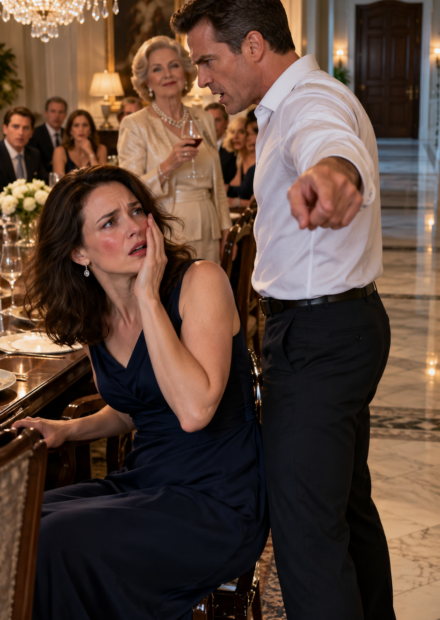
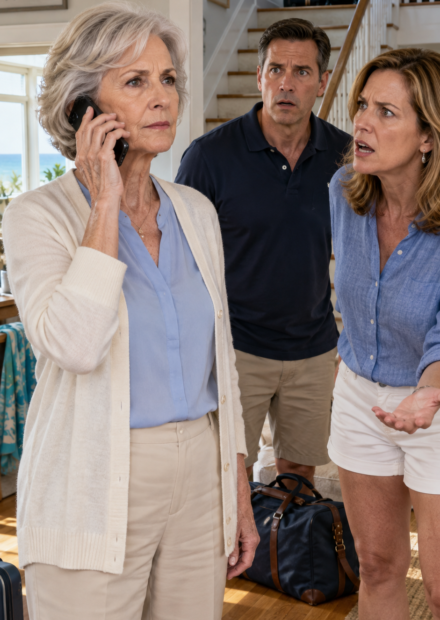
THERE WAS NO ROOM FOR ME IN MY OWN BEACH HOUSE. THEN I LEARNED WHAT MY SON HAD SIGNED.
Chapter 1 – THERE WAS NO ROOM FOR ME
“There’s really no room for her.”
My daughter-in-law said it while standing in my kitchen.
In my house.
With my dead husband’s coffee mug in someone else’s hand.
For several seconds, I simply stood there with my overnight bag hanging from my fingers, wondering whether I had misunderstood her.
At seventy years old, I had learned that shock was rarely dramatic when it first arrived.
There was no scream.
No shattered glass.
No cinematic rush of anger.
Sometimes shock was simply standing in your own doorway while twenty-one people carried on around you as though you were the unexpected guest.
I had come back to the cottage a day early.
That was my mistake, according to my son.
I didn’t know that yet.
At that moment, all I knew was that there were six cars squeezed into the gravel drive, another vehicle half on the grass, and two bicycles leaning against the hydrangeas Henry had planted twenty-eight years earlier.
The front door had been unlocked.
I could hear children before I even stepped inside.
They were running upstairs, laughing and shouting. Somewhere toward the back of the house, music was playing through a speaker. The smell of bacon, sunscreen, damp towels, and coffee filled the hallway.
For one strange second, I thought I had walked into the wrong cottage.
Then I saw Henry’s old sea chest beneath the stairs.
Someone had stacked three suitcases against it.
I walked farther inside.
A little girl I didn’t recognize nearly collided with me.
“Sorry!”
She darted around me and disappeared toward the kitchen.
I followed.
That was where I found Megan.
My daughter-in-law was standing beside the island in white shorts and a blue linen shirt, pouring orange juice into plastic cups.
My son Robert stood near the sink.
Neither of them looked pleased to see me.
That was the first thing I noticed.
Not surprise.
Not happiness.
Not even embarrassment.
Annoyance.
A young man I had never met was standing near the coffee machine, holding Henry’s chipped navy mug.
Henry had used that mug almost every morning for thirty-six years.
The handle had been glued twice.
I had offered to throw it away after the second repair.
Henry had looked at me as though I had suggested throwing away one of his kidneys.
“It still holds coffee, Evelyn.”
That was Henry’s philosophy about most things.
If something still served its purpose, you didn’t discard it merely because it had been damaged.
After he died, I couldn’t bring myself to use the mug.
But I kept it beside mine in the cupboard.
The young man noticed me staring.
“Oh.” He looked down at the mug. “I’m sorry. Is this yours?”
Before I could answer, Megan laughed.
“Everything here is basically family stuff.”
Basically.
Family.
Stuff.
Three words.
That was all it took.
The young man smiled uncertainly and lifted the mug slightly.
“I can use another one.”
I looked at him.
“It belonged to my husband.”
His expression changed immediately.
“Oh God. I’m sorry.”
He put it carefully beside the sink.
“You didn’t know,” I said.
And he hadn’t.
That mattered.
Then Megan said, “Mom, we weren’t expecting you until tomorrow.”
I looked at her.
She had called me Mom since she married Robert twenty-two years earlier.
Usually I liked it.
That afternoon, the word sounded oddly possessive.
Robert finally stepped forward.
“Why are you back early?”
Not hello.
Not good to see you.
Why are you back early?
“My appointment was canceled.”
“What appointment?”
“My dentist.”
“I thought that was tomorrow.”
“It was moved.”
Robert rubbed his forehead.
He was fifty-one years old, but for a moment he looked exactly as he had at sixteen whenever I caught him doing something he shouldn’t.
Except at sixteen, he had usually possessed the decency to look guilty.
Now he looked inconvenienced.
I glanced around.
There were paper plates on the counter. Grocery bags covered half the dining table. Wet footprints crossed the hardwood floor.
Someone had draped beach towels over the quilt hanging along the back of the sofa.
My quilt.
I had sewn it during the winter Henry had his first heart surgery.
On the side table beside the window stood our wedding photograph.
Or rather, half of it stood there.
A Bluetooth speaker had been placed partly on top of the frame.
I walked over and moved it.
Megan watched me.
“We’ve got kind of a full house,” she said.
“I can see that.”
“It’s just for the weekend.”
“Who are these people?”
The question seemed to offend her.
“My sister’s family is here. My parents. The Harrisons. You know Claire.”
I did know Claire, Megan’s college friend.
I did not know the Harrisons.
Robert spoke quickly.
“Some people are upstairs.”
“How many?”
He hesitated.
That hesitation frightened me more than the number eventually did.
“Fourteen adults.”
I waited.
“And seven kids,” Megan added.
Twenty-one.
Twenty-one people.
I looked toward the staircase.
“Where is everyone sleeping?”
Megan began counting on her fingers.
“The kids are doubled up. My parents have your room because your bed is easier for Dad’s back. Claire and Ben have the guest room. Amy and Josh are in Robert’s old room. The Harrisons brought an air mattress, and—”
“My room?”
She stopped.
“Yes.”
“You put someone in my bedroom?”
“We thought you were coming tomorrow.”
There it was again.
As though ownership of my home expired temporarily whenever I wasn’t expected.
I set my bag down.
“I’ll take the small bedroom.”
Megan and Robert exchanged a look.
I saw it.
Perhaps if I hadn’t, things would have unfolded differently.
But I saw it.
Megan lowered her voice.
“There’s really no room for her.”
She wasn’t speaking to me.
She was speaking to Robert.
About me.
In front of me.
My son stared at the counter.
Something inside me became very still.
For twenty years, I had made room.
I made room when Robert and Megan needed to stay with us while their kitchen was remodeled.
I made room when their children were small and babysitters canceled.
I made room every Thanksgiving when Megan’s parents decided at the last minute that they didn’t want to cook.
I made room at the cottage for friends of friends, visiting cousins, teenage sleepovers, birthday weekends, anniversary dinners, graduation parties.
Henry and I had always believed a house should be generous.
“Empty rooms don’t make memories,” he used to say.
So we opened them.
Again and again.
Somewhere along the way, apparently, my family had stopped understanding the difference between being welcomed and being entitled.
I looked at Robert.
“There was room for me before twenty-one people were invited.”
His head came up.
“Mom.”
“Yes?”
“Don’t do this.”
That hurt.
More than Megan’s words.
More than the towels on my quilt.
More than Henry’s mug.
Don’t do this.
I knew that sentence.
Our family had used different versions of it for years.
Don’t make Christmas awkward.
Don’t upset Megan.
Don’t embarrass Robert.
Don’t mention the money.
Don’t correct them in front of the children.
Don’t turn it into a thing.
What it always meant was this:
Please absorb the discomfort yourself so nobody else has to experience it.
I had become very good at that.
Henry had been better at refusing.
Perhaps that was why everyone had behaved differently when he was alive.
I looked at my son.
“Did you invite these people?”
“Yes.”
“Did you ask me?”
“We’ve been planning this for weeks.”
“That isn’t what I asked.”
His jaw tightened.
Megan crossed her arms.
“We thought it would be fine.”
“Why?”
“Because we’ve done family weekends here before.”
“When I knew about them.”
Robert sighed.
“Mom, you were supposed to come tomorrow.”
Still no apology.
I suddenly realized he genuinely believed that was the important fact.
I had disrupted their schedule.
“How did you get inside?”
Silence.
“Robert?”
“The lockbox.”
I stared at him.
The cottage had a small lockbox attached behind the outdoor shower. Years earlier, after Henry’s heart problems became worse, I had given Robert the code.
For emergencies.
Later, I allowed him to use it when he had permission to come down without us.
I had never changed it.
Why would I?
He was my son.
“Who gave everyone permission to use the house?”
“Come on.”
“Who?”
Robert looked away.
Megan answered.
“We did.”
“And what exactly did you tell them?”
Her expression hardened.
“That it was the family beach house.”
I nodded slowly.
“The family beach house.”
“Yes.”
“No, Megan.”
I heard how calm my own voice sounded.
That seemed to unsettle her more than anger would have.
“It is my beach house. Family is invited.”
She gave a short laugh.
“Oh, for heaven’s sake. Nobody is trying to steal your house.”
Three weeks earlier, I might have believed her.
But three weeks earlier, I had been standing outside this same cottage after dinner.
The kitchen window had been open.
Megan hadn’t known I was there.
I had gone around the side of the house to clip a few hydrangeas.
I heard her voice.
“When it’s ours, the first thing going is that ugly little sunroom.”
Then Robert had said something too softly for me to hear.
Megan laughed.
“I’m serious. Tear the whole thing off. Open the kitchen to the water. The property would be worth twice as much.”
I had stood outside holding three blue hydrangeas.
When it’s ours.
Not if.
Not someday.
When.
I had never told them I heard.
The next morning, I drove home and called my attorney.
His name was Daniel Mercer.
He had handled our estate planning for almost fifteen years.
Henry trusted him.
So did I.
Three weeks ago, I sat across from Daniel and told him I wanted to change what happened to the cottage after my death.
Under our old plan, Robert was eventually supposed to receive it.
Henry and I had thought that was natural.
He was our only son.
He loved the ocean.
He had learned to swim off this beach.
We imagined his children bringing their own children someday.
But after Henry died, Robert’s questions about the cottage changed.
At first they sounded responsible.
How old is the roof?
What are the taxes now?
Did Dad ever replace the septic line?
Then:
Have you had it appraised recently?
Do you know what places on this road are selling for?
Would you ever consider renting it in July?
Megan had begun talking about renovations.
Rental income.
Resale value.
Removing the sunroom.
The room Henry built with his own hands.
I did not disinherit Robert.
I never wanted that.
I simply changed the plan.
After my death, unless I chose otherwise while I was alive, the cottage would be sold.
Education trusts would be created for my grandchildren.
A portion of the proceeds would fund a vocational scholarship in Henry’s name.
Robert would still receive a meaningful share of my estate, but through a trust.
Not a deed.
Daniel had also prepared a separate document revoking Robert’s unrestricted access to the cottage.
I had not signed it.
Not yet.
I had told Daniel I needed time.
Some foolish part of me hoped I was overreacting.
Then I came home early.
And my daughter-in-law told my son there was no room for me.
I reached into my purse.
Robert noticed.
“Who are you calling?”
I found Daniel’s number.
Megan gave a nervous little laugh.
“Are you calling a hotel?”
I looked at her.
“No.”
Daniel answered on the fourth ring.
“Evelyn?”
“Daniel.”
Something in my voice must have warned him.
“What happened?”
I looked at Robert.
Then Megan.
“Send the letter.”
Robert went pale.
And that was the moment I knew he understood exactly which letter I meant.
—