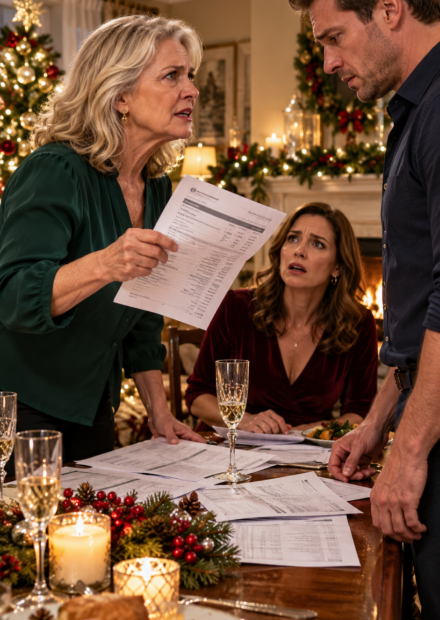
Chapter 3 – THE PRICE OF ALWAYS SAYING YES
Kevin cried.
That was the part I hadn’t prepared for.
Anger, yes.
Denial, yes.
Excuses, certainly.
But my forty-six-year-old son sat at the kitchen table where he had eaten pancakes as a child and cried into both hands.
“I was going to put it back.”
Rebecca stared at him.
“You took money from her?”
Kevin didn’t answer.
I did.
“Nine thousand seven hundred forty dollars.”
Rebecca looked genuinely shocked.
“You told me she was helping.”
My head turned.
“Helping with what?”
Kevin closed his eyes.
Their debt.
That was the truth underneath everything.
Not just Elaine and Donald’s debt.
Kevin and Rebecca’s.
Credit cards.
A business loan.
A vehicle.
Private-school expenses.
A failed investment with Donald.
By the time Kevin finished explaining, the combined amount was close to $300,000.
That number sounded familiar.
The HELOC.
Three hundred thousand dollars.
The renovation had never been the whole point.
The house wasn’t merely somewhere for everyone to live.
It was collateral.
My home was their rescue plan.
Rebecca insisted she had never known Kevin was taking money directly from my account.
I believed her.
At least about that.
But she had known about the HELOC idea.
She had known about the plan to consolidate debt.
And she had convinced herself it was reasonable because someday, in her mind, the house would belong to Kevin anyway.
Exactly as Henry had feared.
I looked at my son.
“Why didn’t you ask me?”
He wiped his face.
“Because I knew what you’d say.”
“What would I say?”
“No.”
There it was.
The entire story of our relationship in one word.
He hadn’t stolen because he believed I would say yes.
He stole because, perhaps for the first time, he knew I wouldn’t.
I removed him from the account the next morning.
Then I gave Kevin and Rebecca thirty days to leave.
Rebecca exploded.
Kevin didn’t.
He simply looked hollow.
“What about Madison?”
That hurt.
He knew it would.
“Madison can stay with me until you find somewhere appropriate.”
Rebecca stood.
“You’re separating our daughter from us now?”
“No. I’m offering your daughter stability while you solve the problem you created.”
“You’re punishing us.”
“No.”
I looked at Kevin.
“For the first time in my life, I’m refusing to save you from a consequence.”
Henry’s words.
Kevin recognized them.
His eyes lifted to mine.
“Dad.”
I said nothing.
“You found something.”
Rebecca looked between us.
“What is he talking about?”
Kevin stood slowly.
“Dad used to say that.”
I still said nothing.
He stared at me.
“What did he leave?”
That question told me something else.
Kevin remembered.
Maybe not the envelope.
But the argument.
“What did you ask your father for thirteen years ago?”
His face changed.
Rebecca frowned.
“Kevin?”
He looked away.
I knew then that Henry’s version was true.
All of it.
The $240,000 exposure.
The argument.
The comment about inheriting the house.
Rebecca demanded an explanation.
Kevin gave her one.
And by the end, she was crying too.
Not because of me.
Because she had just learned that the financial instability in her marriage had begun years before she understood it.
The next three weeks were ugly.
Boxes appeared.
Arguments echoed upstairs.
Elaine stopped visiting.
Donald called me once and apologized.
Rebecca accused me of destroying the family.
Kevin barely spoke.
Madison moved through the house like a ghost.
She was the only one I worried about.
One evening she sat beside me on the porch.
“Grandma?”
“Yes?”
“Are Mom and Dad getting divorced?”
“I don’t know.”
“Is it because of you?”
The question hurt.
“No.”
“Mom said everything was fine before you changed your mind.”
I looked at my granddaughter.
“About what?”
“The house.”
I turned toward her.
“What did your mother tell you?”
Madison hesitated.
“That you said Dad could have it.”
My blood went cold.
“When?”
“After Grandpa died.”
“I never said that.”
She looked confused.
“Dad said you did.”
That night I confronted Kevin.
He didn’t deny it.
“I said eventually.”
“You told your daughter I promised you my house.”
“I assumed—”
“You assumed I would die.”
“Mom, that’s not fair.”
“No, Kevin. What’s unfair is teaching a fifteen-year-old girl that her grandmother is stealing something from her father by continuing to own it.”
He looked ashamed.
Good.
For once, I let him feel it.
Then something happened that changed everything.
Two days before Kevin was supposed to move out, I received a certified letter.
It came from a law office I didn’t recognize.
The letter stated that Kevin was concerned about my recent behavioral changes and wanted to discuss a voluntary family financial-management arrangement.
Voluntary.
Such a gentle word.
Samuel read it and became very quiet.
“They’re building a record.”
“Who?”
He pointed at the letter.
“This lawyer represents Kevin.”
My heart sank.
My son had hired an attorney.
Samuel asked me for my notebook.
I handed it over.
The safety plan.
The contractor visit.
The POA request.
The HELOC inquiry.
The bank transfers.
Everything.
Samuel smiled without humor.
“They have a problem.”
“What?”
“You’ve documented their behavior better than they’ve documented yours.”
The next morning, I scheduled a full medical evaluation voluntarily.
Not because Kevin asked.
Because I wanted facts.
Cognitive screening.
Medication review.
Vision.
Hearing.
Mobility.
Everything.
The physician found no evidence of cognitive impairment.
I sent the report to Samuel.
Then I did something Kevin never expected.
I requested a formal accounting of every dollar I had given or loaned him during the twelve years since Henry died.
The total made me physically ill.
$146,300.
That did not include gifts.
Christmas.
Birthdays.
Vacations.
Meals.
It included only direct financial rescue.
Combined with the unauthorized transfers, I had protected my son from more than $156,000 worth of consequences.
Henry had been right.
And I had helped create the man now standing against me.
That realization hurt worse than the theft.
On moving day, Kevin carried the last box to a rented storage unit.
Rebecca and Madison were staying temporarily with Elaine and Donald.
Kevin had found a small apartment.
Before he left, he stood in the foyer.
The house was quiet.
“Mom.”
I waited.
“I never wanted to hurt you.”
“I believe that.”
He looked surprised.
“Then why are you doing this?”
“Because wanting not to hurt someone isn’t enough when you keep hurting them.”
His eyes filled.
“I was scared.”
“So was I.”
“I thought if we could consolidate everything, we could start over.”
“With my house.”
“You would’ve still lived here.”
That sentence ended whatever softness remained in me.
“You really don’t understand.”
He looked at me.
“No, Kevin. I would not have ‘still lived here.’ I already live here. This is my home. You turned ownership into permission.”
He looked down.
Then he left.
I thought that was the end of the battle.
It wasn’t.
Three days later, Samuel called.
“Margaret, I need you to come in.”
“What happened?”
“The attorney Kevin hired sent supporting documents.”
My stomach tightened.
“What documents?”
“Statements from family members expressing concern about your judgment.”
I sat down.
“Who?”
There were four.
Rebecca.
Elaine.
Donald.
And Kevin.
Each described incidents of forgetfulness.
Confusion.
Emotional instability.
One alleged I had left the stove burning.
Another claimed I had become lost driving home.
Neither had happened.
But one statement contained something real.
A fall.
Eight months earlier, I had slipped on ice outside the pharmacy.
Rebecca had picked me up.
Now that fall had become evidence that I was physically unsafe alone.
I felt sick.
Samuel kept talking.
But I barely heard him.
Because I suddenly remembered something.
The pharmacy.
Rebecca had driven me home.
While I was icing my ankle, she had taken photographs of my insurance card “in case we needed urgent care.”
My driver’s license had been in the same wallet pocket.
A photograph.
My identification.
The HELOC inquiry.
The POA request.
I looked at Samuel.
“She photographed my license.”
His expression changed.
“When?”
I told him.
Then I remembered something else.
The retirement statement.
It had arrived by mail three months earlier.
I had left it on the desk in Henry’s old office.
The office I gave Rebecca.
For the first time, the pieces aligned.
Not proof.
But a pattern.
I went home and searched the office.
Rebecca had cleared almost everything.
But behind the filing cabinet was a torn piece of yellow paper.
Three lines.
My date of birth.
The approximate retirement balance.
And the last four digits of my Social Security number.
Written in Rebecca’s handwriting.
I called Samuel.
He told me not to touch anything else.
Then I saw the indentation on the carpet.
A rectangular space where something heavy had recently sat.
A portable scanner.
Rebecca owned one.
I had seen it beside her laptop.
And suddenly I understood why Henry’s warning had never been only about money.
It was about access.
Access becomes familiarity.
Familiarity becomes entitlement.
And entitlement, if nobody stops it, eventually starts calling itself authority.
But there was still one question I couldn’t answer.
How far had Rebecca gone?
The answer arrived the next morning.
My bank called.
Someone had attempted to submit additional documentation connected to the earlier HELOC inquiry.
The submission included a scanned identification document.
Mine.
And a signed authorization.
The signature looked like my name.
But I had never signed it.
—