Chapter 4 – THE DAY THEY LEFT MY HOUSE
Friday morning arrived gray and cold.
I woke at five thirty.
For nearly a year, I had dreaded mornings because I never knew which version of my house I would walk into.
Sloan might be in the kitchen complaining.
Harrison might be asking me for something.
There might be strangers in the living room.
Packages at the door.
Dishes in the sink.
My belongings moved.
My plans changed.
That morning, the house was filled with boxes.
I made coffee.
Then I sat by the window and watched dawn arrive.
At eight, Harrison came downstairs.
“Moving truck will be here at ten.”
“All right.”
He looked tired.
“Sloan’s sister is coming.”
“All right.”
“She’s angry.”
“I assumed.”
He almost smiled.
Then his expression became serious.
“I signed something.”
He handed me a document.
It was a repayment agreement.
David had suggested one but told me not to force Harrison to sign anything without independent advice.
Harrison had written this himself.
The amount.
$47,800.
Minus the $3,000 already repaid.
A monthly repayment schedule.
His signature.
“I want it documented,” he said.
I read it.
“You should have someone review this.”
“I will.”
“I mean it.”
“I know.”
I put the paper down.
“Harrison, repayment doesn’t buy forgiveness.”
“I know.”
“And missing payments doesn’t mean I stop loving you.”
He looked at me.
“That isn’t what I expected you to say.”
“Money and love should never have been mixed together like this.”
His eyes filled.
“I don’t know how to fix what I did.”
“You don’t fix it in one day.”
“What if you never trust me again?”
I considered lying.
I didn’t.
“I don’t know if I will.”
He nodded slowly.
“But if I do,” I said, “it will be because of what you do next. Not because of what you promise today.”
The moving truck arrived at ten twelve.
Sloan’s sister, Paige, arrived shortly afterward.
Paige barely looked at me.
That was fine.
I wasn’t interested in defending myself to someone who had heard only Sloan’s version.
Boxes went out.
Furniture went out.
Clothes.
Shoes.
Kitchen appliances Sloan had bought.
A giant mirror she had leaned against my hallway wall without asking.
At noon, I walked upstairs.
The guest bedroom was nearly empty.
On the bed sat the burned Gucci bag.
Sloan was standing beside it.
“You can have it,” she said.
I looked at her.
“I don’t want it.”
“You made such a big deal about it.”
“I made a big deal about the money used to buy it.”
She laughed bitterly.
“Well, congratulations.”
“For what?”
“You got what you wanted.”
I looked around the empty room.
“What do you think I wanted?”
“Harrison away from me.”
“No.”
“You’ve been trying since we got married.”
“That isn’t true.”
“You never thought I was good enough.”
I leaned against the doorframe.
There were a hundred things I could have said.
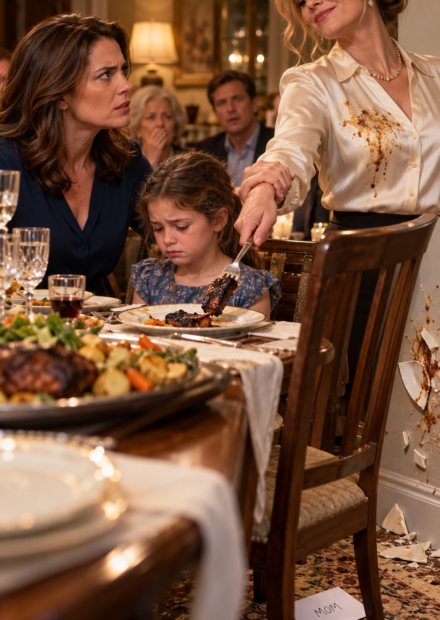
Instead, I asked, “Why did you knock over my cake?”
She froze.
There.
At last.
The actual question.
Not the bag.
Not the money.
Not the house.
The cake.
“I told you. It was an accident.”
“No.”
“You can’t prove otherwise.”
“I don’t need to.”
She picked up a box.
“Then why ask?”
“Because I want to know why.”
For several seconds, she stared at me.
Something shifted in her face.
The polished certainty disappeared.
“I was angry.”
It was barely audible.
“About what?”
“Harrison had been talking about moving out.”
I frowned.
“When?”
“Before your birthday.”
I hadn’t known.
“He said we couldn’t keep living here.”
“So you were angry with me?”
“I was angry with everyone.”
“Why my cake?”
She laughed without humor.
“Because everyone was making such a fuss over you.”
I stared.
She looked away.
“Brenda spent days planning everything. Harrison bought flowers. Your neighbors came. Everybody kept talking about how wonderful you were and how much you’d done for everyone.”
“And that upset you?”
“You don’t understand.”
“No. I don’t.”
“My birthday was six weeks earlier.”
“The Gucci bag.”
Her mouth tightened.
“Harrison forgot until that afternoon.”
Ah.
There it was.
The emotional clue I had missed.
“He bought the bag because he’d forgotten.”
“Yes.”
“And he used my money.”
“I didn’t know that until later.”
I wasn’t certain I believed her.
But I let her continue.
“He spent your whole birthday running around making sure everything was perfect.”
“So you knocked over my cake.”
“I was drunk.”
“You had two glasses of wine.”
“Why do you care now?”
“Because I spent a year wondering what I had done to make you dislike me.”
Her eyes met mine.
“You didn’t do anything.”
The answer surprised us both.
Sloan sat on the edge of the bed.
“I hated being here.”
“You could have left.”
“We couldn’t afford to.”
“You could have changed how you lived.”
She laughed.
“You make everything sound easy.”
“No. I make it sound necessary.”
She stared at the floor.
“I grew up watching my mother count every dollar. Every bill was a crisis. We moved constantly. Lights got shut off. There was never enough.”
For the first time, she wasn’t performing.
I listened.
“I promised myself I would never live like that.”
“So you spent money you didn’t have.”
“Yes.”
“And Harrison tried to keep up.”
Her face tightened.
“I didn’t force him.”
“No.”
That mattered.
Sloan had manipulated him.
But Harrison had made choices.
I wasn’t going to erase his responsibility simply because blaming Sloan would be easier.
“He wanted to give me things,” she said.
“And you wanted to receive them.”
“Yes.”
She looked at me.
“I knew about the account after a while.”
“How much did you know?”
“That he could take money.”
“Did you ever tell him to stop?”
Silence.
That was my answer.
“Did you ever ask him to take money?”
Another silence.
“Sloan.”
“Sometimes.”
My chest tightened.
“For what?”
“Bills.”
“And the bag?”
“No.”
She answered quickly.
“I swear. I didn’t know the bag came from that account until after your birthday.”
I believed that part.
Not because I trusted her.
Because the shame on her face looked different from the defiance I’d seen before.
“You still accepted everything else.”
“Yes.”
“Why?”
She shrugged.
“Because after a while, it felt like we’d already crossed the line.”
I understood that better than I wanted to.
Small wrongs make larger wrongs easier.
The first six hundred dollars had probably felt enormous.
By forty thousand, it was just another transfer.
“You tried to get into my office.”
Her face went still.
“Yes.”
“Why?”
“I wanted to find out whether you’d changed your will.”
I stared at her.
It was so ugly and so ordinary that for a second I couldn’t process it.
“My will?”
“Harrison said you’d probably cut him out.”
“After five days?”
“I panicked.”
“Why would that matter to you?”
“Because he’s your only child.”
I felt physically ill.
“So after discovering he’d taken nearly forty-eight thousand dollars from me, you were worried there might be consequences to what he inherited someday.”
“When you say it like that—”
“There is no other way to say it.”
She stood.
“I know.”
I looked at her for a long time.
There was no secret conspiracy.
No brilliant criminal plan.
No hidden villain waiting behind Sloan.
Just entitlement.
Fear.
Debt.
Weakness.
Greed.
A marriage built partly around appearances neither of them could afford.
And my own silence, which had allowed all of it to grow inside my home.
That almost made it worse.
Because monsters are easy to recognize in stories.
Real damage is often done by ordinary people repeatedly telling themselves the next bad decision will be the last one.
“I don’t hate you,” I said.
Sloan looked surprised.
“But I don’t want you in my home.”
She nodded.
“I know.”
“And I’m not replacing the bag.”
For the first time, she almost smiled.
“I figured.”
She picked it up.
At the doorway, she stopped.
“I really am sorry about the cake.”
I studied her.
“Are you sorry you did it?”
She swallowed.
“Or sorry about what happened afterward?”
Her eyes dropped.
That was answer enough.
She carried the bag downstairs.
At two thirty, the final box went onto the truck.
Harrison stood on the front porch.
He looked around the house.
“I’ll call you.”
“Give it a few days.”
His face fell.
“I need some space.”
“Okay.”
He hugged me.
At first, I kept my arms at my sides.
Then I hugged him back.
He was still my son.
That was the terrible, beautiful difficulty of it.
Love does not disappear the moment trust does.
Sometimes that would be easier.
Sloan waited beside the car.
Before Harrison walked away, I said, “One more thing.”
He turned.
“Don’t make me responsible for your marriage anymore.”
He frowned.
“I don’t understand.”
“If Sloan is angry, let her be angry. If you’re angry, say you’re angry. If you disagree, disagree. Don’t ask someone else to shrink so the two of you don’t have to face each other.”
He stared at me.
Then nodded.
“I’ll try.”
“No.”
I smiled sadly.
“Do it.”
He left.
I watched the car disappear.
Then I closed the front door.
The house was silent.
For a moment, the silence frightened me.
I had spent almost a year resenting their noise.
Now that it was gone, grief rushed into the empty space.
I sat on the stairs.
And cried.
I cried for Thomas.
For the money.
For Harrison.
For myself.
For the eleven months I had spent tiptoeing through rooms that belonged to me.
For every time I had confused keeping my son close with allowing him to hurt me.
For the cake.
Yes.
Even the cake.
Because Brenda had made it with love.
And Sloan had destroyed it because she was angry that I was being celebrated.
There was something profoundly sad about that.
An hour later, the doorbell rang.
It was Brenda.
She held a cake box.
“No,” I said immediately.
“Yes.”
“Brenda.”
“You never got your birthday cake.”
She walked past me.
Inside the box was a smaller lemon cake.
Simple white frosting.
No elaborate sugar flowers.
No sixty-five candles.
Just one candle in the center.
Brenda set it on the kitchen table.
“What is that for?”
“One.”
“One what?”
“One boundary.”
I laughed through my tears.
“That doesn’t make sense.”
“It doesn’t have to. Light it.”
So I did.
Brenda sang “Happy Birthday” badly and loudly.
When she finished, I closed my eyes.
“What did you wish for?” she asked.
“You know I can’t tell you.”
“Fair.”
I blew out the candle.
For the first time in a year, nobody in my house was angry with me.
Nobody was telling me I was too sensitive.
Nobody was waiting for me to apologize for having needs.
I ate two pieces of cake.
Then I slept for ten hours.
—