HE PROMISED ME A HOME FOR LIFE. THEN I FOUND THE RECORDING MY SON NEVER KNEW EXISTED.
Chapter 5 – A HOME WITH MY NAME ON THE DOOR
The settlement was signed four months later.
Daniel and Claire refinanced their house.
They repaid £62,000 immediately.
The remaining £18,000 was placed into a formal repayment arrangement.
There were signatures.
Dates.
Terms.
Consequences.
Everything the original promise should have had.
When Priya slid the final papers toward me, I stared at Daniel’s signature.
I remembered another promise.
Your £80k is for the downstairs room and works. You’ll have a home with us for life. Promise.
That one had required only trust.
This one had required lawyers.
“Are you all right?” Priya asked.
“Yes.”
And I was.
Not happy.
Not victorious.
Just no longer helpless.
I used part of the returned money, together with my savings, to buy a small ground-floor flat.
It was fifteen minutes from Helen.
Twelve minutes from Daniel’s house.
Close enough for Sophie and Max.
Far enough for me.
The first time the estate agent showed it to me, I almost dismissed it.
The kitchen was smaller than my old one.
The carpet needed replacing.
The garden belonged to everyone in the building.
Then I entered the sitting room.
Beside the window was a space just wide enough for an armchair.
Sunlight fell across the floor.
I stood there for a long time.
The estate agent asked, “Can you imagine yourself here?”
I looked toward the window.
“Yes.”
I could.
I bought a blue chair.
Not because Daniel had once shown me one in a photograph.
Because I liked blue.
That distinction mattered.
Helen helped me unpack.
Sophie chose cushions.
Max assembled a small bookshelf with such confidence that we had to rebuild it after he went home.
I hung Robert’s photograph beside the window.
Not the formal one from our anniversary.
My favorite.
He was standing in our old garden wearing a terrible straw hat, holding a tomato as though he had personally invented agriculture.
On my first night alone, I made tea.
Then I sat in the blue chair.
The flat was quiet.
For a moment, the silence frightened me.
It reminded me of the silence after Robert died.
The reason I had been vulnerable to Daniel’s promise in the first place.
I had been so afraid of being alone that I failed to ask whether being surrounded by people necessarily meant being cared for.
It doesn’t.
There is a kind of loneliness that exists only in company.
I had felt it at Daniel’s dinner party while eating at the kitchen counter.
I had felt it folding their laundry.
I had felt it every time someone walked past my temporary room without asking whether I was still waiting for the permanent one.
Now I sat alone in a flat that belonged to me.
And I did not feel lonely.
I felt peaceful.
Daniel and I did not return to normal.
I no longer wanted normal.
Normal had required too much pretending.
For several weeks, we spoke only about the children and the repayment.
Then he began calling on Sundays.
At first the conversations lasted five minutes.
Then ten.
He stopped asking whether I had forgiven him.
I stopped waiting for the perfect apology.
Claire did not call.
That was fine.
Then one afternoon, nearly three months after I moved into the flat, she appeared at my door.
I almost didn’t recognize her.
Not because she looked different.
Because I had never seen her uncertain.
“Maggie.”
“Claire.”
“Can I come in?”
I hesitated.
Then stepped aside.
Her eyes moved around the flat.
The sofa.
The books.
Robert’s photograph.
The blue chair.
“That’s nice,” she said.
“Yes.”
She looked at the chair for a moment longer than necessary.
“I suppose it is.”
I made tea.
Not because I was serving her.
Because I wanted tea.
That distinction mattered too.
We sat opposite each other.
Claire held her cup with both hands.
“Daniel doesn’t know I’m here.”
“All right.”
“I wanted to talk about Sophie.”
My body tensed.
“What about her?”
“She’s angry with me.”
“Sophie is thirteen.”
“This is different.”
I waited.
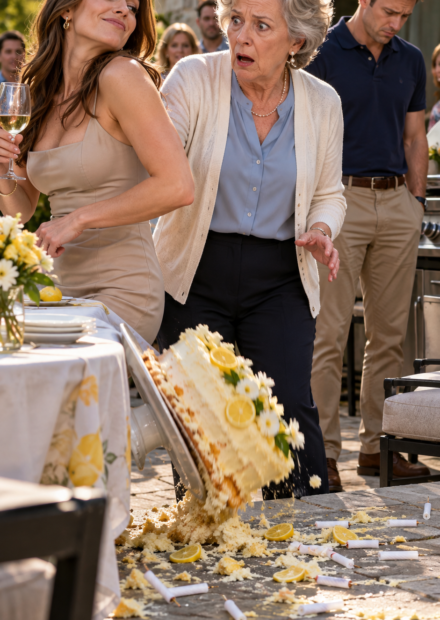
“She keeps bringing up your birthday cake.”
“Her birthday cake.”
Claire closed her eyes.
“Yes.”
“She wanted the one I made.”
“I know.”
“You knew then.”
She looked at me.
“I thought the bakery cake would look better in the photographs.”
I almost smiled at the absurdity.
“All of this over photographs.”
“It wasn’t just that.”
“No?”
She set down her cup.
“I was angry with you.”
“I know.”
“You were everywhere.”
That might once have wounded me.
Now I simply asked, “Why?”
Claire looked toward the window.
“Because Daniel made you my responsibility without ever saying it.”
I frowned.
“He told me you wanted me there.”
“At first, I did.”
“And later?”
“Later I felt like there was another adult in my house all the time.”
“Then why didn’t you tell me?”
“Because Daniel said you’d be devastated.”
I absorbed that.
“He told me you were anxious when entertaining.”
Claire looked confused.
“What?”
“The dinner party. When I ate at the counter.”
Her face changed.
“Oh.”
“Daniel said you became anxious when entertaining and that was why there wasn’t room.”
“There was room.”
“I know.”
She looked down.
“I was being horrible.”
“Yes.”
No excuse.
No softening.
Claire almost smiled.
“You’ve changed.”
“I hope so.”
She nodded.
Then she said, “I resented you.”
“I know.”
“But that doesn’t excuse what I did.”
“No.”
“I threw the cake away because I knew it would hurt you.”
There it was.
A confession so simple it needed no decoration.
“Why?”
She stared into her tea.
“Because I wanted you to understand that it was my house.”
I sat very still.
“And did it work?”
She looked around my flat.
“I suppose it did.”
For the first time, I saw something in Claire I had not allowed myself to see before.
Not innocence.
Not goodness.
Fear.
She had felt invaded.
She had wanted control.
She had resented Daniel for making promises that affected her home.
Then, instead of confronting her husband honestly, she had punished the easier target.
Me.
Understanding that did not excuse her.
But it made the story less mysterious.
“Why are you here, Claire?”
She swallowed.
“Because Sophie heard more than we realized.”
My stomach tightened.
“What?”
“She heard us arguing about the money. She knows enough.”
“Have you told her the truth?”
“Some.”
“How much is some?”
“That Daniel promised you the room and we used the money elsewhere.”
“And?”
“And that you left because things became difficult.”
I stared at her.
“No.”
Claire’s shoulders stiffened.
“No?”
“Do not make this into weather.”
“What?”
“Things didn’t ‘become difficult.’ People made choices.”
She looked away.
“Sophie doesn’t need every detail.”
“I agree.”
That surprised her.
“She does not need the recording. She does not need financial documents. She does not need to carry adult anger.”
Claire nodded.
“But do not teach her that harm simply happens by itself.”
Her eyes filled.
“I don’t know what to tell her.”
“Tell her the truth in words appropriate for her age.”
“Which is?”
“That you and Daniel made promises to me that you didn’t keep. That you handled money badly. That you treated me in ways you now regret. And that I left because adults are allowed to protect themselves even from people they love.”
Claire stared at me.
Then she nodded.
“I’m sorry.”
I had waited so long to hear those words.
Strangely, they did not feel enormous.
Perhaps apologies become smaller when you have already rebuilt without them.
“I believe you’re sorry,” I said.
“Can you forgive me?”
There was that question again.
People often want forgiveness to work like a receipt.
Payment made.
Account closed.
“I’m working on not carrying anger,” I said. “That’s what I can promise.”
She nodded.
When she stood to leave, she paused beside Robert’s photograph.
“He would have hated me.”
I looked at the picture.
“No.”
She turned.
“Robert didn’t waste much time hating people.”
“What would he have done?”
I smiled.
“He would have told you exactly what he thought.”
Claire gave a weak laugh.
“I wish I’d known him better.”
“So do I.”
At the door, she looked at me.
“Sophie wants to bake with you this weekend.”
“She’s welcome.”
“Victoria sponge.”
I felt something tighten in my throat.
“Of course.”
That Saturday, Sophie arrived carrying strawberries.
Max came too, although he claimed baking was boring and then ate half the filling.
We made Robert’s cake.
The first sponge sank slightly in the middle.
The second leaned.
Sophie used too much cream.
I told her there was no such thing.
She laughed.
For one beautiful second, I heard Robert laughing with her.
Daniel arrived to collect them at five.
He stood at my doorway.
He had been inside the flat before, but he still looked around each time as though trying to understand the life I had built after leaving his.
Sophie came running from the kitchen.
“Dad, look.”
She carried a plate with a thick slice of cake.
Daniel looked at it.
Then at me.
Something passed across his face.
Shame.
Memory.
Perhaps both.
“Looks good,” he said.
“It’s Granddad’s recipe,” Sophie said.
“I know.”
“Try it.”
Daniel took the plate.
He ate a bite.
For several seconds, nobody spoke.
Then he smiled.
“It’s good.”
Sophie looked triumphant.
“Nana made it.”
“I helped,” I corrected.
“You did most of it.”
Max shouted from the kitchen, “I did quality control.”
I laughed.
Sophie laughed.
Even Daniel laughed.
Then his eyes met mine.
“I remember Dad saying that.”
“Yes.”
He put down the plate.
The children ran to find their coats.
Daniel and I were alone.
“Mum?”
“Yes?”
“I’ve been thinking.”
“That sounds dangerous.”
He smiled faintly.
Then became serious.
“I don’t expect things to go back.”
I waited.
“I used to.”
“I know.”
“I thought if I paid the money back and apologized, eventually we’d get back to how we were.”
“We won’t.”
“I know that now.”
I studied him.
He looked older.
Perhaps I did too.
“I’m trying to understand why I did it,” he said.
“Have you?”
“Partly.”
He leaned against the wall.
“I think I kept telling myself you’d be all right because you always were.”
I said nothing.
“You handled everything. Dad’s illness. His funeral. The house. Me. The kids. Everything.”
“That didn’t mean I couldn’t be hurt.”
“I know.”
“But you didn’t then.”
“No.”
He swallowed.
“I think I turned your strength into an excuse.”
That was perhaps the most perceptive thing he had said since this began.
“If you complained, I told myself you were emotional. If Claire complained, I tried to fix it. If the kids needed something, I dealt with it. But you…”
He stopped.
“I assumed you’d absorb it.”
“Yes.”
“I’m sorry.”
“I know.”
Sophie appeared with her coat.
“Are we going?”
“In a minute.”
She rolled her eyes and disappeared again.
Daniel smiled.
Then he looked toward the blue chair.
“Is that…”
“Yes.”
“The chair from the picture?”
“No.”
He frowned.
“It looks like it.”
“It does.”
“Then why no?”
“Because this one is mine.”
He understood.
I saw it happen.
He nodded.
“Right.”
When they left, Sophie hugged me.
Max forgot his school bag and returned thirty seconds later.
Daniel stood outside beside the car.
Claire was in the passenger seat.
She raised a hand.
I raised mine.
No grand reconciliation.
No dramatic embrace.
Some wounds heal quietly.
Others become scars.
Both can be forms of survival.
A year after the birthday cake went into the rubbish, Sophie turned fourteen.
This time, her birthday gathering was at my flat.
Not because I had demanded it.
Because Sophie asked.
“I want Nana’s cake,” she announced.
Claire looked at me.
“Is that okay?”
“Yes.”
So I baked it.
Strawberries.
Cream.
Two layers.
A little too much jam.
Robert would have approved.
Daniel arrived early with folding chairs.
That detail almost made me laugh.
“Enough seats?” he asked.
I looked around.
“Count them.”
He did.
Twice.
There were enough.
Everyone sat at the same table.
When Sophie blew out her candles, she closed her eyes for a long time.
“What did you wish for?” Max asked.
“You’re not supposed to tell.”
“Then it won’t happen.”
“That’s the opposite of how wishes work.”
They argued.
Claire told them to stop.
Daniel cut the cake.
I sat back and watched them.
For years, I had believed family peace meant preventing conflict.
I thought love meant absorbing discomfort.
I thought motherhood required endless accommodation.
I was wrong.
Peace built on one person’s silence is not peace.
Love without respect becomes permission.
And a promise without accountability can become a weapon in the hands of someone who knows you want desperately to believe it.
I did eventually receive the remaining £18,000.
Daniel made the final payment eleven months after the settlement.
He came to my flat personally.
“You don’t need me to sign anything?” he asked.
“Yes.”
I handed him the receipt.
He laughed softly.
“Of course.”
He signed.
Then he looked at me.
“That’s everything.”
“Yes.”
“Eighty thousand.”
“Yes.”
“God.”
“What?”
“I can’t believe I nearly lost you over money.”
I shook my head.
“You didn’t nearly lose me over money.”
He frowned.
“You nearly lost me over what you were willing to do to me for it.”
His face fell.
But he nodded.
“You’re right.”
I put the signed document into a folder.
Then I made tea.
We drank it by the window.
He told me about Sophie’s school.
I told him Helen had booked us a weekend away.
He complained about his back.
I told him he was forty-one, not ninety.
For twenty minutes, we were simply mother and son.
Not the mother and son we had been.
Something more cautious.
More honest.
Perhaps that was better.
Before leaving, he stood beside Robert’s photograph.
“I still talk to Dad sometimes.”
“So do I.”
“Do you think that’s weird?”
“No.”
“What do you say?”
“None of your business.”
He laughed.
Then looked at the photograph.
“I tell him I’m sorry.”
My throat tightened.
Daniel continued.
“I know he can’t hear me.”
“Maybe saying it matters anyway.”
He nodded.
At the door, he hugged me.
This time, I hugged him immediately.
Not because I had forgotten.
Not because trust had magically returned.
Because healing is not the same as erasing.
After he left, I sat in my blue chair.
Outside, rain had begun tapping against the glass.
I thought about the woman I had been two years earlier.
A widow in a quiet house.
Frightened of becoming unnecessary.
Frightened of stairs.
Frightened of loneliness.
Frightened that saying no to her only child might mean losing him.
That woman believed security meant having someone promise to take care of her.
I no longer believed that.
Security was knowing what belonged to me.
Knowing where I stood.
Knowing I could say no.
Knowing I could love someone without surrendering my judgment to them.
Knowing I could walk away from a table where there was supposedly no chair for me and build a table of my own.
I sometimes thought about my old house.
I missed the roses.
I missed the crooked back step.
I missed the pantry door with Daniel’s childhood height marks.
For a long time, selling it felt like the mistake that caused everything.
Eventually, I stopped seeing it that way.
The mistake was not selling a house.
The mistake was believing that because a promise came from my son, I did not need to protect myself.
There is a difference.
I know that now.
The old phone still sits in my desk drawer.
I could throw it away.
I probably should.
Robert stopped using it years before he died. The battery barely holds a charge.
But every so often I open the drawer and see it.
Not as evidence.
Not anymore.
As a reminder.
The truth had been sitting there all along.
In the message Daniel sent.
In the delays.
In the changed plans.
In the kitchen.
In the French doors.
In the way Claire spoke to me.
In the way Daniel looked away.
In the dinner chair that supposedly did not exist.
In the room that supposedly would.
And finally, in a recording no one knew had been made.
But the most important truth was not on that phone.
It was something I had to learn myself.
I was sixty-four when my son took £80,000 from me with a promise he already knew he might not keep.
I was sixty-five when I got most of it back.
But somewhere between those two birthdays, I recovered something that had nothing to do with money.
My own authority over my life.
Sophie came over one Sunday several weeks later.
She dropped her bag by the door and immediately took the blue chair.
“That’s my chair,” I said.
“No, it isn’t.”
“I bought it.”
“I always sit here.”
“You’ve sat there three times.”
“Exactly. Tradition.”
I laughed and sat on the sofa.
She curled her legs beneath her.
For a while she scrolled through her phone.
Then she looked at me.
“Nana?”
“Yes?”
“Are you happy?”
Children ask enormous questions casually.
I thought before answering.
“Yes.”
“Happier than when you lived with us?”
I looked around my little flat.
At Robert’s photograph.
At the bookshelf Max had finally assembled properly.
At the cake tin waiting on the counter.
At the front door whose key belonged to me.
“Yes.”
Sophie nodded as though she had expected that answer.
“Good.”
Then she returned to her phone.
I watched her for a moment.
“Sophie?”
“Hmm?”
“Do you know something?”
“What?”
“There was room at that dinner table.”
She looked up.
For a second she seemed confused.
Then she remembered.
The dinner party.
Me at the counter.
Her thirteen-year-old self looking into the dining room and saying, There’s loads of room.
She smiled.
“I told you.”
“Yes.”
“You should have just brought another chair.”
“I should have.”
She shrugged.
“So why didn’t you?”
I looked at my granddaughter.
Because I had been afraid of making people uncomfortable.
Because I had confused being easy to live with for being loved.
Because I thought gratitude meant accepting humiliation.
Because women of my generation were often praised for how much inconvenience we could quietly absorb.
But Sophie did not need a speech.
So I told her the simplest truth.
“I hadn’t learned yet.”
“Learned what?”
“That sometimes you don’t need anyone’s permission to take your place.”
She considered this.
Then nodded.
“Granddad would’ve brought the chair.”
I laughed.
“Oh, absolutely.”
“He probably would’ve made a big scene.”
“Definitely.”
“And Mum would’ve been furious.”
“Without question.”
Sophie grinned.
I looked at Robert’s photograph.
For a moment, I could almost hear him.
Then I looked around the home I had chosen for myself.
The room was warm.
Rain moved softly against the window.
My granddaughter was sitting in my blue chair.
There were two mugs on the table and strawberry cake in the kitchen.
And every chair in my home had room for me.
That was enough.
More than enough.
Because my son had once promised me a home for life.
He broke that promise.
So I built something better.
A life in which my home no longer depended on anyone promising I was allowed to stay.