Chapter 1 – THE CAKE ON MY FLOOR
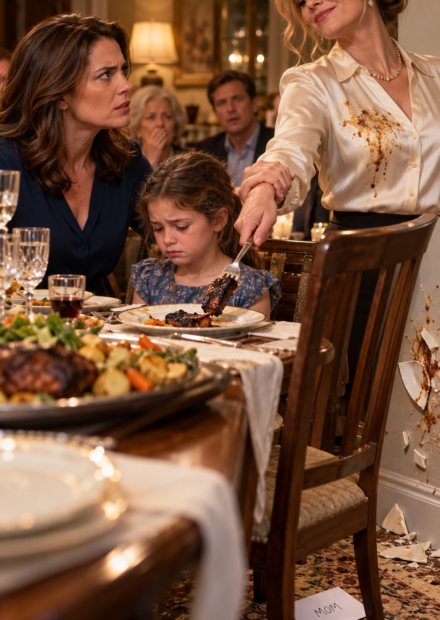
On my sixty-eighth birthday, my son looked straight at me, dropped the lemon cake I had baked from his late father’s recipe onto my hardwood floor, and said, “Pick it up.”
His wife laughed.
My eleven-year-old granddaughter, Lily, stared at the yellow frosting spreading across the floor with tears gathering in her eyes, while her fourteen-year-old brother, Noah, suddenly found his dinner plate fascinating.
I remember thinking how strange it was that humiliation could make a room so quiet.
The refrigerator hummed.
The old clock above the pantry ticked.
Somewhere outside, a car passed along the wet October street.
And my only son stood over the cake his dead father used to make for me every birthday and waited for me to get on my knees.
“Mom,” Daniel said.
He pointed toward the floor.
“You heard me.”
That was when something inside me became very still.
My name is Thora Caldwell.
For most of my sixty-eight years, I had mistaken making life easier for people I loved for the same thing as loving them.
Especially Daniel.
My husband Harold used to warn me about that.
“Helping somebody climb out of a hole is kindness,” he once told me. “Climbing into every hole ahead of them so they never fall is something else.”
At the time, I accused him of being too hard on our son.
Six years after Harold died, I finally understood what he meant.
The cake lying on my floor had taken me almost four hours to make.
Not because lemon cake is particularly difficult, but because Harold had never written down his recipe.
He cooked by instinct.
A little more zest.
A little less milk.
Butter softened exactly enough that his thumb left a shallow mark.
He would taste the batter, wrinkle his nose theatrically, then add vanilla even though he always claimed vanilla had no business in a proper lemon cake.
After he died, I tried seven times to recreate it.
Seven failures.
Too dry.
Too sweet.
Too dense.
Not enough lemon.
Then, three days before my sixty-eighth birthday, I tried again.
When I tasted the first slice, I had to sit down.
For one second, Harold was back in our kitchen.
That was the cake Daniel dropped.
I looked at him.
“Why did you do that?”
His expression changed as though my question irritated him more than his own behavior.
“Because you wouldn’t stop.”
“Stop what?”
“Making everything about Dad.”
Vanessa shifted in her chair.
“Daniel—”
“No.” He raised one hand. “Every birthday. Every holiday. Every family dinner. Dad liked this. Dad used to do that. Dad would have wanted something else. We get it.”
I stared at him.
That wasn’t how the argument had started.
Twenty minutes earlier, Daniel had asked me for money.
Again.
Twenty-eight thousand dollars.
He wanted to invest in what he called an “expansion opportunity” for the consulting company he had started eighteen months earlier.
I had asked three questions.
What was the money for?
What were the projected costs?
Why couldn’t the company finance the expansion itself?
Daniel had interpreted those questions as betrayal.
“You know I’m good for it.”
“That isn’t what I asked.”
“I’ve paid you back before.”
Sometimes he had.
Often he hadn’t.
When I reminded him that I had already put eighteen thousand dollars into the same business nine months earlier, Vanessa said I was embarrassing him in front of the children.
I told her I wasn’t discussing anything shameful.
Money was simply money.
Then Daniel said the sentence he had used in a dozen different forms for years.
“If Dad were here, he would help me.”
I answered before I could stop myself.
“If your father were here, he would ask for the same numbers I just asked for.”
Daniel’s face hardened.
He looked at the cake.
Then at me.
And with both hands, he lifted the glass cake stand from the table.
For one absurd second, I thought he was moving it.
Then he tilted it.
The cake slid.
It hit the hardwood with a wet, heavy sound.
Lily gasped.
Vanessa laughed.
Not loudly.
It was a quick, nervous sound, but I heard it.
Daniel looked directly at me.
“Pick it up.”
Now, standing there with my coat halfway on, I realized the argument had never been about twenty-eight thousand dollars.
It was about whether I was still willing to obey the role I had created for myself.
“Where are you going?” Daniel demanded.
“Home.”
He actually frowned.
“You are home.”
“No,” I said quietly. “I’m not.”
That stopped him.
The house where we were standing legally belonged to me, but I hadn’t lived there in twelve years.
I had bought it after Daniel’s first business collapsed.
He and Vanessa had been thirty-one and twenty-nine then, with a toddler and another baby on the way.
Their credit was damaged.
Their lease was ending.
Daniel had cried in Harold’s garage because he believed he had failed his family.
I bought the house for $346,000.
They were supposed to pay enough monthly to cover taxes, insurance, and maintenance.
Over time, that arrangement changed.
Payments came late.
Then partially.
Then not at all for months when Daniel was “between opportunities.”
I covered the roof.
I replaced the furnace.
I paid the property taxes twice when Daniel claimed he had forgotten the deadline.
And somewhere along the way, Daniel stopped saying Mom’s house.
He started saying our house.
I had noticed.
I had simply chosen not to correct him.
Vanessa followed me into the hallway.
“Thora, come on. He was joking.”
I turned around.
Daniel was standing beside the ruined cake with his arms folded.
“Were you?”
He said nothing.
Lily whispered, “Grandma?”
That almost broke me.
I walked back and kissed the top of her head.
“I’m okay, sweetheart.”
She glanced at the cake.
“No, you’re not.”
Daniel immediately said, “Lily, stay out of this.”
I looked at my granddaughter.
Children notice more than adults want to believe.
Noah still hadn’t looked at me.
But his jaw was clenched.
I kissed Lily again, told both children I loved them, and walked outside.
Daniel followed me onto the porch.
Cold October air hit my face.
“Mom, don’t be ridiculous.”
There it was.
The sentence that had controlled me for years.
Don’t be ridiculous.
Don’t overreact.
Don’t make this awkward.
Don’t make him apologize.
Don’t make him repay the money.
Don’t make him explain.
Don’t make him face consequences.
I turned.
“What exactly would a reasonable response be, Daniel?”
He opened his mouth.
Nothing came.
I continued down the steps.
“Come back inside before you upset the kids.”
I stopped beside my car.
“You dropped their grandfather’s cake onto the floor and ordered their grandmother to pick it up.”
His face changed.
“You upset them.”
Then I got into my car.
My phone buzzed before I had backed out of the driveway.
DANIEL:
Are you actually doing this?
Another message appeared.
Come back before this gets even more dramatic.
Then:
You’re upsetting Lily.
Not one apology.
I drove away.
I should have gone home.
Instead, I ended up in a twenty-four-hour diner beside the interstate, sitting beneath fluorescent lights with a cup of black coffee growing cold between my hands.
A waitress named Marcy asked whether I wanted pie.
“No, thank you.”
“You sure? Birthday pie is free.”
I looked up.
She nodded toward the little birthday pin Lily had fastened to my sweater earlier that evening.
I’d forgotten I was wearing it.
For some reason, that almost made me cry.
“I think I’ve had enough cake tonight.”
She smiled without asking questions and refilled my coffee.
I opened my contacts.
Margaret Sloan.
My finger hovered over her name.
Margaret had been Harold’s attorney for nearly twenty years.
After his death, she became mine.
Three years earlier, she had asked me a question I hadn’t wanted to answer.
“What happens when you’re no longer here to rescue Daniel from himself?”
I had been offended.
Then frightened.
Then defensive.
My estate wasn’t enormous by the standards of people who appeared in financial magazines, but Harold and I had done well.
We had lived below our means.
We owned rental properties.
Harold had invested steadily.
There were retirement accounts, municipal bonds, the house Daniel lived in, my own smaller home, and the proceeds from selling Harold’s manufacturing company.
Daniel was our only child.
Naturally, most of it would eventually pass to him.
That was what I had always assumed.
Margaret had suggested a trust with independent oversight because Daniel had already demonstrated poor judgment with money.
I refused.
“He’ll mature.”
Margaret had looked at me for a long moment.
“Thora, he’s forty.”
I canceled our next appointment.
Now Daniel was forty-three.
And I was sitting alone in a diner on my birthday because he had ordered me to kneel on my own floor.
At 9:17 p.m., I typed:
I’m ready to make the changes we discussed. First appointment tomorrow, please.
Margaret responded eleven minutes later.
9:00 a.m.
That was all.
I stared at those numbers.
And for the first time that evening, I breathed normally.
The next morning, Margaret was already waiting when I arrived.
She was sixty-two, silver-haired, practical, and almost impossible to intimidate.
Her assistant brought coffee.
Margaret closed the office door.
“What happened?”
I told her.
All of it.
The cake.
The money.
The house.
The messages.
The years before that.
When I finished, Margaret didn’t immediately discuss wills or trusts.
She asked one question.
“What do you want now?”
I looked through the window behind her at the maple trees lining the street.
“I don’t know.”
“Yes, you do.”
I looked back at her.
“I want to stop being afraid that saying no will cost me my son.”
Margaret’s expression softened.
“That isn’t an estate-planning answer.”
“No.”
“But it’s probably the answer we needed before we discuss estate planning.”
She opened my file.
“What else?”
I thought of Lily’s face.
Noah staring at his plate.
Daniel pointing at the floor.
“I want everything Harold and I built protected.”
“From creditors?”
“Yes.”
“Bad investments?”
“Yes.”
“Divorce?”
“Yes.”
She paused.
“Daniel?”
That one hurt.
But I answered.
“Yes.”
Margaret turned several pages.
“Then we have work to do.”
Over the next two hours, she explained what could be changed and what couldn’t.
Nothing dramatic happened.
No secret billionaire inheritance appeared.
No magic document erased my son from my life.
What Margaret gave me was something far more useful.
Structure.
My assets could be moved into a revocable trust while I was alive, with provisions governing what happened after my death.
Daniel would not receive unrestricted control simply because he was my son.
Certain distributions could benefit him and the grandchildren without handing him the entire principal.
An independent trustee could oversee major distributions.
Education funds for Lily and Noah could be separated.
And the house Daniel lived in needed immediate attention because our informal arrangement had become dangerously vague.
“Do they have a written lease?” Margaret asked.
“An old one.”
“How old?”
“Ten years.”
“Current rent?”
I told her.
Margaret removed her glasses.
“Thora, that’s less than half the market rate.”
“I know.”
“Are they current?”
I hesitated.
She already knew the answer.
“How far behind?”
“Four months.”
Margaret made a note.
Then she asked something that chilled me.
“Has Daniel ever represented to anyone that he owns the property?”
“I don’t know.”
“Has he borrowed against it?”
“He can’t. His name isn’t on the deed.”
“That wasn’t my question.”
I stared at her.
Margaret continued.
“I want a title search.”
“Why?”
“Because clarity is cheaper than assumptions.”
Before I could answer, my phone began vibrating.
Daniel.
I declined the call.
It rang again.
Then Vanessa.
Then Daniel.
Margaret watched without comment.
Finally a text appeared.
We need to talk about the house.
I felt a cold pressure move through my chest.
I turned the phone toward Margaret.
She read the message.
Then another appeared.
There are things you don’t understand.
Margaret’s eyes lifted to mine.
“When did he last ask you for documents related to the property?”
I thought back.
Six months earlier, Daniel had asked for a copy of the insurance declaration page.
Before that, he wanted the property-tax bill.
He said his accountant needed them.
Margaret picked up her office phone.
“I’m ordering the title search now.”
Twenty minutes later, I left her office believing the worst thing I would have to confront was my son’s entitlement.
At 12:43 that afternoon, Margaret called me.
“Thora, come back.”
Something in her voice made me grip the phone tighter.
“What happened?”
“The house is still legally yours.”
I closed my eyes.
“Then what’s wrong?”
There was a short silence.
“Someone has been trying very hard to make it look as though Daniel has authority he does not have.”
And that was when my birthday stopped being a family argument.
It became an accounting.
—