Chapter 5 – WHAT I CHOSE TO LEAVE BEHIND
I sat across from my son with the photograph between us.
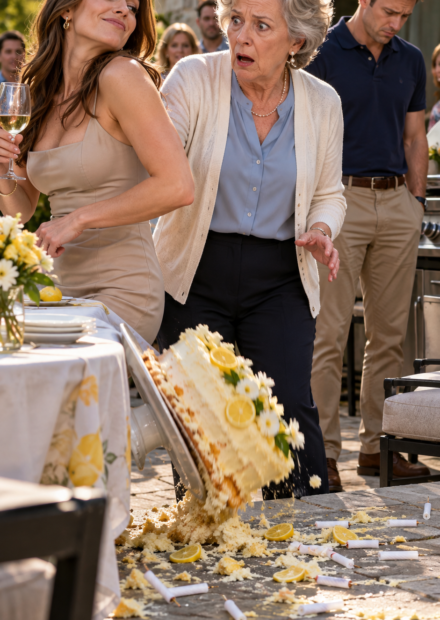
Yellow frosting.
Broken layers of cake.
The glass stand lying on its side.
One of the candles still visible near the edge of the frame.
Sixty-eight.
A ridiculous little plastic number that had cost me ninety-nine cents.
I remembered Lily crying.
Noah staring downward.
Vanessa laughing because she was frightened.
Daniel pointing at the floor.
“Why did Noah show you this?” I asked.
“He didn’t.”
Daniel rubbed his palms together.
“I found it on the family tablet.”
“And?”
“I asked him why he took it.”
His voice broke.
“He said he wanted proof.”
“Proof of what?”
“That it happened.”
I couldn’t speak.
Daniel looked toward the window.
“He said every time I did something bad, everybody acted normal afterward. He said he started wondering if maybe he remembered things wrong.”
The words went through me like cold water.
That was exactly what I had taught those children.
Not intentionally.
But every time Daniel exploded and I restored peace without demanding change, I helped erase the explosion.
Every time I paid a debt secretly, I erased the consequence.
Every time I accepted an apology because confrontation frightened me, I erased the pattern.
Noah had taken a photograph because he needed evidence that reality was real.
I covered my mouth.
Daniel whispered, “I did that to him.”
Neither Margaret nor I answered.
After a moment, he continued.
“I went to a motel last night.”
“Why?”
“Because Vanessa told me to leave.”
I looked at him.
“She found another debt.”
“What debt?”
“Credit cards.”
“How much?”
“Thirty-seven thousand.”
I closed my eyes.
“Business?”
“Some.”
“Some?”
He nodded.
“What else?”
“Life.”
One word.
Restaurants.
Trips.
Clothes.
The illusion that things were going well.
Daniel had been financing the appearance of success while waiting for Harold’s imagined money to make the appearance real.
He laughed bitterly.
“I kept thinking I just had to get to forty-five.”
I looked at him.
“And then?”
“Then Dad would fix it.”
“Your father is dead.”
“I know.”
“No, Daniel.”
My voice softened.
“I don’t think you did.”
His face crumpled.
For six years, Daniel had used Harold’s memory as a weapon against me.
Dad would help.
Dad would understand.
Dad intended this.
But perhaps he had been doing something else too.
He had been keeping his father alive as the ultimate rescuer.
Just as I had kept rescuing him while Harold was alive.
Daniel looked at the papers.
“I don’t want the fund.”
“You don’t have the fund.”
“I know.”
That mattered.
A month earlier, he would have argued.
Now he nodded.
“I know.”
Margaret spoke for the first time.
“The document you’re considering doesn’t need to be signed today.”
“I want it signed.”
I looked at her.
“What exactly is it?”
“It acknowledges that Daniel has no current ownership interest in the fund, no right to rely on it for business or personal borrowing, and no authority to represent otherwise.”
“That sounds reasonable.”
“There is also language confirming he has no ownership interest in the house.”
Daniel nodded.
“I asked her to add that.”
I looked at him.
“Why?”
He swallowed.
“Because I need to stop pretending things are mine because I might get them someday.”
That sentence did not repair anything.
But it was the first honest sentence I had heard from him in a long time.
He signed.
I did not hug him.
I wanted to.
But forgiveness offered too quickly can become another form of rescue.
Instead I asked, “What happens now?”
“I close the company.”
My chest tightened.
“Completely?”
“The consultant says I can keep a smaller operation if I get rid of the office, equipment leases, and employees I can’t afford.”
“That sounds painful.”
“It is.”
“Can you do it?”
He gave a weak smile.
“I guess we’re going to find out.”
“What about Vanessa?”
“I don’t know.”
“The children?”
His face changed.
“They’re staying in the house with her.”
“And you?”
“I’m renting a room from Mark.”
Mark was an old college friend.
For once, Daniel had found an answer that did not involve my checkbook.
I nodded.
Then I left.
The months that followed were not cinematic.
Nobody applauded.
Nobody was dragged away.
There was no dramatic courtroom victory.
Real consequences were quieter.
Daniel closed most of his company.
He sold equipment.
He negotiated debts.
His credit suffered.
He took consulting work for another firm, something his pride would once have considered humiliating.
Vanessa and the children stayed in my house.
For three months, Daniel lived elsewhere.
I did not interfere in their marriage.
That was harder than it sounds.
When Vanessa called crying, I listened but did not solve.
When Daniel complained that she wouldn’t trust him with finances, I told him trust was hers to give, not mine to negotiate.
When Lily asked whether her parents would divorce, I told her I didn’t know.
I stopped promising outcomes I could not control.
Meanwhile, Margaret and I completed my estate plan.
The house remained mine.
Lily and Noah received protected education provisions.
The larger estate would be held under structured terms rather than handed directly to Daniel.
An independent trustee would manage significant distributions after my death.
The Second Chance Fund remained under my control.
Margaret asked whether I wanted to remove Daniel entirely.
I thought about it for several days.
Then I said no.
Not because he deserved the money.
Not because he didn’t.
Inheritance was no longer going to be a reward system for me.
I wanted my estate to reflect responsibility rather than anger.
Daniel could benefit under conditions that prevented the money from being pledged recklessly, consumed by creditors unnecessarily, or treated as instant capital for another grand business idea.
Lily and Noah would have their own protections.
And part of the estate would go to a scholarship fund Harold and I had once discussed for students studying skilled trades.
When Margaret showed me the final documents, I felt something unexpected.
Peace.
Not triumph.
Peace.
Daniel didn’t know the numbers.
I decided he didn’t need to.
Six months after my birthday, I received an invitation from Lily.
Not Daniel.
Not Vanessa.
Lily.
GRANDMA — DINNER SATURDAY. PLEASE COME.
Underneath, she had drawn a lemon.
I laughed for the first time in what felt like days.
When I arrived that Saturday, Daniel opened the door.
He was living at the house again.
Slowly.
Carefully.
He and Vanessa were seeing a marriage counselor.
He had a salaried job now.
The smaller version of his company had been dissolved entirely because he admitted he could not manage both without repeating old habits.
None of that guaranteed anything.
But change isn’t a guarantee.
It’s behavior repeated long enough to become believable.
Daniel stepped aside.
“Happy half-birthday.”
I frowned.
“What?”
Lily came running from the kitchen.
“Dad said we needed a redo.”
Noah appeared behind her.
He had grown almost an inch.
On the dining table sat a lemon cake.
Crooked.
The frosting was uneven.
One side leaned noticeably lower than the other.
I stopped.
Daniel looked embarrassed.
“I tried Dad’s recipe.”
I walked closer.
“You don’t have his recipe.”
“No.”
He looked at me.
“So I tried to remember.”
For one second, neither of us spoke.
Then I laughed.
It sounded strange at first.
Then Lily laughed.
Then Noah.
Even Vanessa smiled.
Daniel cut the cake.
He handed me the first slice.
I tasted it.
Too much sugar.
Not enough zest.
The texture was slightly dry.
It was nothing like Harold’s.
Daniel watched my face.
“Well?”
“Your father would be offended.”
Noah laughed so hard he nearly choked.
Daniel smiled.
Then his eyes filled.
“I miss him.”
“I know.”
“I was angry at him.”
That surprised me.
“For dying?”
He nodded.
“For leaving me with everything messed up.”
I put down my fork.
“Daniel, things weren’t messed up because he died.”
“I know that now.”
He looked toward his children.
“I think I needed him to still be responsible for me.”
I understood.
Because for years, so had I.
I needed Harold to be responsible for being the stricter parent.
Then after he died, I used grief as permission to avoid becoming one myself.
Daniel reached into his pocket.
“I have something for you.”
My body tensed before I could stop it.
He noticed.
That hurt him.
Good, I thought.
Not because I wanted him hurt.
Because some pain teaches us what our behavior has cost.
He placed an envelope on the table.
Inside was a check.
$500.
I looked at him.
“What is this?”
“The first payment.”
“For what?”
“Everything.”
I almost laughed.
“Daniel, you owe me considerably more than five hundred dollars.”
“I know.”
“You may never repay it.”
“I know.”
“Then why?”
“Because I spent years deciding that if you could afford to give something, I didn’t owe it back.”
His voice was quiet.
“I need to stop thinking like that.”
I held the check.
I could have refused it.
Five hundred dollars meant little to me financially.
It meant more to him.
So I accepted it.
“Thank you.”
Lily looked between us.
“Are we done being weird now?”
Vanessa burst out laughing.
I did too.
Daniel shook his head.
“No promises.”
Dinner was simple.
Roast chicken.
Potatoes.
Green beans.
Lemon cake.
No speeches.
No dramatic reconciliation.
And that was exactly right.
Afterward, Noah helped me carry dishes into the kitchen.
He was unusually quiet.
“What?” I asked.
He glanced toward the dining room.
“Dad told me he apologized to you.”
“He did.”
“Did you forgive him?”
I considered my answer carefully.
“Yes.”
Noah looked relieved.
Then I added, “But forgiveness doesn’t mean pretending something never happened.”
His eyes moved toward me.
“It doesn’t?”
“No.”
I dried a plate.
“It means I don’t want to spend my life carrying anger. Your father still has to rebuild trust.”
Noah nodded.
“Okay.”
“Why?”
He shrugged.
“Just wondering.”
I knew better.
He was learning.
Maybe all of us were.
Before I left, Daniel walked me to my car.
The October night when I had driven away from that house felt very far away.
Spring had arrived.
The maple tree beside the driveway was green again.
“Mom?”
I turned.
“I need to ask you something.”
My stomach tightened from old habit.
Money?
A loan?
Another emergency?
Daniel must have read my expression because he shook his head.
“Not money.”
I almost smiled.
“Okay.”
“When you changed your estate plan…”
There it was.
I waited.
He shoved his hands into his pockets.
“Actually, never mind.”
“No. Ask.”
He looked embarrassed.
“Am I still in it?”
Six months earlier, that question would have infuriated me.
Now I simply answered.
“Yes.”
His shoulders dropped slightly.
“But you don’t control it.”
He nodded.
“And you don’t know how much.”
Another nod.
“And I’m not discussing the details.”
“I understand.”
“Do you?”
“I think so.”
He looked back at the house.
Then he said something I never expected.
“If you decide someday that Lily and Noah should get everything instead, I’ll understand that too.”
I studied his face.
“That’s not the decision I’ve made.”
“Okay.”
He hugged me.
I let him.
Then I drove home.
A year passed.
Then another.
Daniel did not become a different person overnight.
Neither did I.
Sometimes he slipped into old habits.
Sometimes I did too.
Once, when his car needed a $2,300 transmission repair, I almost offered to pay before he even asked.
I literally had to close my mouth.
He found financing through the repair shop.
Another time, he called to complain about an unexpected tax bill.
I listened.
Then I said, “That sounds stressful.”
He waited.
So did I.
Finally he laughed.
“You’re really not going to offer, are you?”
“No.”
“Okay.”
And somehow, that became our new language.
He stopped interpreting every boundary as rejection.
I stopped interpreting every struggle as an emergency.
Vanessa eventually apologized again for forging my signature.
This time, she didn’t explain why she had done it.
She simply said, “It was wrong.”
That apology meant more.
The lender did not pursue the application, and no loan was made against my property.
Daniel and Vanessa spent years repairing their finances.
Their marriage survived, although I learned not to take credit for that either.
That belonged to them.
Noah graduated high school four years later.
At his graduation dinner, Daniel stood to make a toast.
My body tensed automatically.
Old memories are stubborn.
But he raised his glass toward his son.
“When Noah was fourteen, he taught me something I should have learned at forty-three.”
Noah looked mortified.
“Dad.”
Daniel smiled.
“I’ll keep it short.”
Everyone laughed.
Then Daniel looked at me.
“Sometimes the person who loves you most isn’t the person who keeps saving you.”
My throat tightened.
“Sometimes they’re the person who finally stops.”
Nobody in the restaurant knew what those words meant.
We did.
After dinner, Noah hugged me.
Lily, now fifteen, complained that everyone had cried too much.
Daniel paid the bill.
I noticed because there had been a time when he would quietly let it slide toward me.
Outside, he handed me my coat.
“Mom?”
“Yes?”
“Do you still make Dad’s lemon cake?”
“Every birthday.”
“Is yours still better than mine?”
“By an embarrassing margin.”
He laughed.
“Fair.”
On my seventy-second birthday, my family came to my house.
My actual house.
Not the property Daniel once called his.
My smaller place with Harold’s photograph on the console and the maple tree outside the kitchen window.
I made the lemon cake.
Daniel carried it from the kitchen with both hands.
When he reached the dining table, he stopped.
For a fraction of a second, our eyes met.
We both remembered.
He set the cake down carefully.
Then he leaned over and kissed my cheek.
“Happy birthday, Mom.”
“Thank you.”
Lily lit the candles.
Noah turned off the overhead lights.
Vanessa brought coffee.
Daniel handed me the knife.
Nobody mentioned the birthday when the cake landed on the floor.
We didn’t need to.
Some memories do not need to be repeated to remain important.
I blew out the candles.
Everyone applauded.
And while Daniel cut the cake, I thought about the woman I had been four years earlier.
The woman sitting in a twenty-four-hour diner with cold coffee between her hands.
She believed she was about to change some legal documents.
She didn’t yet understand that paperwork was the smallest part of what had to change.
I had spent decades believing love meant preventing pain.
Harold had understood something I didn’t.
Sometimes pain is information.
A failed business can teach limits.
A missed payment can teach responsibility.
A broken promise can teach trust.
And a cake dropped onto a hardwood floor can show a sixty-eight-year-old woman exactly how much disrespect she has been swallowing in the name of keeping her family together.
I didn’t save my family by giving Daniel more.
I didn’t save it by taking everything away either.
I saved my part of it by finally understanding where I ended and my son began.
His debts were his.
His marriage was his.
His business was his.
His mistakes were his.
My money was mine.
My home was mine.
My future was mine.
And my love?
That was mine too.
I could give it freely without attaching a check.
That was the lesson neither Daniel nor I understood until far too late.
After everyone left that evening, I cleaned the kitchen.
There was one slice of lemon cake remaining.
I carried it into the living room and sat beside Harold’s photograph.
“You were right,” I told him.
I could almost hear his answer.
About what?
Harold hated admitting he was right too easily.
I smiled.
“Don’t get excited.”
Rain tapped softly against the window.
I ate the cake slowly.
Extra zest.
Exactly the way he liked it.
Then my phone buzzed.
A message from Daniel.
Thank you for tonight.
A second message appeared.
Love you, Mom.
Nothing else.
No request.
No emergency.
No number with a dollar sign beside it.
Just four words.
I looked at Harold’s photograph.
Then I typed back.
Love you too.
And I meant it.
Not because everything had been forgotten.
Not because everything had been repaired.
But because I had finally learned something that took me sixty-eight years, a ruined birthday cake, and a frightened boy’s photograph to understand.
Love and obedience were never the same thing.
Love and money were never the same thing.
Forgiveness and permission were never the same thing.
And protecting myself did not mean I had stopped being Daniel’s mother.
It meant I had finally stopped being the place where every consequence went to disappear.
That night, before I went upstairs, I opened the cabinet where I kept Harold’s handwritten recipes.
There was no lemon cake recipe inside.
There never had been.
I had spent years trying to recreate it from memory.
But this time, instead of feeling sad about that, I took out a blank index card.
I wrote down what I had learned.
Two cups flour.
Fresh lemon zest.
Butter.
Sugar.
Eggs.
Vanilla.
I paused.
Then added one final note at the bottom.
More zest than seems reasonable.
I laughed.
At the top of the card, I wrote:
HAROLD’S LEMON CAKE — AS I REMEMBER IT.
Then I crossed out HAROLD’S.
I wrote:
OUR LEMON CAKE.
Because that was what remained when everything else had finally been separated properly.
Not property.
Not inheritance.
Not debts.
Not expectations.
A recipe.
A family.
A memory.
And the freedom to love them without surrendering myself.
I placed the card inside the box and turned off the kitchen light.
Four years earlier, I had walked out of that other house believing I was leaving my birthday dinner.
I know now that I was leaving something much older.
I was leaving the version of motherhood that required me to kneel every time someone I loved made a mess.
And I never picked it up again.