Chapter 5 – THE LIFE AFTER THE FRAME
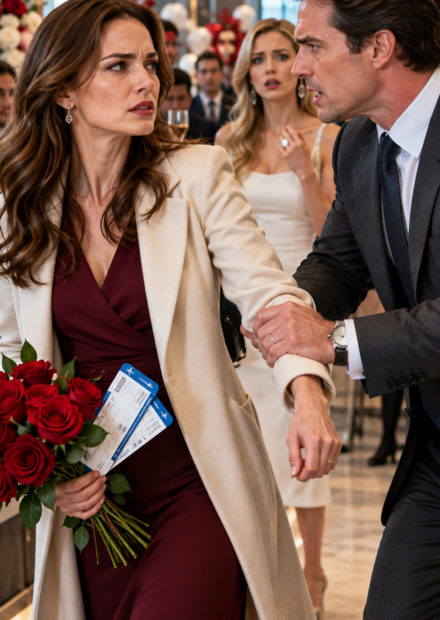
One year after I walked out of the Grand Marlo ballroom, I returned.
Not for Mason.
Not for Hartwell Global.
For myself.
The charity had invited me months earlier.
My first instinct was to decline.
Then I looked at Lily and Rose crawling across my living-room floor, fighting over a wooden giraffe, and realized I was tired of allowing one terrible night to own an entire building.
So I accepted.
I wore midnight blue.
No diamonds.
No wedding ring.
My daughters stayed with Victoria.
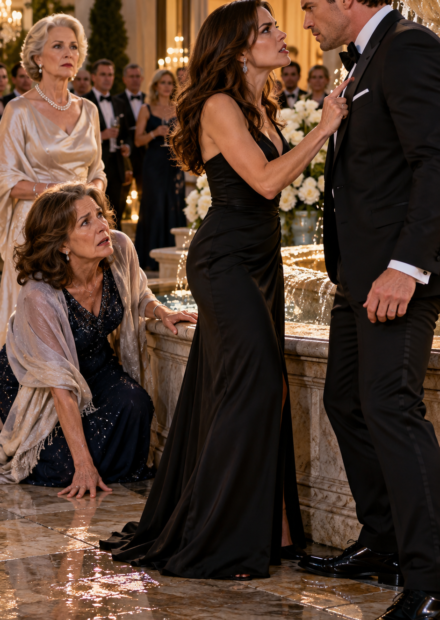
At 9:17 p.m., I stood beneath the same Austrian chandeliers.
I checked the time deliberately.
Then I smiled.
Nothing happened.
No betrayal.
No collapse.
No life-changing realization.
Just a minute passing.
That felt like victory.
The ballroom looked smaller than I remembered.
Pain has a way of enlarging rooms.
I walked past the marble column where Victoria had stood.
For a moment, I saw myself there again.
Thirty-five weeks pregnant.
Champagne silk.
Bare finger.
A heart turning to stone because softness had become too dangerous.
I wanted to reach backward through time and tell that woman something.
You are going to survive this.
Not beautifully.
Not painlessly.
But completely.
“Emily.”
I turned.
Mason stood several feet away.
He wore a simple black suit.
No tuxedo.
No entourage.
No Camille.
He looked older.
Not dramatically.
Honestly.
There were faint lines beside his eyes I didn’t remember.
“Hello,” I said.
“Hello.”
For a moment, we simply looked at each other.
“How are the girls?”
“You saw them yesterday.”
“I know.”
I smiled.
“They’re still fine.”
He smiled too.
We had learned how to be parents without pretending to still be spouses.
It had not been easy.
There were arguments.
Schedules.
Boundaries.
Late-night fevers.
Lily refusing bottles unless held at a ridiculous angle.
Rose developing a habit of waking at four in the morning and laughing as though sleep were a personal weakness.
Mason showed up.
That mattered.
He never missed pediatric appointments.
He learned to change diapers.
He learned which daughter liked which blanket.
He learned that being a father was not the same thing as funding childhood.
He never asked me to praise him for it.
That mattered too.
“How’s Queens?” I asked.
“Loud.”
“You always liked loud.”
“I thought I did.”
“And Hartwell?”
“I’m told it survives without my daily genius.”
“How devastating.”
“Humiliating.”
We smiled.
There was affection between us now.
Not the old kind.
Maybe something quieter.
The affection of two people who had known each other at their poorest and richest, best and worst, and had finally stopped lying about what that knowledge meant.
Graham was CEO.
Hartwell Global had stabilized at a lower valuation.
The financial press still described Mason’s departure as the collapse of an empire.
Mason had stopped reading those articles.
He remained a shareholder and occasional adviser but no longer ran the company.
For the first time since his twenties, his identity did not come with a title.
“What are you doing here?” I asked.
“Victoria made me come.”
“That sounds like her.”
“She said hiding from this ballroom gives it too much power.”
I laughed.
“She told me exactly the same thing.”
“Of course she did.”
Across the room, the orchestra began tuning.
Mason’s expression changed.
I knew why.
A waltz.
The same one.
He looked toward the dance floor.
Then back at me.
“I didn’t know they were playing this.”
“I believe you.”
He put his hands in his pockets.
A nervous habit from Queens.
“Emily?”
“Yes?”
“I’m sorry.”
I raised an eyebrow.
He smiled faintly.
“I know. I’ve said it approximately four thousand times.”
“Probably more.”
“I don’t mean only for the affair.”
My smile disappeared.
“I’m sorry I made you invisible.”
The room seemed to quiet around us.
“I’m sorry I let people tell the story of my life as though you were an accessory to it.”
I swallowed.
“I’m sorry I confused your loyalty with permission.”
He looked toward the marble column.
“And I’m sorry that you had to leave me before I understood what staying had cost you.”
There was a time when those words would have brought me home.
Now they simply brought tears to my eyes.
And that was okay.
Healing did not require indifference.
“You’re different,” I said.
“I’m trying.”
“I know.”
“Is it enough?”
I understood the question beneath the question.
I answered carefully.
“For Lily and Rose, yes.”
Pain flickered across his face.
Then acceptance.
“And for you?”
“It’s enough for me to forgive you.”
His eyes widened slightly.
“But forgiveness isn’t the same as returning.”
He nodded.
“I know.”
“I think you actually do.”
“I do.”
The orchestra began.
Couples moved toward the dance floor.
Mason glanced at them.
Then at me.
For half a second, I thought he might ask me to dance.
He didn’t.
That was how I knew he had changed.
The old Mason would have wanted the gesture.
The cinematic moment.
The photograph.
The perfect story.
This Mason simply stood beside me and allowed the imperfect truth to exist.
“Mom still has the silver ring?” he asked.
I touched the chain beneath my dress.
“No.”
I pulled it out.
The ninety-dollar silver ring hung from a delicate chain around my neck.
Mason stared.
“You kept it.”
“I kept what it meant.”
His eyes filled.
“Not what it became.”
He nodded.
“That seems fair.”
“It isn’t about fair.”
“No?”
“No.”
I slipped the ring beneath my dress again.
“It reminds me that I was capable of believing in something before it was valuable.”
He looked at me.
“You.”
I smiled.
“Myself.”
For a moment, he could not speak.
Then he laughed softly.
“That’s better.”
“Yes.”
“It is.”
A photographer approached.
“Mr. and Mrs. Hartwell?”
I opened my mouth.
Mason answered first.
“Ms. Hartwell.”
The photographer corrected himself.
“Ms. Hartwell, Mr. Hartwell, may I get a photograph?”
I looked at Mason.
A year earlier, cameras had captured the end of us.
I could have walked away.
Instead, I nodded.
“One.”
We stood beside each other.
Not touching.
The camera flashed.
No performance.
No illusion.
Just two people who had once been married and were now parents to two daughters they both adored.
The photographer thanked us and moved on.
Mason exhaled.
“Strange.”
“What?”
“Last year I would have cared desperately how that picture looked.”
“And now?”
“I care whether Lily has figured out how to climb out of her crib.”
“She has.”
His eyes widened.
“What?”
“She did it this morning.”
“Why didn’t you tell me?”
“Because I wanted to see your face.”
“That child is thirteen months old.”
“That child is your daughter.”
“Exactly why I’m terrified.”
I laughed.
Really laughed.
Mason did too.
Then his phone buzzed.
He looked at it.
“Mom.”
“What does she want?”
He read the message and groaned.
“She says Rose won’t sleep without the rabbit.”
“The yellow one?”
“She says blue.”
“Yellow.”
“She specifically says blue.”
“Then she has the wrong rabbit.”
He typed quickly.
I shook my head.
“Billionaire problems.”
“Former billionaire-CEO problems.”
“You’re still obscenely rich.”
“Yes, but now I know money cannot identify stuffed animals.”
“Growth.”
“Humbling.”
The music continued.
Around us, people danced.
A year earlier, I had believed walking away was the hardest thing I would ever do.
I had been wrong.
The hardest part came afterward.
Learning not to answer every call.
Learning that loneliness did not mean I had made the wrong decision.
Learning to let Mason fail without rescuing him.
Learning to co-parent with a man I still sometimes loved in the quiet, inconvenient places inside myself.
Learning that missing someone did not obligate me to return to them.
Learning that forgiveness did not erase consequences.
Learning that a marriage could contain real love and still become a place you had to leave.
Mason glanced at the dance floor again.
Then he looked at me.
“I should go rescue Mom from the rabbit emergency.”
“You should.”
He hesitated.
“Good night, Emily.”
“Good night, Mason.”
He walked away.
Halfway across the ballroom, he stopped.
For one second, my heart tightened.
Then he turned.
“Emily?”
“Yes?”
“Thank you.”
“For what?”
“For leaving.”
I stared at him.
He smiled sadly.
“I hated you for it for about twelve hours.”
“Only twelve?”
“Fine. Forty-eight.”
“More believable.”
“But you kept the promise.”
My throat tightened.
The promise.
*If I ever let this city turn me into someone you don’t recognize, you leave me to the wolves.*
“You asked me to.”
“I didn’t think you’d ever have to.”
“Neither did I.”
He nodded.
“I’m glad you did.”
Then he left.
I stood beneath the chandeliers.
The music swelled.
Couples turned beneath the golden light.
A waiter offered me champagne.
I took sparkling water instead.
Some habits of pregnancy had stayed with me.
I walked toward the balcony.
Outside, Manhattan glittered beneath the cold October sky.
The city looked exactly as it had one year earlier.
That was another strange thing about heartbreak.
Your world can end while everyone else’s traffic lights keep changing.
Taxis still honk.
Restaurants still close.
People still fall in love.
Babies still wake at four in the morning.
Companies rise.
Valuations fall.
Headlines disappear.
Life refuses to freeze simply because you once thought you could not continue.
I rested my hands against the balcony railing.
My phone vibrated.
A photograph from Victoria.
Lily was asleep sideways in her crib.
Rose was hugging the yellow rabbit.
Underneath, Victoria had written:
**Your ex-husband insisted it was blue. I told him billion-dollar companies have been built by less observant men.**
I laughed.
Another message arrived.
From Mason.
**In my defense, the lighting was bad.**
I typed:
**In your defense, you’ve never been good at noticing what’s directly in front of you.**
Three dots appeared.
Stopped.
Appeared again.
Finally:
**I deserved that.**
I smiled.
Then put my phone away.
Behind me, applause filled the ballroom as the waltz ended.
For a moment, I was back there.
Thirty-five weeks pregnant.
My husband’s hand on Camille’s waist.
Six hundred people watching.
The ring cutting into my swollen finger.
Victoria crying.
The doors waiting.
I remembered how terrified I had been beneath all that calm.
Nobody saw it.
That was the part photographs missed.
They captured my straight spine.
My lifted chin.
The controlled expression.
They did not capture the voice inside me asking:
*What if leaving destroys everything?*
In some ways, it did.
It destroyed the marriage I had been trying to preserve.
It destroyed Mason’s illusion that success excused neglect.
It destroyed the version of Hartwell Global built around one man’s mythology.
It destroyed Camille’s fantasy that winning another woman’s husband meant winning his life.
It destroyed the penthouse family portrait.
It destroyed the story everyone had been telling about us.
But destruction is not always the opposite of creation.
Sometimes it clears the ground.
Hartwell Global survived without its mythology.
Mason survived without his throne.
Our daughters gained a father who finally understood that presence was an action.
And I discovered something I should have known eleven years earlier.
I had never been powerful because Mason needed me.
I had been powerful because I could choose whether to stay.
That distinction changed everything.
The balcony doors opened behind me.
Victoria stepped outside.
“There you are.”
I smiled.
“What happened to babysitting?”
“Mason relieved me.”
“That sounds dangerous.”
“He brought three different rabbits.”
I laughed.
Victoria came beside me.
For a moment, we looked at the city.
Then she reached into her purse.
“I’ve been waiting a year to give you this.”
She placed a small envelope in my hand.
“What is it?”
“Open it.”
Inside was a receipt.
I frowned.
Then I saw the amount.
The platinum wedding ring had been sold.
Every dollar had been donated to a housing program for women and children rebuilding their lives after leaving unsafe or unstable homes.
I looked at Victoria.
“Mason?”
“He chose the organization.”
My eyes burned.
“He didn’t tell me.”
“He said telling you would make it look like he wanted credit.”
I looked down at the receipt.
For once, Mason had done something good without needing the photograph.
Victoria touched my arm.
“He has changed.”
“I know.”
“You still love him.”
I looked at her.
She smiled sadly.
“I’m seventy-three, not blind.”
I folded the receipt carefully.
“Yes.”
The word felt peaceful.
“I probably always will, in some way.”
“And you still won’t go back.”
“No.”
Victoria nodded.
“Good.”
I blinked.
“You agree?”
“My son needed to learn that becoming better does not entitle him to recover everything he broke.”
I looked through the glass.
The ballroom shimmered.
“He asked me once if there was anything he could do to get you back,” Victoria continued.
“What did you tell him?”
“That becoming a good man only to win a woman is another form of performance.”
I smiled.
“That sounds like you.”
“I told him to become one because his daughters will someday decide what love looks like by watching him.”
My chest tightened.
“That got his attention.”
“I imagine.”
Victoria kissed my cheek.
“I’m going home before one of those babies decides sleep is oppression.”
“Thank you.”
She headed inside.
“Victoria?”
She turned.
“Thank you for that night.”
Her eyes softened.
“I did nothing.”
“You held the ring.”
Tears appeared in her eyes.
“Yes.”
“I needed somebody to hold it.”
She nodded.
“I know.”
Then she left.
I stayed on the balcony another minute.
At 10:06, I collected my coat.
I walked through the Grand Marlo alone.
Not lonely.
Alone.
There is a difference.
People smiled.
Some recognized me.
Some undoubtedly remembered the photographs from the previous year.
I no longer cared what version of the story they carried home.
I knew mine.
At the mahogany doors, I stopped.
The same doors.
The same polished brass.
The same expensive hush as they opened.
Cold night air touched my face.
A car waited outside.
Not Mason’s.
Mine.
I stepped beneath the awning.
One year earlier, I had walked through those doors carrying two unborn daughters and believing my life was ending.
Now Lily and Rose were waiting for me.
So was a small apartment filled with toys, bottles, books, laundry, laughter, and furniture that did not require an interior designer.
My life had become smaller in square footage.
Larger in every way that mattered.
Before getting into the car, I looked back once.
Through the glass, I could see the ballroom lights.
People dancing.
For years, I had thought leaving meant losing.
That night taught me otherwise.
Sometimes the person who walks away is not abandoning the life she built.
Sometimes she is finally claiming it.
Mason had needed twenty-seven minutes to realize I was gone.
It took him much longer to understand what had left with me.
The woman who remembered every promise.
The woman who softened every consequence.
The woman who turned his ambition into a company, his apartment into a home, his mistakes into survivable inconveniences, and his success into a polished story the world could admire.
When I stopped doing those things, his empire cracked.
But that was never my revenge.
I did not destroy Mason Hartwell.
I simply stopped saving him from himself.
There is a difference.
The car door opened.
I climbed inside.
As we pulled away, the Grand Marlo disappeared behind us.
My phone buzzed.
Another picture from Mason.
Rose was asleep on his chest.
Lily had apparently conquered his hair with both fists.
His message read:
**They’re fine. Take your time.**
I looked at the photograph for a long moment.
Then typed:
**I’m on my way.**
Not to him.
Not back to our marriage.
Home.
To my daughters.
To the life I had chosen.
I touched the small silver ring beneath my dress.
Once, it had represented a promise between Mason and me.
Now it represented another promise.
One I had made to myself beneath six hundred watching eyes.
Never again would I stay somewhere simply because leaving frightened me.
Never again would I confuse endurance with devotion.
Never again would I make myself invisible so someone else could look larger.
And if my daughters ever asked me why their father and I had divorced, I would not tell them he was a monster.
Because he wasn’t.
I would not tell them Camille stole him.
Because she didn’t.
I would tell them the truth.
Their father became lost inside the life we built.
I loved him.
I tried to reach him.
Then one night, beneath a thousand lights, I finally understood that I could not keep disappearing just to keep him from noticing he had disappeared too.
So I took off my ring.
I put it in their grandmother’s trembling hand.
And I walked away.
Their father eventually found himself again.
But by then, I had found myself too.
And neither of us needed the old marriage to prove that the love had once been real.
Outside my window, Manhattan streamed past in ribbons of gold.
For the first time in years, I did not wonder what Mason was doing.
I did not wonder who was watching him.
I did not wonder whether the world still thought he was magnificent.
I knew something the cameras had never understood.
The most important moment of that gala had not been the billionaire dancing beneath the chandeliers.
It had been the pregnant woman quietly walking toward the door.
Because while everyone else was watching him—
I was finally choosing me.