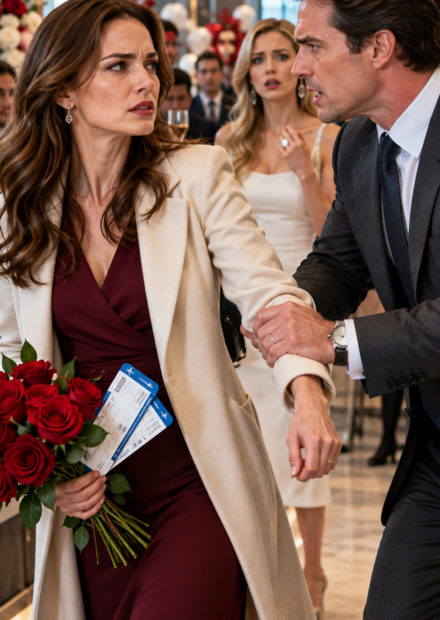
Chapter 1 – TAKE WHAT BELONGS TO YOU
The black trash bag hit me in the chest before I understood that my daughter-in-law was actually throwing me out of my own house.
“Take whatever belongs to you,” Brooke said.
Behind her, my son stared at the marble floor.
Three women sat in my living room drinking mimosas at eleven in the morning.
One of them was recording me.
I remember that detail more clearly than almost anything else.
Her name was Chelsea. She was one of Brooke’s friends from the social-media world she had built around baking videos, home decorating, motherhood advice, and photographs of rooms she had never paid for.
Chelsea held her phone vertically, pretending at first that she was checking messages.
But the camera was pointed directly at me.
I looked from the phone to Brooke.
My daughter-in-law was thirty-three years old, eight months pregnant, beautifully dressed, and standing beneath the chandelier Harold and I had chosen twenty-seven years earlier.
She had one hand resting on her belly.
The other was still extended from where she had shoved the trash bag at me.
“The baby needs space,” she said.
I didn’t answer.
“Daniel needs peace.”
Still I said nothing.
“And I need to be able to run this household without feeling like somebody is constantly watching me.”
This household.
Those were the words that finally settled everything inside me.
Not because they hurt the most.
Because they told me exactly how far things had gone.
I glanced at Daniel.
My only son.
He was thirty-eight years old, six feet tall, broad-shouldered like his father, with Harold’s brown eyes and Harold’s unfortunate habit of rubbing the side of his thumb when he was nervous.
He was doing it now.
Rub.
Rub.
Rub.
His gaze never left the floor.
“Daniel?” I asked.
His eyes lifted for half a second.
“Mom…”
That was all.
One word.
Then he looked toward Brooke.
That hurt more than the trash bag.
I had spent months telling myself Daniel was trying to keep the peace.
That he was under pressure.
That the pregnancy was difficult.
That Brooke was frightened.
That marriage required compromise.
That a mother should not force her son to choose between his wife and herself.
I had invented excuse after excuse because the alternative was admitting that my son had become a guest inside his own courage.
Brooke sighed.
“Please don’t make this dramatic.”
One of her friends lowered her mimosa.
I looked around the room.
The morning sun fell through the tall windows Harold had installed himself with his brother Frank. The light struck the walnut floorboards, the piano nobody played anymore, and the silver-framed photograph on the mantel.
Harold and me.
Our wedding day.
I was twenty-three.
He was twenty-five.
He was laughing because the photographer had told him to look serious and Harold had never been able to do anything merely because someone told him to.
Forty-six years later, three weeks before cancer finally took him, he had held my hand in our bedroom and said, “Don’t let grief make you surrender your judgment, Eleanor.”
I had been angry at him.
“You’re not even gone yet.”
“I know.”
“Then stop talking as though you are.”
He had smiled.
“Somebody has to think about Tuesday.”
That was Harold.
Everyone else worried about catastrophe.
Harold worried about Tuesday.
The electric bill.
The furnace.
Whether the gutters were clean.
Where the deed was kept.
Whose name appeared on what.
He believed disaster usually arrived wearing ordinary shoes.
I had forgotten that until Brooke shoved a trash bag into my hands.
I looked at her.
“One final time,” I said. “Are you certain this is what you want?”
Her expression changed into something almost amused.
“Eleanor, we’ve discussed this.”
No.
She had discussed it.
Daniel had avoided discussing it.
I had been informed.
“That wasn’t my question.”
Brooke’s mouth tightened.
“Yes. I’m certain.”
“Daniel?”
He swallowed.
“Maybe it would be good if everybody had some space.”
Everybody.
Such a useful word.
Nobody had to be guilty when everybody needed space.
I nodded.
“All right.”
Brooke blinked.
I think she had expected tears.
Perhaps shouting.
Perhaps begging.
Maybe that was why Chelsea had been invited.
I never learned whether the recording had been planned or whether Chelsea simply sensed content when she saw humiliation approaching.
Either way, my calm disappointed them.
Brooke handed me another trash bag.
“You can start with the personal things.”
I walked into the living room.
Nobody moved.
I went to the mantel and picked up the silver wedding photograph.
The frame was heavier than it looked.
Harold had given it to me on our tenth anniversary.
I placed it carefully inside the bag.
Brooke gave a small smile.
“That’s a start.”
I looked at her.
Then I kept going.
The crystal candlesticks from our twenty-fifth anniversary.
My grandmother Rose’s gold watch.
Harold’s cuff links.
The porcelain music box my sister June had brought home from Germany.
My mother’s Bible.
June’s handmade quilt.
A brass letter opener Harold had kept on his desk for thirty years.
The little wooden elephant Daniel had carved in seventh-grade shop class and given me for Christmas.
Every time I removed something, the room changed.
Not physically.
Something underneath it changed.
Brooke’s confidence began to thin.
“You don’t need to strip the place,” she said.
“I’m taking what belongs to me.”
“I didn’t mean every antique.”
“You told me to take whatever belonged to me.”
Chelsea lowered her phone slightly.
Another friend, Madison, stared into her mimosa as if suddenly fascinated by orange juice.
Brooke folded her arms.
“Fine.”
I went upstairs.
My bedroom had already stopped feeling entirely mine.
That transformation had happened slowly.
First Brooke moved the family photographs from the hallway because she said the frames made the house feel “visually cluttered.”
Then my blue armchair disappeared from the living room.
She said it clashed with the new color palette.
Then my china was moved from the dining room cabinet into boxes in the basement because Brooke preferred neutral stoneware.
When I asked where the china had gone, she told me not to worry.
“I packed it safely.”
As if I were the guest.
As if she were preserving the possessions of an elderly relative whose mind had begun slipping.
The first time that thought occurred to me, I rejected it.
The second time, I started paying attention.
Now I entered my bedroom and found two empty suitcases already sitting beside the bed.
That stopped me.
I had not put them there.
Brooke had.
She had prepared for this.
I turned around.
She stood in the doorway.
“Those should be enough.”
“For sixty-eight years?”
“You’re not taking your entire life.”
“No,” I said. “Apparently I’m only taking whatever belongs to me.”
Her jaw moved.
Downstairs, somebody whispered.
I opened my closet.
Most of my clothes had been pushed to one side over the previous month because Brooke said she needed storage for nursery overflow.
The nursery was three rooms away.
I had not questioned it.
That was another thing grief had done to me.
It had made resistance feel exhausting.
After Harold died, every disagreement seemed too expensive.
So I paid for peace by surrendering inches.
A drawer.
A shelf.
A chair.
A cupboard.
A decision.
By the time I realized how much I had paid, Brooke believed she owned the store.
I packed clothing.
Shoes.
Toiletries.
Photographs.
Letters.
I took Harold’s old cardigan from the hook behind the closet door and held it against my face.
His scent was gone.
That hurt unexpectedly.
For one second I was not angry anymore.
I was simply a widow standing in a room where my husband would never sleep again.
“Eleanor?”
Brooke’s voice.
Impatient.
I folded the cardigan.
“Coming.”
Daniel was waiting in the hallway.
Brooke had gone downstairs.
“Mom.”
He spoke quietly.
I stopped.
He glanced toward the staircase before coming closer.
“Please don’t make this harder.”
I stared at him.
There are moments when a mother sees every age her child has ever been.
I saw Daniel at four, sleeping with his cheek against my shoulder during a thunderstorm.
At eight, crying because his hamster died.
At sixteen, coming home smelling like grocery-store cardboard and cold air because he had taken extra shifts before Christmas.
At twenty-one, hugging me outside his college dorm.
At thirty-four, standing beside Brooke at their wedding, happier than I had ever seen him.
And now.
Thirty-eight.
Whispering in his mother’s hallway because he was afraid his wife might hear him.
“I’m not making anything harder,” I said.
His face tightened.
“She’s stressed.”
“So am I.”
“The pregnancy—”
“I know she’s pregnant, Daniel.”
“She feels like she doesn’t have control over anything.”
I almost laughed.
Instead I said, “So you gave her control over me?”
“That’s not fair.”
“No?”
He looked away.
I lowered my voice.
“Do you agree with her?”
He didn’t answer.
“Do you believe I should leave?”
“Mom, it isn’t about that.”
“What is it about?”
He rubbed his thumb.
“She wants our own home.”
I waited.
The silence stretched.
Finally I said, “Then perhaps you should get one.”
His eyes snapped toward mine.
For the first time that morning, fear appeared in his face.
Not anger.
Fear.
He knew.
Brooke didn’t.
But Daniel knew.
Before he could say anything, Brooke called from downstairs.
“Daniel?”
He stepped away from me instantly.
That movement broke something.
Not permanently.
But enough.
I carried the suitcase downstairs.
In the kitchen, sunlight reflected from the white marble counters Brooke had chosen during the renovation after Harold died.
She called them hers.
“My counters.”
“My cabinets.”
“My kitchen.”
Harold had left money for maintenance and improvements. I had allowed Daniel and Brooke to oversee the renovation because I thought it would help them feel at home.
I had wanted them to feel at home.
That was the irony.
I had succeeded too well.
Then I saw the cherry-red KitchenAid mixer.
I stopped.
Daniel had bought it for me when he was sixteen.
He had worked three months at Bellman’s Grocery, stacking shelves after school.
That Christmas, he had dragged an enormous box from behind the tree.
“I know yours makes that weird grinding noise,” he had said.
Harold had looked at the price tag afterward and whispered to me, “That boy spent nearly every dollar he earned.”
I had baked Daniel’s graduation cake with that mixer.
His twenty-first birthday cake.
His engagement cake.
Even part of the dessert table for his wedding.
Now Brooke used it in her baking videos.
She called it “the iconic red centerpiece of my signature kitchen.”
I walked toward it.
Brooke watched me.
I reached behind the mixer and unplugged it.
Her face changed immediately.
“Excuse me?”
I wrapped the cord around the base.
“That’s an appliance.”
“Yes.”
“It matches my kitchen.”
I lifted it.
“Not anymore.”
Chelsea made a choking sound that might have been a laugh.
Brooke spun toward her.
Chelsea immediately stared at her phone.
I carried the mixer into the foyer.
When I returned, Brooke was standing with both hands on the island.
“This is ridiculous.”
I opened the drawer beside the stove.
There it was.
The wooden recipe box.
My mother’s.
Dark oak, scratched at the corners, with RECIPE CARDS painted across the lid in faded yellow letters.
I put my hand on it.
Brooke moved so quickly that the stool beside her scraped the floor.
“No.”
I looked at her.
“That stays here.”
“Why?”
“Because those are family recipes.”
I opened the drawer fully.
“They are.”
“So they stay with the family.”
“My mother wrote half of them.”
“And Daniel is your son.”
“My sister wrote some.”
“I use them.”
“Harold’s mother wrote some.”
“Eleanor.”
I lifted the box.
Brooke stepped between me and the doorway.
“I’m Daniel’s family now.”
Something went very still inside me.
I held the recipe box against my chest.
“You married into a family,” I said. “You did not erase the women who kept it alive.”
Daniel closed his eyes.
Brooke’s cheeks flushed.
“If you walk out with that box, don’t expect to come back.”
That was when I almost smiled.
Not because anything was funny.
Because she still didn’t understand.
“Brooke,” I said softly, “you still believe this is about the door.”
For the first time all morning, uncertainty crossed her face.
I walked past her.
In the hall closet, behind Harold’s old winter coats, were three brown leather suitcases.
I pulled them out.
Brooke followed.
“Why do you need three?”
I didn’t answer.
Her friends had stopped talking completely.
Chelsea no longer pretended not to record.
I knelt beside the largest suitcase.
Daniel appeared at the end of the hallway.
The moment he saw which suitcase I had chosen, his face went pale.
That was the one Harold had taken on business trips for nearly twenty years.
After he retired, he had used it only twice.
But there was something else about it.
Something Brooke did not know.
I opened the suitcase.
My fingers found the hidden interior pocket beneath the lining.
And suddenly I was back in the hospital eighteen months earlier.
Harold was thin then.
So thin that his wedding ring had begun sliding around his finger.
He had asked Daniel to go downstairs for coffee.
Then he had looked at me.
“Ellie.”
“What?”
“Brown suitcase.”
I frowned.
“What about it?”
“Inside pocket.”
“You should sleep.”
“Listen.”
I hated that word because Harold only used it that way when he had already made a decision.
He reached for my wrist.
“The deed is in there.”
“Why?”
“Because nobody looks in an old suitcase.”
“We have copies.”
“I know.”
“The lawyer has records.”
“I know.”
“So why—”
“Because paper in your hand is sometimes worth ten explanations.”
I had started crying.
“Harold.”
“Don’t put it in a bank box.”
“Why are we talking about this?”
“Keep it somewhere you can reach when people forget what is yours.”
At the time, I thought he meant after his death.
I thought he was protecting me from paperwork.
I had not understood.
Not completely.
Now, kneeling on the floor while my daughter-in-law recorded my eviction through her friend’s phone, I reached into that hidden pocket.
My fingers touched folded paper.
Daniel whispered, “Mom.”
Brooke turned toward him.
“What?”
He said nothing.
I removed the document.
Unfolded it.
Brooke crossed her arms.
“What is that?”
I held it out.
“Something Harold wanted me to keep close.”
She took one step nearer.
Her eyes moved down the page.
I watched her search.
She knew enough to recognize a property deed.
And she knew exactly which name she expected to see.
Daniel Carter.
My son.
It wasn’t there.
She looked again.
Then she looked at me.
“This doesn’t prove anything.”
Before I could answer, the doorbell rang.
Everyone froze.
Through the narrow glass beside the front door stood a gray-haired man holding a leather briefcase.
Brooke frowned.
I knew him immediately.
Arthur Bell.
Harold’s attorney.
My attorney now.
Brooke looked from Arthur to me.
Then to the deed.
“Why is a lawyer here?”
I folded the document carefully.
“Because you told me to take what belongs to me.”
Her voice rose.
“I meant your belongings!”
Daniel finally looked at his wife.
His face had lost all color.
“Brooke,” he whispered.
She turned on him.
“What?”
He swallowed.
“You should have checked the deed.”
And for the first time that morning, Brooke stopped looking like the woman in charge of my house.
She looked like a woman who had just discovered she might never have owned the floor beneath her feet.
—