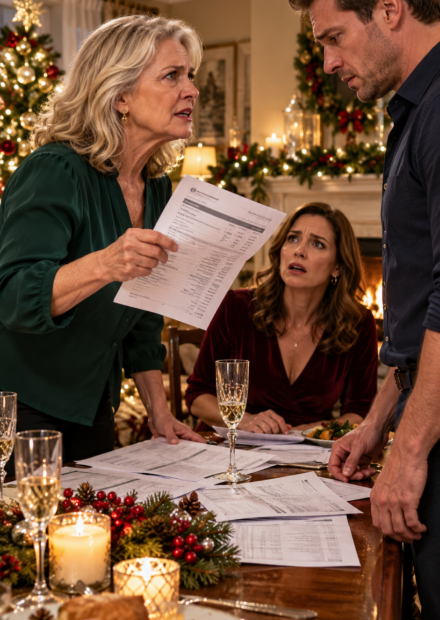
Chapter 4 – THE LETTER HAROLD LEFT BEHIND
Arthur’s office occupied the second floor of an old brick building downtown.
By the time I arrived, rain had started.
Daniel was sitting in the conference room alone.
He looked ten years older than he had that morning.
I sat across from him.
“Where’s Brooke?”
“Home.”
“Is she all right?”
“She’s upset.”
“I know.”
“She turned off her phone.”
“Probably wise.”
He looked at me.
“You still care.”
“Of course I care.”
“After what she did?”
I folded my hands.
“Caring about someone does not require surrendering to them.”
He looked away.
Arthur entered carrying a slim folder.
Not the thick estate folder from earlier.
This one was cream-colored.
Harold’s handwriting appeared across the front.
DANIEL — ONLY IF NECESSARY.
My throat tightened.
Daniel stared.
“That’s Dad’s writing.”
“Yes,” Arthur said.
He sat beside us.
“Your father prepared this approximately seven months before his death.”
Daniel looked at me.
“Did you know?”
“Not about this.”
Arthur removed three pages.
“He asked me to keep it. He said if ownership of the house ever became a source of conflict between you and Eleanor, I should give you this.”
Daniel rubbed his face.
“Dad expected this?”
“No,” Arthur said. “Your father prepared for possibilities. There’s a difference.”
That was Harold.
Arthur slid the letter toward Daniel.
“You can read it.”
Daniel unfolded it.
His hands trembled.
He read silently at first.
Then stopped.
“Read it aloud,” I said.
He looked at me.
“Mom…”
“I want to hear him.”
Daniel swallowed.
Then began.
“Daniel,
“If Arthur is giving you this letter, something has gone wrong regarding the house.”
My eyes filled immediately.
It sounded exactly like Harold.
No dramatic opening.
No sentiment.
Something has gone wrong.
Fix the problem.
Daniel continued.
“I want you to understand one thing before anything else. I love you. Nothing written below changes that.”
Daniel’s voice broke.
He stopped.
Arthur waited.
So did I.
Eventually he continued.
“The house belongs to your mother because I intended it to belong to your mother. This was not an oversight, punishment, or statement that I trusted you less as my son.”
Daniel wiped his face.
“I made this decision because property can turn love into leverage if people are not careful.”
I closed my eyes.
Harold.
Always practical.
Always seeing three moves farther than the rest of us.
Daniel read on.
“You may someday marry. You may have children. You may succeed beyond anything I can imagine. You may also lose money, make mistakes, face pressure, divorce, debt, illness, or circumstances neither of us can predict.
“If your name is on the house, those circumstances can reach your mother’s home.
“If only her name is on it, they cannot reach it through you.”
Daniel stopped.
The room became very quiet.
That was it.
The reason.
Not Brooke.
Not distrust.
Protection from uncertainty.
Harold had not excluded his son because he thought Daniel would betray me.
He had separated ownership because he knew life could pressure decent people into terrible decisions.
Arthur nodded toward the letter.
“There’s more.”
Daniel continued.
“I hope your mother eventually leaves you whatever she chooses to leave you. But that choice must remain hers.
“Do not count her possessions while she is alive.
“Do not make plans with money that is still providing someone else security.
“And never confuse being my son with being entitled to everything I built.”
Daniel could not continue.
He put the letter down and covered his face.
I was crying too.
Arthur quietly left the room.
For several minutes, neither of us spoke.
Then Daniel said, “He knew me.”
“Yes.”
“He knew exactly what I’d do.”
“No.”
Daniel looked at me.
“He knew what any of us could do.”
“That’s worse.”
“Why?”
“Because I thought I was better than this.”
I reached across the table.
He stared at my hand.
“I let her treat you like you were in the way.”
“Yes.”
“I let her call it our house.”
“Yes.”
“I knew.”
“Yes.”
His eyes filled again.
“I kept telling myself it would be mine someday.”
There it was.
The truth without decoration.
“I didn’t plan to take it from you,” he said.
“I know.”
“But I started thinking about it like it was already mine.”
“I know.”
“When Brooke talked about the studio, the loan, the baby, I didn’t correct her.”
“Why?”
He thought for a long time.
“Because I liked being the man who could give her this.”
That answer hurt.
But I understood it.
Daniel had always wanted to be like Harold.
Provider.
Builder.
Protector.
But Harold had spent decades earning what he provided.
Daniel had begun borrowing an identity from property that wasn’t his.
“She thought I owned it,” he said.
“Yes.”
“And every time I didn’t correct her, the lie got bigger.”
“Yes.”
He looked at me.
“Do you hate her?”
“No.”
That surprised him.
“I’m angry with her. Deeply. But hatred would keep her living in my head after she leaves my house.”
He almost smiled.
“That sounds like Dad.”
“No. Your father could hold a grudge until the moon fell into the ocean.”
Daniel laughed.
A real laugh.
The first all day.
Then he cried harder.
I moved around the table.
He stood.
And my thirty-eight-year-old son folded into my arms.
I held him.
Not because the problem was solved.
Because he was my son.
Those were different things.
At 11:36, his phone rang.
Brooke.
He looked at me.
“Answer.”
He did.
Her voice was loud enough for me to hear.
“Daniel, somebody’s outside.”
He straightened.
“What?”
“Cars. Two cars. They keep driving past.”
Fear entered her voice.
The internet.
People had apparently identified the neighborhood.
I felt sick.
“Tell her to lock the doors,” I said.
Daniel relayed it.
Brooke heard me.
“Is your mother there?”
“Yes.”
“Put me on speaker.”
He did.
“Brooke?”
Her voice trembled.
“Eleanor, I’m sorry.”
Not defiant.
Not angry.
Afraid.
“There are people messaging me. Somebody posted the street name.”
“Call the police if you feel threatened.”
“I did. They said they’ll patrol.”
“Good.”
“I don’t want to be here alone.”
I looked at Daniel.
“Go home.”
He hesitated.
“Mom—”
“Your wife is pregnant and frightened. Go.”
He grabbed his coat.
At the door, he stopped.
“What about you?”
“I’ll be fine.”
“Are you coming home?”
Home.
The word felt strange.
“Not tonight.”
He nodded.
Then he left.
Arthur returned a minute later.
“He okay?”
“No.”
“Good.”
I stared at him.
Arthur smiled faintly.
“People who believe they’ve done nothing wrong rarely change.”
I looked at Harold’s letter.
“There’s another page.”
Arthur nodded.
I had noticed it.
Daniel had been too upset.
I unfolded it.
This part was addressed to me.
“Ellie,
“If you are reading this, I’m sorry you’re dealing with something I hoped would never happen.”
I smiled through tears.
Of course.
He had planned both sides of the conversation.
“Do not punish Daniel for disappointing you. But do not rescue him from the consequences either.
“We raised him to stand on his own feet.
“If he forgets, remind him where the floor is.”
I laughed.
Arthur looked away politely.
The final lines were shorter.
“The house is yours.
“Not because I gave it to you.
“Because we built the life that paid for it together.
“You earned every room.
“Stay if you want.
“Sell if you want.
“Paint it purple if you want.
“But make the choice yourself.
“Love,
“H.”
I pressed the paper against my chest.
For eighteen months I had believed grief required me to preserve everything.
Harold’s chair.
Harold’s tools.
Harold’s house.
Harold’s routines.
But his letter told me something different.
The house was not a shrine.
It was mine.
And ownership was not merely the right to stay.
It was the right to choose.
At 11:58, Daniel texted.
HOME. BROOKE SAFE. POLICE CAME BY. WE NEED TO TALK TOMORROW.
I looked at the time.
Two minutes before midnight.
Then another message arrived.
From Brooke.
I hesitated before opening it.
There were only six words.
I DIDN’T KNOW WHAT I WAS DOING.
I stared at them.
Then I typed:
YES, YOU DID.
I did not send it.
I erased the words.
Because anger wanted a perfect sentence.
Wisdom wanted morning.
At midnight exactly, I folded Harold’s letter and put it inside my purse.
By then Brooke knew the house was mine.
Daniel knew why his father had never put him on the deed.
And I finally knew something more important.
I did not need Harold’s paperwork to prove that I belonged in my own life.
I needed it only because I had waited too long to say so myself.
—